


Page 78 - April-May-2017
P. 78
78
                                           E-gloves to protect


                                           workers from dangerous


                                           vibration levels


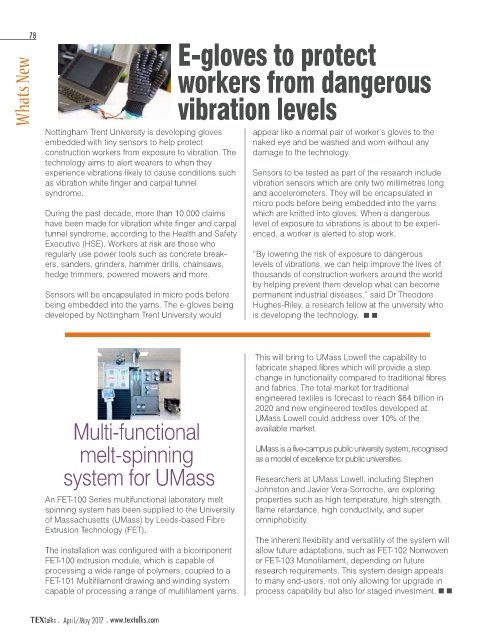
            Nottingham Trent University is developing gloves   appear like a normal pair of worker’s gloves to the
            embedded with tiny sensors to help protect       naked eye and be washed and worn without any
            construction workers from exposure to vibration. The   damage to the technology.
            technology aims to alert wearers to when they
            experience vibrations likely to cause conditions such   Sensors to be tested as part of the research include
            as vibration white finger and carpal tunnel      vibration sensors which are only two millimetres long
            syndrome.                                        and accelerometers. They will be encapsulated in
                                                             micro pods before being embedded into the yarns
            During the past decade, more than 10,000 claims   which are knitted into gloves. When a dangerous
            have been made for vibration white finger and carpal   level of exposure to vibrations is about to be experi-
            tunnel syndrome, according to the Health and Safety   enced, a worker is alerted to stop work.
            Executive (HSE). Workers at risk are those who
            regularly use power tools such as concrete break-  “By lowering the risk of exposure to dangerous
            ers, sanders, grinders, hammer drills, chainsaws,   levels of vibrations, we can help improve the lives of
            hedge trimmers, powered mowers and more.         thousands of construction workers around the world
                                                             by helping prevent them develop what can become
            Sensors will be encapsulated in micro pods before   permanent industrial diseases,” said Dr Theodore
            being embedded into the yarns. The e-gloves being   Hughes-Riley, a research fellow at the university who
            developed by Nottingham Trent University would   is developing the technology.


                                                             This will bring to UMass Lowell the capability to
                                                             fabricate shaped fibres which will provide a step
                                                             change in functionality compared to traditional fibres
                                                             and fabrics. The total market for traditional
                                                             engineered textiles is forecast to reach $84 billion in
                                                             2020 and new engineered textiles developed at
                                                             UMass Lowell could address over 10% of the
                  Multi-functional                           available market.

                    melt-spinning                            UMass is a five-campus public university system, recognised
                                                             as a model of excellence for public universities.
                system for UMass                             Researchers at UMass Lowell, including Stephen


                                                             Johnston and Javier Vera-Sorroche, are exploring
            An FET-100 Series multifunctional laboratory melt   properties such as high temperature, high strength,
            spinning system has been supplied to the University   flame retardance, high conductivity, and super
            of Massachusetts (UMass) by Leeds-based Fibre    omniphobicity.
            Extrusion Technology (FET).
                                                             The inherent flexibility and versatility of the system will
            The installation was configured with a bicomponent   allow future adaptations, such as FET-102 Nonwoven
            FET-100 extrusion module, which is capable of    or FET-103 Monofilament, depending on future
            processing a wide range of polymers, coupled to a   research requirements. This system design appeals
            FET-101 Multifilament drawing and winding system   to many end-users, not only allowing for upgrade in
            capable of processing a range of multifilament yarns.  process capability but also for staged investment.

