


Page 81 - April-May-2017
P. 81
80                                                                                                            81
 INDEX17 award with   New Standard 100 by


 its blind hiring   Oeko-Tex test criteria

 recruitment process              come into force


 EDANA, the international nonwovens association,   applications and resumes without any personal data
 has presented Suominen with INDEX17 Award in   on them. The masked data includes, for example, the   Following the end of the usual three-month   the list of regulated softeners in all of the product
 Sustainable Process or Management Practice   applicant’s full name, gender, ethnicity and age. This   transition period, the test criteria and limit values of   classes. The three organic tin compounds
 category for Suominen’s pioneering Blind Hiring   minimises the possibility of unconscious biases   the Standard 100 by Oeko-Tex published at the start   dipropyltin (DPT), monophenyltin (MPhT) and
 recruitment process that ensures equal opportunities.   affecting the recruitment process, according to   of the year have now finally come into force on 1   tetraethyltin (TeET) are now regulated with limit
 INDEX17 Awards are the highest accolade for the   the company.  April 2017.  values in all product classes.
 best examples of excellence in the nonwovens
 industry.   Suominen successfully piloted Blind Hiring in 2015   The new regulations include changes such as   The UV stabilisers UV 320, UV 327, UV 328 and UV
 and after that it was defined as the default recruit-  regarding the parameter “per- and polyfluorinated   350 have now also been provided with limit values
 Suominen successfully piloted Blind Hiring in 2015   ment approach at the company.  compounds”. Here, many substances have been   in product classes I to III. In addition, the use of the
 and after that it was defined as the default recruit-  added or listed explicitly by name in product class I   blue colourant Navy Blue is also now explicitly
 ment approach at the company.  Suominen manufactures nonwovens as roll goods for   (items for babies and toddler), for example, and   prohibited for product certification per Standard 100
 wipes, as well as for medical and hygiene products.   provided with limit values. Thus, since 1 April the   by Oeko-Tex.
 Suominen follows the Blind Hiring principle in all new   The end products made of Suominen’s nonwovens   use of per- and polyfluorinated compounds in
 recruitments, including top management, to promote   include wet wipes, feminine care products and   product class I is severely restricted and nearly   With many of these new requirements the Oeko-Tex
 diversity and to ensure equal opportunities when   swabs, for instance. Suominen is the global market   eliminated.  Association aims to significantly support both the
 applying for a job at the company. As a result, the   leader in nonwovens for wipes and employs 650   Zero Discharge of Hazardous Chemicals (ZDHC)
 hiring manager will receive and assess candidates’   people in Europe and in the Americas.  A large number of substances were also included in   initiative and the Detox campaign.


 New circular 100 fabric with                                           ‘growing’


 Lycra dualFX technology                                                plant-based


 Calik Denim has developed new Circular 100   that can be achieved by using different laundry
 fabrics powered by Lycra dualFX technology by   treatments. Unlike conventional high elasticity   footwear
 Invista in order to create a better alternative to   denim fabrics, Calik’s new bi-stretch fabric comes
 traditional jeans leggings fabric.  in wider width (around 120 cm), features low
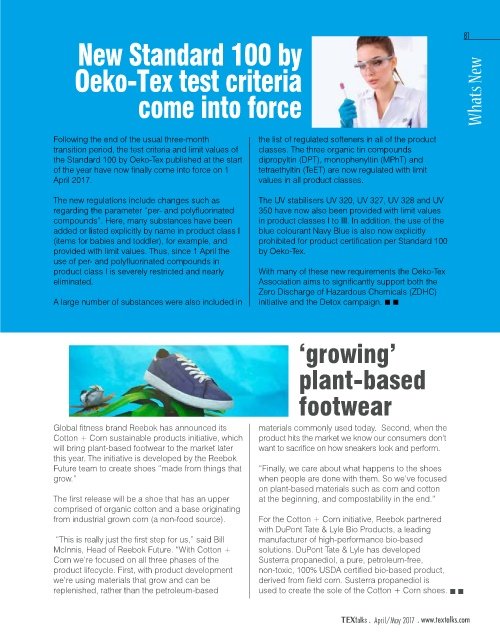
 shrinkage (around 2%), presents less creasing   Global fitness brand Reebok has announced its   materials commonly used today.  Second, when the
 The specific fabric construction of Circular 100, suitable   thanks to its vertical elasticity, and shows no   Cotton + Corn sustainable products initiative, which   product hits the market we know our consumers don’t
 for athleisure besides jeans, has been developed to   elastane slippage for a premium look.  will bring plant-based footwear to the market later   want to sacrifice on how sneakers look and perform.
 create a unique silky and soft touch inside, whilst offering   this year. The initiative is developed by the Reebok
 elasticity and flexibility for increased comfort.  Lycra dualFX technology brand was developed in   Future team to create shoes “made from things that   “Finally, we care about what happens to the shoes
 response to market demand for high-stretch denim   grow.”    when people are done with them. So we’ve focused
 Jeans created with Circular 100 are lightweight,   fabrics that keep their shape. It is based on several   on plant-based materials such as corn and cotton
 have a soft hand feel, and offer a “barely there”   patented technologies from Invista related to dual   The first release will be a shoe that has an upper   at the beginning, and compostability in the end.”
 feeling when worn, according to the manufacturer.   core yarns and bi-component yarns.  comprised of organic cotton and a base originating
 The super stretchiness Circular 100 offers is due to   from industrial grown corn (a non-food source).  For the Cotton + Corn initiative, Reebok partnered
 its high elasticity in both weft and warp directions,   Typically, as fabric stretch increases so does the   with DuPont Tate & Lyle Bio Products, a leading
 which enables the wearer to move freely without   tendency for fabric growth or shrinkage. By    “This is really just the first step for us,” said Bill   manufacturer of high-performance bio-based
 limits. The fabric’s vertical elasticity also provides   combining Lycra fibre and Lycra T400 fibre   McInnis, Head of Reebok Future. “With Cotton +   solutions. DuPont Tate & Lyle has developed
 an amazing high waist fit.  together in one fabric, the company says it   Corn we’re focused on all three phases of the   Susterra propanediol, a pure, petroleum-free,
 achieved the best of both worlds — the high   product lifecycle. First, with product development   non-toxic, 100% USDA certified bio-based product,
 Versatile Circular 100 fabric aims to enable   stretch of Lycra fibre and the recovery power of   we’re using materials that grow and can be   derived from field corn. Susterra propanediol is
 designers to create jeans with a variety of looks   Lycra T400 fibre, for increased design flexibility.  replenished, rather than the petroleum-based   used to create the sole of the Cotton + Corn shoes.

