


Page 69 - April-May-2018
P. 69
68                                                                                                             69
 mattress because it   Rs.2500 – Rs.6000 per square meter depending
 fiber growth by an increasing demand and an   Chinese market for textile exports is not ideal since   and since its focus is on automation, it requires less   9% maintenance savings and gives a total cost   is more functional   upon the origin whether it is Chinese or Japanese. If
 average growth rate of 4.6%. However, since the   it’s just a $30 billion market. China seeks to develop   labor, resulting in less labor cost.  advantage of 18.5% which can be higher with   compared to   we manufacture it in Pakistan, then the price is going
 global economy is growing and as more consumers   its textile market by producing 500 million garments   optimization of spinning process.  conventional looms.   to come down 40-50% of the imported fabric price.
 achieve middle class status, they will buy more   per year by 2020. Availability of locally manufactured   Mr Rodger John   High performance
 cotton clothing. China is closing factories that   machinery and chemicals, energy supply price, rail   Gilmartin, Managing   Mr Peter Spirgi,   fibers like carbon,   Mr Sheikh Moazzam Ahmed, emphasized on a
 making polyester and viscose which do not meet   network to Europe, production capacity are some of   Director Triblend   Sales Manager Rieter   glass, Kevlar are   strategy of developing agro economic zones across
 environmental standards and will be resulting in   the challenges that CPEC will bring for Pakistan   Consultants,   Machine Works,   woven to form   the province of Punjab so they can focus on value
 compared the
 In two days conference, the overview of some of the   establishing   increase of cotton demand.  industry.  technical and   informed that Rieter   technical fabrics which are used in composites. He   generation for each zone based on the geographical
 is the only
 Key Speakers informative presentations are as    technological   Mr Aamir Fayyaz   Mr Jos Notermans,   financial   manufacturer of all   added, imported fabrics 3k carbon prices are   crop enhancement values.
 sectors in Pakistan   Sheikh, Chairman   performance of US   four compact, ring,
 Mr Mohammad   facilitating them with   of APTMA and CEO   SPGPrints B.V.,   Cotton versus Cotton Fibers from India and the CIS   rotor and air-jet yarn
 Pervaiz Malik,   top notch Italian   of Kohinoor textile   gave a   in the manufacturing of knitted garments. The data
 Honorable Federal   machinery for   presentation on   spinning machines. Every Rieter machine can be
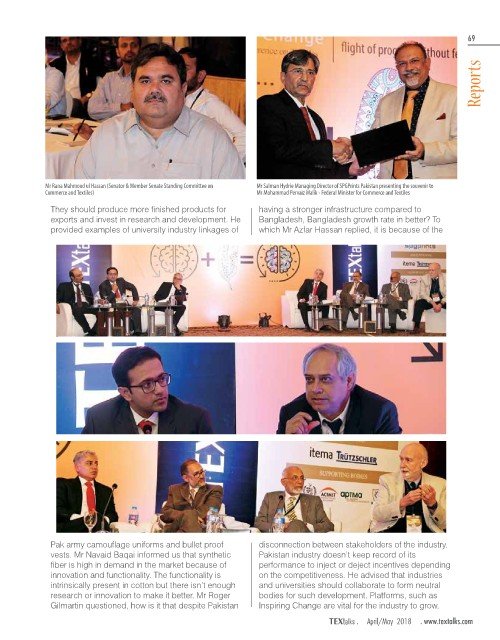
 Minister for   training.  mills limited, talked   digital printing and   showed that US yarn performed better during   controlled and optimized based on the mill   Mr Rana Mahmood ul Hassan (Senator & Member Senate Standing Committee on   Mr Salman Hydrie Managing Director of SPGPrints Pakistan presenting the souvenir to
 Commerce and   about APTMAs   it being an enabler   spinning at half the frequency of machine stops per   requirements supported by industry 4.0.  Commerce and Textiles)   Mr Mohammad Pervaiz Malik - Federal Minister for Commerce and Textiles
 Textiles, while   Mr Alessandro   initiatives for   for fast fashion.   hour compared to Indian yarn and outperformed   They should produce more finished products for   having a stronger infrastructure compared to
 addressing the   Zucchi, President of   sustainability. He   Digital printing provides a range of over 15 million   Indian Cotton in waste loss at all stages of yarn   Dr Muhammad   exports and invest in research and development. He   Bangladesh, Bangladesh growth rate in better? To
 Tausif, academic
 conference said   ACIMIT,   added that export led growth is the only way forward   colors. Digital printing is expensive compared to   manufacturing process. Also, at the stage of   and applied   provided examples of university industry linkages of   which Mr Azfar Hassan replied, it is because of the
 that Pakistan economy has recorded a remarkable   accentuated that   to be able to finance balance of payment of deficit   conventional printing, however, its cost saving in   manufacturing, US Cotton was 10 cents per pound   researcher at
 revival in the past 5 years and today Pakistan is on   Italian companies   but exports have decreased by 10% because of lack   operations and sustainable. He briefed about two   cheaper than CIS fiber. After garment manufacturing,   University of Leeds,
 the cusp of high growth trajectory. He further briefed   are leader in   of technological investment and the industry has lost   main products of SPGPrints, Pike and Javelin. Their   US cotton has a 21cents per pound advantage over   talked about what’s
 about the facilitations provided to the Pakistan textile   providing textile   its technological competitiveness. He told that   digital printing machines use archer technology and   the use of Indian cotton and 31 cents per pound   new in textile. He
 sector which included reduced markup rate on LTFF,   technology solutions   APTMA has proposed the government to create an   provide a relief from ink mist. Referring to speed he   advantage over the CIS fiber. He emphasized the   raised the topic of
 duty free import of textile machinery, enactment of   and can match the machinery requirement of   enabling environment where over the next 5-7 years   added, The Pike can print 35 meters per minute. He   advantages of US Cotton as lower fiber loss,   circular economy
 plant breeder’s right bill, duty drawbacks and   Pakistan industry. He further stated that their   we should establish up to 1000 garment and   further illustrated by an example, “suppose if we   where our goal should be to ensure sustainable
 refunds and much more. He said that the   technology is based on sustainability standards and   made-up stitching facility. 10,000 garments a day will   print 20 hours a day, print 20 meters in a minute   Improved Operating Performance, Higher Quality   consumption and production patterns to extract
 government has been considering various other   that ACIMIT is the pioneer to introduce eco-friendly   produce average 3 million garments and by taking   producing 1200 meters per hour, in 20 hours we get   and Considerable Financial Advantages.  maximum value from resources already in use. He
 facilitations for the federal budget. Such measures   technology. The main focus of their machinery is to   $6.5 as an average price will result in approximately   24000 meters per day and by the end of 360 days,   suggested that the industry should focus more on
 will provide long term sustainability in the textile   reduce the cost of production which ACIMIT has   $19.5 million worth of exports. Where, 1000 such   we get approximately 9 million meters per year”. He   Mr Hammad Naqi   close loop and upcycling methodology. He defined
 sector. He assured that the textile sector is their top   proudly achieved. Their machinery reduces the   factories can create $20 billion worth of exports.  further informed that SPGPrints is also a key ink   Khan, CEO WWF   upcycling as a recycle process in which we obtain a
 most priority in the forthcoming budget for the next   consumption of energy up to 40%. ACIMIT is   Mr Azfar Hassan,   manufacturer for the digital printing.   Pakistan, on the   higher end product using a different product as its
 financial year.  certified green label technology. The companies that   CEO Matrix   topic of sustainable   resource. He further discussed, that overseas   Mr Yousaf Fareed  Mr Mazhar Mirza
 Publisher of TEXtalks International
 Pakistan representative of Cotton Council International USA
 raw material for
 use green label technologies consume 27% less   Sourcing Pakistan,   Mr Ralf Muller,   production being a long term threat, industries
 Mr Hassan Iqbal,   water. ACIMIT is looking forward to improving their   highlighted that the   Sales Manager   textile – responsible   should adopt Reshoring, which can further help in
 Federal Secretary   position in the Pakistani industry.   only way to grow is   Trützschler, in the   choices for   better optimization of Industry 4.0 and on demand
 for Textile Division,   to embrace   beginning gave a   sustainable   manufacturing.
 expressed his   Mr Bruce Atherley,   change. New   brief introduction of   production, highlighted that since the textile industry   Panel Discussions
 dismay on the 18th   Executive Director   technology   Trützschler. He said   can’t run without water and the industrial issues of   Mr Amjad Baig, CEO
 amendment   of Cotton Council   providing tools for   that in the last 10   water are increasing rapidly, adoption of water   Lead International,
 through which the   International USA,   years Pakistan’s   efficient technologies can reduce the water   highlighted that the
 agriculture sector was transferred from federal to   gave a talk on the   transparency, real time information and data   ranking is 3rd in the number of carts delivered from   consumption by 40%. Farmers should be given   economy is   Panel discussion Day 1– What are the challenges   highlighted that the advantages of low cost labor will
 analytics should be invested in. Our industries
 provincial government. He stressed on extension of   global Cotton   should be adopting industry 4.0. He mentioned, we   their manufacturing company in Germany. He gave a   proper training to use water efficiently. Industries are   changing and   Pakistan faces and how do we overcome these   diminish because of advanced automated
 export growth rate package to 2 years and that the   trends, U.S. Cotton   need to create a vision that is unique to Pakistan and   presentation on process cutting and quality   encouraged to adopt Zero Discharge of Hazardous   change is fast. We   challenges?   machinery and since energy is a main cost,
 government will take measures to rationalize cost of   Update and what’s   addresses the uniqueness of our situation to draw   improvement in rotor spinning. Product range of   Chemicals (ZDHC) and Zero Liquid Discharge   should be ready to   industries will be established in America, China and
 doing business. He stated, “It is no more era of aid,   new in Cotton USA. He illustrated about Global   policies that will guide our industry.  Trutzschler includes blowrooms, carts, draw frames   business (ZLD) consortiums for sustainability.  adopt the new   [Mr Azfar Hassan-moderator (CEO Matrix Sourcing),   India, countries where energy is cheaper. The
 it’s the era of trade”. He said that policies can’t be   Cotton and Man Made Fibers demand, US Cotton   and comber for spinning, turnkey solutions and   technological advancements, digitalize business and   Dr Tanveer Hussain (Rector – NTU Pakistan), Mr   machinery used in Pakistan is obsolete and there
 made single handedly; the stakeholder’s and   production, Global US Cotton exports and US   Dr Tanveer Hussain,   non-woven bonding technologies in their program   Mr Navaid Baqai,   manufacturing operations and ensure that they are   Roger Gilmartin (Managing Director TriBlend   isn’t much investment happening in technology and
 government have to work together like hand in glove.  sustainable agriculture. As per his presentation,   Rector – NTU   for non-woven, roller carts and fled carts for card   Global Director of   properly connected with the ecosystem, customer,   Consultants USA), Mr Anees Khawaja (Director   that Pakistan factories are grossly overstaffed by
 since 2000, total cotton consumption has grown only   Pakistan,   clothing, and manufacturing machinery for technical   CCI, revealed that   suppliers and other stakeholders. He added that   Mahmood Group), Mr Navaid Baqai (Global Director   unprofessional and lazy labor. Furthermore, he   Pak army camouflage uniforms and bullet proof   disconnection between stakeholders of the industry.
 Dr Gian Paolo Bruno, Trade Commissioner Italy,   by 1.3% per year. Whereas, over the same time   presented on the   yarns and carpet yarns for man-made fibers. He   US fiber is easier to   innovation not only needs research but also needs to   – Cotton Council International USA), Mr Imtiaz   suggested that Pakistani market should focus more   vests. Mr Navaid Baqai informed us that synthetic   Pakistan industry doesn’t keep record of its
 talked about a bilateral strategic project to enhance   period, total fiber consumption has grown by 3.3%   significance of   further emphasized on IDF2 (integrated draw frame   process resulting in   be commercialized.  Rastgar (Chairman Rastgar Group), Mr Anis-ul-Haq   on local or underdeveloped markets rather than the   fiber is high in demand in the market because of   performance to inject or deject incentives depending
 value addition of textile in Pakistan. Italy is   per year. Manmade fiber has taken 87% share of   CPEC. He stated   2) better performance, higher flexibility and   2-5% spinning   (Secretary General APTMA)]  over saturated markets of the west. Dr Tanveer noted   innovation and functionality. The functionality is   on the competitiveness. He advised that industries
 efficiency gain,
 that Pakistan import   efficiency, low investment cost, low space   8-20% energy   Mr Ayub Asghar, Assistant Professor – National   that Pakistani industry needs to focus on   intrinsically present in cotton but there isn’t enough   and universities should collaborate to form neutral
 from China is more than exports. Considering   requirement and low cans transport expenditure.   savings in carding,   Textile University, enlightened us that it’s the new   In the panel discussion Mr Roger Gilmartin   diversification of fiber, product mix and technology.   research or innovation to make it better. Mr Roger   bodies for such development. Platforms, such as
 IDF2 is being used widely for open loop spinning   era of spacer fabrics which is a replacement of foam   Gilmartin questioned, how is it that despite Pakistan   Inspiring Change are vital for the industry to grow.

 April/May  2018                                                                        April/May  2018

