


Page 72 - April-May-2018
P. 72
72 73
Textile Learning Factory 4.0 Based on a standard set of learning modules, Product smart 1 2 3 Warping creel
workshops and trainings can be tailored to the
Warping machine
customizable
Weaving machine
wristband
participants’ individual requirements and needs.
These workshops and trainings enable anticipation 3 4 5 4 5 Light table
coating & thermo-
6 setting device
of change required along the three dimensions of a 6 Inkjet printer
Cutting machine
digital transformation: 2 8 7 sewing machine
7 Testing station
1 9
• The technical system (processes & tools), with a 8
paradigm shift towards smart, connected plants 9
leading to a shift to real-time, data-driven decisions
across networks, integrated process optimization,
and changes in the physical process execution (e.g.,
collaborative man-machine interaction, and smart,
in-line quality control) The main aim of the
• The management system (organization, IT, factory environment is to
performance management), with a need to not only foster hands-on,
focus on identifying visible waste on the shop floor experimental capability
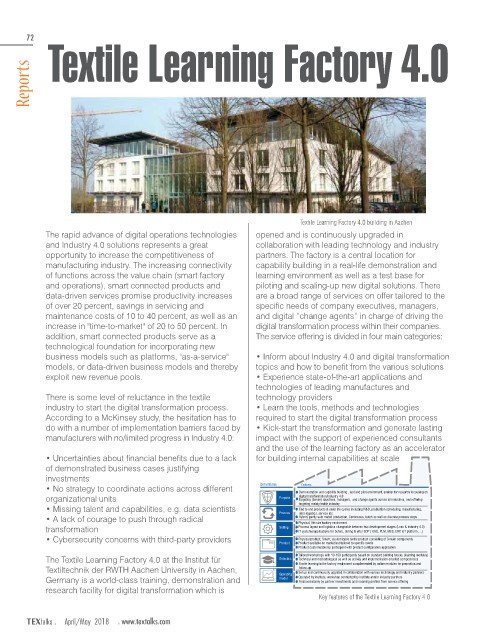
Textile Learning Factory 4.0 building in Aachen
but also “digital waste” along the end-to-end process building. Hence, the
The rapid advance of digital operations technologies opened and is continuously upgraded in • The people system (capabilities and mindset & factory infrastructure
and Industry 4.0 solutions represents a great collaboration with leading technology and industry behaviors), with significant changes in job profiles needs to meet certain
opportunity to increase the competitiveness of partners. The factory is a central location for across all plant functions, as well as new roles (e.g., requirements that
manufacturing industry. The increasing connectivity capability building in a real-life demonstration and data analysts, IT integrators) differentiate it from a
of functions across the value chain (smart factory learning environment as well as a test base for real-life factory. One of the
and operations), smart connected products and piloting and scaling-up new digital solutions. There The Textile Learning Factory will feature an integrated key differentiators is the Sewing station in the factory 4.0
data-driven services promise productivity increases are a broad range of services on offer tailored to the end-to-end value chain covering Industry 4.0 topics ability to change between
of over 20 percent, savings in servicing and specific needs of company executives, managers, across all operations-related functions and two implementation levels of the process:
maintenance costs of 10 to 40 percent, as well as an and digital “change agents” in charge of driving the departments and not just focus on • Level 1 – Current State Operation (Lean)
increase in "time-to-market" of 20 to 50 percent. In digital transformation process within their companies. manufacturing-related Industry 4.0 solutions. The • Level 2 – Future State Operation (Industry 4.0)
addition, smart connected products serve as a The service offering is divided in four main categories: factory will therefore showcase how a company of
technological foundation for incorporating new the future will operate along its entire value chain. Level 1 serves as a realistic, good practice industry
business models such as platforms, "as-a-service" • Inform about Industry 4.0 and digital transformation environment in which main Lean tools and methods
models, or data-driven business models and thereby topics and how to benefit from the various solutions Suppliers Procurement Production ( incl. Customer such as SMED, value stream mapping, Five S,
planning)
service
exploit new revenue pools. • Experience state-of-the-art applications and Kanban (pull systems) and poka-yoke
technologies of leading manufactures and customer Product (error-proofing) have been implemented, but the
There is some level of reluctance in the textile technology providers specific order Development potential of Industry 4.0 applications has not been
industry to start the digital transformation process. • Learn the tools, methods and technologies Advanced Analytics including Cyber Security utilized. Level 1 is used to train and teach
According to a McKinsey study, the hesitation has to required to start the digital transformation process participants the required methods and tools to
do with a number of implementation barriers faced by • Kick-start the transformation and generate lasting In order to allow experimental capability building a conduct a digital transformation in a realistic factory
manufacturers with no/limited progress in Industry 4.0: impact with the support of experienced consultants hands-on realistic factory environment that features environment. Level 2 on the other hand is used to
and the use of the learning factory as an accelerator an integrated end-to-end value chain for the showcase the potential of state-of-the-art Industry 4.0
• Uncertainties about financial benefits due to a lack for building internal capabilities at scale production of a smart, customizable wristband. The applications directly after the hands-on trainings in
of demonstrated business cases justifying wristband can be individually configured by the Level 1.
investments participants prior to a training or workshop, and will
Features
• No strategy to coordinate actions across different Dimentions Demonstration and capibility building , test and pilot enviroment, enabler for research focousing on be produced during the course of the workshop and Industry 4.0 applications Description 1st wave implementation
organizational units Purpose digital transformation/industry 4.0 participants can personalize their own wristbands as Train & 1 Condition monitring Real-time status of the process steps parameters
Targeting (Senior) exuctives, managers, and change agents across all industries, own offering
targeting mainly textile industry
• Missing talent and capabilities, e.g. data scientists Process End to end products & order life cycles including R&D, production scheduling, manufacturing, well as purchase them from home by using an online Level 1 teach 2 Product shadow Tracking of a product production cycle
participants
intra-logistics, service etc.
required
• A lack of courage to push through radical Physical, life-size factory enviroment product configurator. After the order is placed, the Current State method & 3 Digital assistant system Digital Work instruction for operators
Hybrid, partly auto mated production, Continuous, batch as well as discrate process steps
Digital KPI board with enabled problem solving
4 Digital performance mgmt
Operation
tools in a
transformation Setting Process layout and logistics changeable between two development stages (Lean & industry 4.0) development and adjustment of the product is (Lean) realistic 5 AGV in logistics Automated material supply
IT systems/applications for before, during & after SOP ( CAD, PLM, MES, ERP, IoT platform, ...)
industry
• Cybersecurity concerns with third-party providers Product Physical product, Smart, customizable textile product consisting of 3 main components initiated, followed by production planning and operation enviorment 6 YET Advanced analytics for yield, Energy & Throughput
Product available on market but tailored to specific needs
Product customizable by participant with product configuration application scheduling. The next step is the manufacturing of the 7 icycle time Real-time line balancing
8 Real-time WIP
Real-time tracking of the stocks (incl. WIP)
The Textile Learning Factory 4.0 at the Institut für Didactics Tailored workshops with 10-150 participants based on standard building blocks (learning modules) product from yarn production to final assembly. Level 2 Demon- 9 Predictive maintenance Advanced analytics for breakdown prevention
Technical and methodological as well as activity and implementation oriented competencies
Onsite learning in the factory enviroment complemented by online modules for prepration and
Textiltechnik der RWTH Aachen University in Aachen, Operating Set up and continucusly upgrated in collaboration with various technology and industry partners Manufacturing includes weaving, coating, Future State strate 10 Smart routing & work station Self-adjusting work stations
follow-up
digital
setup
Operation
Germany is a world-class training, demonstration and model Operated by institute, workshop conducted by institute and/or industry partners thermosetting, printing and cutting of the main strap, (Industry 4.0) solutions & 11 In-line QC & adaptive machining In-line qualitycontrol with machines feedback
industry 4.0
Financed mainly by partner investments and incoming profiles from service offering
12 Human machine collaboration
Human Robot collaboration
research facility for digital transformation which is as well as the final assembly, which includes sewing, applications 13 3D printing Tailored production components
Key features of the Textile Learning Factory 4.0
testing and packaging of the final product.
April/May 2018 April/May 2018

