


Page 48 - April-May 2021
P. 48
of settings that can be adjusted to meet each
spinners’ unique needs. But adjusting the break draft
has still been difficult, unpredictable and very slow.
The AUTO DRAFT function from Truetzschler, which is
part of our successful autoleveller draw frame TD 10,
uses an innovative measuring method to
automatically optimize the break draft during
production conditions. And it takes less than two
minutes.
For many decades, spinners have been wrestling
with the awkward problem of how to adjust the break
draft on the draw frame. This is partly because
adjusting the break draft involves changing a wide
range of settings on the draw frame – and each
setting needs to be adapted in line with every other
setting. As a result, many spinners simply leave their
Our customers across the textile industry around the
world are already benefitting from AUTO DRAFT, a
break draft settings untouched because they don’t
have time to interrupt their busy production schedule.
feature in our autoleveller draw frame TD 10. The
major advantages include:
On top of this, there is currently no laboratory test or
• Optimal adjustment of the break draft – including
Our innovative AUTO DRAFT function provides a
measured variable that provides clear information
selecting the best possible settings for new
high-impact solution to this awkward problem in the
materials at the first attempt.
about the optimal break draft settings. Even fiber and
production of carded ring yarns, including polyester.
• Correct drafting distribution in the drafting system.
draw frame manufacturers are only able to provide
It uses a state-of-the-art measuring method to
rough guidelines, which means spinners can only tell
• Less adjustment and shorter process times.
calculate the best possible break draft setting
• Better basic settings for the machine – which
if their break draft settings are suitable when they
automatically – within real production conditions. The
inspect the finished yarn.
reduces the negative effects of sub-optimal machine
method considers all fiber and sliver parameters, as
setting and provides a better, more uniform sliver
well as the settings on the specific model of draw
quality.
Many spinners try to adjust the break draft using the
frame and the relevant external boundary conditions.
• Reduction of costs related to quality control.
Coefficient of Variation (CV) value. But while low
The user can then choose whether to apply the
break drafts often improve sliver evenness, this
• Easy monitoring and adjustment of the machine
recommended setting in the software of their
settings when the quality of the raw material changes.
approach can open up additional problems (as
machine.
• And improvements at later stages in the
shown in the graphic below). Setting the break draft
too low can reduce yarn strength and elongation.
production process.
AUTO DRAFT is able to identify the optimal break
And it can also increase the number of imperfections
draft setting in less than two minutes. This
How it works
and have a negative effect on the running behavior
accelerates the process of adjusting the break draft
When activated, the AUTO DRAFT function
and efficiency of the machines operating at later
and creates meaningful clarity about how to optimize
continuously changes the break draft from 1.00 to
stages in the spinning process. This means
those adjustments. Put very simply: It is faster and
1.95, and then measures the draft forces
optimization is only possible in the very long
better than everything else that is currently available
within the drafting system.
term, if at all.
on the market.
48 Modern draw frame machines offer a fantastic range Faster and better than anything else on the market A massive range of attractive benefits
want to produce the fabric meeting specific
quality requirements,” says Michelle Salg,
Product Manager Fabric Inspection at Uster.
Total supervision
Defects that become visible only in the woven
fabric are the nastiest threat. Often, it’s too late
when defects such as reed marks, dirty yarns or
floats are spotted – but it can’t happen with Uster
A radical leap in fabric inspection Q-Bar 2. Its fabric inspection algorithms detect
even ‘invisible’ defects in the fabric. It’s the
simple solution to improving fabric yield by
Uster Q-Bar 2 becomes the unique formation automated formation monitoring.
Q-Bar 2 also monitors critical machine units in
monitoring system the formation zone. If there is a problem here, the
system makes it easy to identify and eliminate it,
preventing further defects and again maximizing
fabric yield.
Last but not least, the system has a permanent
eye on the fabric width, an essential factor for
further processing. For this reason, Q-Bar 2
provides continuous width measurement of the
woven fabric, from loom setup to full roll.
Designed for users
The technology in this new formation monitoring
system is impressive, but Q-Bar 2 is highly
developed in many other aspects too. Its attrac-
tive industrial design is also ergonomic, so users
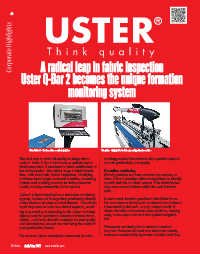
Uster Q-Bar 2 – The formation monitoring system The system displays the fault image and position in real time
have easy access to all important parts. Weavers
appreciate its simple installation on existing
The best way to avoid off-quality is simply not to and long-awaited innovations with a positive impact weaving machines. And operators like the
make it. Uster Q-Bar 2 introduces a radical leap in on both productivity and quality. integrated LEDs used by Q-Bar 2: system status
fabric inspection. It monitors the fabric additionally at is indicated and the positions of detected defects
the earliest point – the critical stage in fabric forma- Formation monitoring shown by red lights. The improved hardware
tion – with automatic, in-line inspection. Identifying Weaving defects can have various root causes, so platform is capable of handling high loom
problems here brings enormous benefits, preventing Uster Q-Bar 2 provides different algorithms to identify speeds and is ready for future innovations.
defects and enabling weavers to deliver constant specific defects and their causes. This inbuilt knowl-
quality and stay competitive in the market. edge can prevent defects within the weft insertion
cycle. First-quality production, to customer specifica-
Q-Bar 2 is best described as a formation monitoring tions, is the overall goal. That is especially
important in demanding applications such as
system, because of its ingenious positioning directly Its enhanced detection position in the fabric forma- industrial and safety textiles. In apparel and
at the interface of warp and weft threads. That allows tion zone means the warp is monitored even before it home textiles too, it is vital to avoid seconds and
rapid response as soon as a defect appears, avoid- is traversed by the weft – a truly unique benefit. It minimize waste fabric. “Independent of the fabric
Conclusion takes all relevant factors into consideration. In this way, ing long-running or repeating faults. Alarm and stop allows detection of incorrect warp positions, missing application, Uster Q-Bar 2 is a game-changer.
The AUTO DRAFT function is a truly game-changing it is enabling spinners to save time and money, while signals alert the operator to correct problems imme- warp, loose warp ends and even pattern irregulari- For the first time, weavers can actually prevent
technology for break draft optimization. It makes it improving quality and making their processes more diately – and early detection reduces second quality ties. weaving defects instead of only reacting to
possible to adjust the break draft quickly and easily, efficient. It’s a major breakthrough for the break draft. and material loss, as well as minimizing the need for them,” says Salg.
using an innovative and automatic method that And it’s empowering Truetzschler’s customers post-production checks. “Formation monitoring is the answer to market
operates within real production conditions – and that worldwide to grab a valuable competitive advantage. requests. Weavers demand zero defect standards,
For weavers, these advantages represent genuine increased sustainability by waste reduction and they
April/May 2021

