


Page 21 - TEXtalks International April/May 2022
P. 21
20                                                                                                             21

                     The need for a


 Levi Strauss & Co. joins the   circular economy


 Organic Cotton Accelerator program   in the US is


 Levi Strauss & Co. (LS&Co.) is the latest to join the   only made up 1 percent of global production in the   growing
 Organic Cotton Accelerator (OCA), a   2019-20 crop year. Moreover, thanks to its massive
 multi-stakeholder organization that brings supply   reach, the heritage denim brand’s participation will
 security and measurable social and environmental   help the program empower organic cotton farmers.   Textile production has increased dramatically over   bottlenecks, and opportunities for circularity.
 impact to organic cotton farming. Organic cotton is   The OCA reached more than 12,000 farmers   recent decades, particularly with the rise of fast
 in high demand for its chemical-free, regenerative   through its farming program from 2019 to 2020,   fashion. Simultaneously, increased production of   Global fiber production, hit by the COVID-19
 properties that are reportedly better for the   during which 2 percent of participating farmers   synthetic, fossil-based fiber (e.g., polyester, nylon)   pandemic, decreased from 111 million tonnes (MT)
 environment and workers. Compared to other   earned on average 2 percent higher net income   due to their cost-efficiency and performance   in 2019 to 109 MT in 2020 after years of growth,
 materials on the market, organic cotton is one of the   from their cotton than conventional farmers.   characteristics (e.g., stretch, durability, shrink   according to the Preferred Fiber & Materials Market
 most environmentally friendly options, as it does not   LS&Co.’s participation brings the brand closer to   resistance) has resulted in a large volume of   Report 2021. While it is not yet clear how the
 have a harsh manufacturing process.  reaching its goals of sourcing more responsible   synthetic fibers. The value chain of textiles is   pandemic and other factors will affect future
 fibers. In a sustainability report published in
 By joining the OCA as a contributor, LS&Co. will help   September, the company pledged to reach 100   characterized by vertical disintegration and global   development, production is expected to rise by 34 %
                                                               to 146 MT by 2030 if the industry builds a back
              dispersion of successive processes that span
 increase the global organic cotton supply, which   percent more sustainable cotton by 2025.
              several industries, including agriculture (natural   business as usual. While the overall fiber production
              fibers), petrochemical (synthetic fibers),       declined in 2020, the market share of preferred fiber
              manufacturing, distribution logistics, and retail.   and materials is increasing. However, despite this
                                                               growth, preferred fibers still only represent less than
              Textile products are produced, used, and disposed
 Trial of Pakistani cotton seed   of in the current linear economic model. It is   a fifth of the global fiber market. This number
                                                               includes—in descending order—recycled polyester
              estimated that a mere 15 % of discarded clothing
 variety starts in Azerbaijan   and textiles are collected for reuse, recycling, or   (8.4 MT), preferred cotton as defined by a list of
                                                               recognized standards (7.8 MT), FSC/PEFC certified
              downcycling in the US, while the remainder is sent
                                                               man-made cellulosic fibers (nearly 3.9 MT), and
              to landfills and incineration. This represents a
              tremendous loss of economic and material value   other recycled and bio-based fibers produced
 Trial sowing of new cotton varieties (one Azerbaijani, one Turkish, and seven Pakistani varieties) has begun in   and has severe social and environmental impacts.   according to recognized standards (0.57 MT). The
 Azerbaijan’s Imishli, Saatli, Sabirabad, and Beylagan regions, Trend reports concerning Azerbaijan’s   market share of recycled fibers increased from 6.9
 Agriculture Ministry. According to the ministry, this experiment aims to identify seeds that are resistant to   A circular economy (CE) approach aims to extend   % in 2016 to 8.1% in 2020, with the majority (7.6%)
 drought and diseases and with high yields. According to the Director of the Institute of Agrarian Problems of   the life of textile products through reuse and repair   coming from recycled PET bottles and only a minor
 Azerbaijan’s National Academy of Sciences, Elchin Khalilov, such test crops have been   and keep end-of-life (EoL) materials in the economy   part (0.5 %) from other recycled feedstock. Furthere,
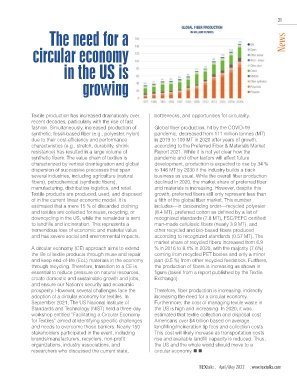
 carried out since 2021.   through recycling. Therefore, transition to a CE is   the production of fibers is increasing as shown in
              essential to reduce pressure on natural resources,   figure (taken from a report published by the Textile
 Historically, cotton production in Azerbaijan has been crucial to the national economy, accounting for   create domestic and sustainable growth and jobs,   Exchange).
 approximately 25% of agricultural revenue. It occurs mainly in the area west of the Caspian Sea. Until the late   and ensure our Nation’s security and economic
 1980s, Azerbaijan was one of the world’s leading cotton producers, producing high yields of raw cotton up to   prosperity. However, several challenges face the   Therefore, fiber production is increasing, indirectly
 2.5 tonnes/ha and gross annual production of 400–500 thousand tonnes.   adoption of a circular economy for textiles. In   increasing the need for a circular economy.
              September 2021, The US National Institute of     Furthermore, the cost of managing textile waste in
 In 1999, seed cotton production amounted to 101,000 tonnes from 156,000 hectares (390,000 acres). Now   Standards and Technology (NIST) held a three-day   the US is high and increasing. In 2020, it was
 the country is looking to increase its cotton production capacity. Therefore, the current trial of new varieties is   workshop entitled “Facilitating a Circular Economy   estimated that textile collection and disposal cost
 under test. Furthermore, the Pakistani cotton variety trial in another country is good news   for Textiles” aimed at identifying specific challenges   Americans over $4 billion based on average
 that could generate revenue.   and needs to overcome those barriers. Nearly 150   landfilling/incineration tip fees and collection costs.
              stakeholders participated in the event, including   This cost will likely increase as transportation costs
              brands/manufacturers, recyclers, non-profit      rise and available landfill capacity is reduced. Thus,
              organizations, industry associations, and        the US and the whole world should move to a
              researchers who discussed the current state,     circular economy.


 April/May 2022                                                                         April/May 2022

