


Page 69 - August-September-2017
P. 69
68                                                                                                             69
 problems and deaths common in non-organic cotton   identified as:  small-scale cotton farmers are all in need of a fairer   BCI in Pakistan
 production. Avoiding pesticides also reduces   • Organic certification of fibres on basis of recog-  deal for their cotton.  Pakistan is the fourth largest producer of cotton in
 production costs and farmer debts – the burden of   nised international or national standards (IFOAM   the world, and importantly also holds the third largest
 pesticide debt has resulted in thousands of suicides   family of standards, EEC 834/2007, USDA NOP)  spinning capacity in Asia (after China and India) with
 in India which is the world’s largest cotton producer.  • Certification of fibres from conversion period is   thousands of ginning and spinning units producing
 3. GM (Genetic Modification) is banned in organic   possible if the applicable farming standard permits   textile products from cotton. For global supply and
 systems, while an estimated a significant amount of   such certification  demand of Better Cotton in the future, Pakistan is a
 all cotton grown worldwide is genetically modified.   • A textile product carrying the GOTS label grade   key strategic country and BCI have established a
 GM cotton poses a potential risk to wildlife and   ‘organic’ must contain a minimum of 95% certified   Better Cotton Initiative (BCI)  regional office to proactively manage the Better
 human health, as well as exposing farmers to   organic fibres whereas a product with the label grade   The Better Cotton Initiative exists to make global   Cotton relationships in the country, as well as
 unnecessary expense.  ‘made with organic’ must contain a minimum of 70%   cotton production better for the people who produce
 4. There's restricted use of chemicals and limited   certified organic fibres  it, better for the environment it grows in and better for
 residues. GOTS ensures that the chemicals used in   the sector’s future, by developing Better Cotton as a
 processing textiles meet strict requirements on   sustainable mainstream commodity. The Better
 toxicity and biodegradability. Final products are   Cotton Standard System is a holistic approach to
 restricted in the amount of allergenic, carcinogenic or   sustainable cotton production which covers all three
 toxic chemical residues. These residues can be   pillars of sustainability: environmental, social and
 inhaled or absorbed through the skin and may cause   economic. Each of the elements – from the Produc-
 allergies, skin rashes or respiratory problems. In   tion Principles and Criteria to the monitoring mecha-
 contrast, non-organic manufacture uses tens of   nisms which show Results and Impact – work
 thousands of acutely toxic chemicals, many of which   together to support the Better Cotton Standard
 are classified as hazardous by the World Health   System, and the credibility of Better Cotton and BCI.   high average temperatures and alternation between
 Organisation (WHO).  The system is designed to ensure the exchange of   dry and wet seasons favours the growing of this
 5. Factory conditions are better. Poor working   good practices, and to encourage the scaling up of   natural fibre crop. Sub-Saharan Africa is the fifth
 conditions and rights in the garments industry are   Fairtrade Cotton  collective action to establish Better Cotton as a   largest cotton exporter worldwide. Cotton is grown
 common place. GOTS certified organic textiles must   Complex issues in the global cotton industry mean   sustainable mainstream commodity. The component   there by about 3.4 million smallholder farmers. A total
 meet social criteria based on the International Labour   millions of small-scale farmers are struggling to make   parts which make up the Better Cotton Standard   of more than 20 million people in the region are
 Organisation (ILO) conventions. These cover   a decent living from growing cotton. With high levels   System are listed below:  directly or indirectly living from cotton. Cotton thus
 minimum wages, working hours, child labour,   of illiteracy and limited land holdings, many cotton   1. ‘Production Principles and Criteria’: providing a   plays a key role in fighting poverty and makes a   Global Recycled Standard
 freedom of association, discrimination, harsh or   farmers live below the poverty line and are depend-  global definition of Better Cotton through 6 key   major contribution to food security in many countries   The Global Recycled Standard (GRS) is a holistic
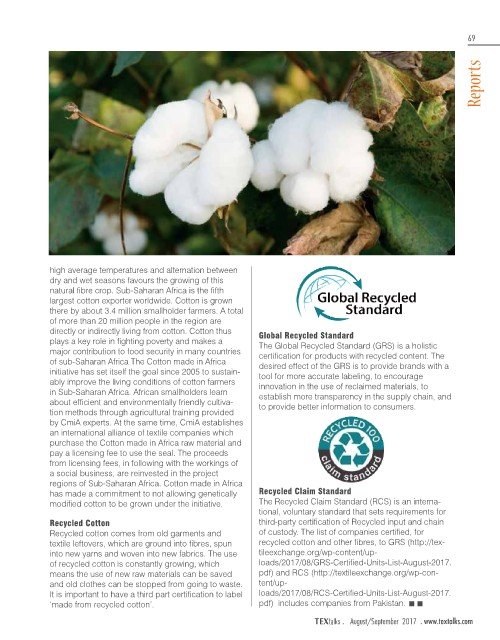
 Thirteen of the world’s most renowned clothing and   (RCS). In addition, Cotton Connect’s REEL   inhumane treatment and more.  ent on middle men or ginners who often buy their   principles. Better Cotton is produced by farmers   oversee the production going on at field level. BCI   of sub-Saharan Africa The Cotton made in Africa   certification for products with recycled content. The
 textile companies have made a public commitment   programme and code provides a starting point for   cotton at prices below the cost of production.   who:  works with WWF-Pakistan, Lok Sanjh Foundation,   initiative has set itself the goal since 2005 to sustain-  desired effect of the GRS is to provide brands with a
 to use cotton only from sustainable sources by 2025.   businesses aiming to for greater sustainability in their   Fairtrade works with the small-scale cotton farmers in      a. minimise the harmful impact of crop protection   CABI and Rural Education Economic and Education   ably improve the living conditions of cotton farmers   tool for more accurate labeling, to encourage
 The agreement was reached in May 2017 at a   cotton supply chain  Asia and Africa and helps build stronger farm-  practices.  Development Society (REEDs). In 2014, 102,000 BCI   in Sub-Saharan Africa. African smallholders learn   innovation in the use of reclaimed materials, to
 high-level meeting held at The British Academy,   er-owned organisations. This is important because      b. use water efficiently and care for the availability   Farmers produced 310,000MT of Better Cotton lint   about efficient and environmentally friendly cultiva-  establish more transparency in the supply chain, and   In addition to conventional quality monitoring and   occur because of defects in the yarn used, in the
 organised by The Prince of Wales’s International   Organic Cotton  farmers can achieve a lot more together as a group   of water.  on 353,000 hectares. Most of the BCI Farmers who   tion methods through agricultural training provided   to provide better information to consumers.   assessment tools, the use of modern technology in   weaving machine operation or from operator error.
 Sustainability Unit (ISU). The companies are – Asos,   Organic cotton benefits cotton producers and the   in negotiations with ginners and traders or in support-     c. care for the health of the soil.  WWF-Pakistan works with are smallholders. BCI   by CmiA experts. At the same time, CmiA establishes   other fields has increasingly found its application in   Many of these defects are spot type and small in
 Eileen Fisher, Greenfibres, H&M, Ikea, Kering, Levi   environment in developing countries by avoiding the   ing the local community.      d. conserve natural habitats.  Farmers in Pakistan for example, achieved an   an international alliance of textile companies which   global textile industry. Two of the interesting examples   nature, but there are also defects that may run the
 Strauss & Co, Lindex, Marks & Spencer, Nike,   potentially harmful effects of toxic pesticides, and the      e. care for and preserve the quality of the fibre.  average of 9% greater yields while using 15% less   purchase the Cotton made in Africa raw material and   in weaving and textile wet processing industry are   whole length of a piece and if unnoticed will result in
 Sainsbury’s, Tesco and Woolworths Holdings. Over   reduced cost of production improves social   Fairtrade encourages sustainable cotton production      f. promote Decent Work.  pesticide 18% less water. Further to achieving this,   pay a licensing fee to use the seal. The proceeds   summarised below.  high waste levels. Once the cloth has been woven
 the past year, ISU has been working in collaboration   conditions. There are a number of reasons why   and is the only standard to provide economic   2. ‘Capacity Building’: supporting and training   they generated a staggering 46% increase in   from licensing fees, in following with the workings of   there may be several additional processes that add
 with Marks & Spencer and The Soil Association to   choosing organic cotton is important for both the   benefits, through a guaranteed Fairtrade Minimum   farmers in growing Better Cotton, through working   income.  a social business, are reinvested in the project   Machine Vision Systems for Textile Industry  value (dyeing, printing, coating) and if long running
 convene leading companies and various   environment and the people who grow and pick the   GOTS  Price and additional Fairtrade Premium for seed   with experienced partners at field level.  regions of Sub-Saharan Africa. Cotton made in Africa   Home and Apparel Textile industry has traditionally   defects are not detected prior to these processes
                                                                                                                                                                                      adopted innovation and the application of new
 “standards” organisations to discuss how to reduce   cotton:   The Global Organic Textile Standard (GOTS) is the   cotton farmers. In 2014, 22 farmers’ organisations in   3. ‘Assurance Program’: regular farm assessment   has made a commitment to not allowing genetically   Recycled Claim Standard  technologies to advance the overall performance of   then additional cost is added to already sub-stand-
                                                                                                                                                                                                                                       ard cloth, resulting in further waste of resources.
 the negative environmental and social impacts   1. Organic fibres are grown without the use of   worldwide leading textile processing standard for   7 countries were certified for Fairtrade cotton produc-  and measurement of results through 8 consistent   modified cotton to be grown under the initiative.  The Recycled Claim Standard (RCS) is an interna-  processes and materials used and to control costs   Traditionally loom operators have a set of looms they
 associated with cotton production.  synthetic fertilisers or potentially toxic pesticides. By   organic fibres, including ecological and social   tion and reported Premium earnings of approximately   results indicators, encouraging farmers to continu-  tional, voluntary standard that sets requirements for   and quality. As manufacturing processes increase in   are responsible for and should patrol them to check
 building soil fertility, organic farmers help lock CO2   criteria, backed up by independent certification of the   £800,000. A large percentage of this was invested in   ously improve.  Recycled Cotton  third-party certification of Recycled input and chain   speed and complexity, whilst at the same time safety   for quality issues. In reality there is often insufficient
 Sustainable Sources for Cotton  into the soil, helping mitigate climate change. It also   entire textile supply chain. Version 5.0 was published   providing farmers with tools and inputs and support-  4. ‘Chain of Custody’: connecting supply and   Recycled cotton comes from old garments and   of custody. The list of companies certified, for   and quality standards become more rigorous, the   time for them to do this reliably and with the ever-in-
 A communiqué following the agreement defines   avoids the use of the toxic pesticides that, in   on 1st of March 2017, 3 years after the Version 4.0   ing education and healthcare facilities in the local   demand in the Better Cotton supply chain.  textile leftovers, which are ground into fibres, spun   recycled cotton and other fibres, to GRS (http://tex-  need for an automated quality control solution is ever   creasing production speeds of looms defects can
 sustainable sources as organic, Fairtrade, Better   non-organic systems, are responsible for poisoning   was introduced and 12 years after the launch of the   community. Fairtrade currently works with almost   5. ‘Claims framework’: spreading the word about   into new yarns and woven into new fabrics. The use   tileexchange.org/wp-content/up-  more pressing.  run a significant length before detection, if they are
 Cotton Initiative (BCI), Cotton Made in Africa (CmiA)   wildlife and rivers, as well as killing an estimated   1st Version. The high ecological and social require-  55,000 cotton farmers in some of the poorest regions   Better Cotton by communicating powerful data,   of recycled cotton is constantly growing, which   loads/2017/08/GRS-Certified-Units-List-August-2017.  ever detected.
 and recycled cotton certified to an independently   16,000 people each year.  ments as well as word-wide practicability and   in the world. In 2014 Fairtrade certified producer   information and stories from the field.  means the use of new raw materials can be saved   pdf) and RCS (http://textileexchange.org/wp-con-  Weaving: On loom Inspection
 verifiable standard such as the Global Recycled   2. By avoiding potentially toxic pesticides cotton   verifiability were considered in the revision work, in   organisations sold an average of 43 percent of their   6. ‘Results and Impact’: monitoring and evaluation   Cotton made in Africa (CmiA)  and old clothes can be stopped from going to waste.   tent/up-  Generally, the biggest cost component in creating   Shelton Vision are specialists in the design,
 Standard (GRS) or the Recycled Claim Standard   workers benefit by avoiding the associated health   order to achieve a reliable and transparent set of   production volumes on Fairtrade terms, much higher   mechanisms to measure progress/change, to ensure   About 8% of the cotton traded in the world market is   It is important to have a third part certification to label   loads/2017/08/RCS-Certified-Units-List-August-2017.  woven cloth is the raw material cost. The va
 criteria. The key criteria for fibre production can be   than in previous years. Meanwhile, globally, 90 million   that Better Cotton delivers the intended impact.  harvested in Sub-Saharan Africa. The climate, with its   ‘made from recycled cotton’.   pdf)  includes companies from Pakistan.  woven cloth can be downgraded by defects that may   systems for surface and product inspection. Shelton

 August/September  2017                                                             August/September  2017


 Vision have applied the power of high speed cloth   product is transported to the consumer). The tool can
 inspection to slow moving webs at a commercially   be accessed at
 realistic price level to detect defects in cloth at an   https://watercalculator.dnvgl.com/Home/Form. The
 early stage and limit the severity to manageable   Global Network for Resource Efficient and Cleaner
 levels. This means that machine vision systems can   Production (RECPnet), supporting organizations in over
 be fitted to every loom to eliminate long running and   60 developing countries, will facilitate the use of the tool,
 repetitive defects. In addition, defect maps are   which primarily targets small and medium-sized
 created that can be used to efficiently find repairable   companies. It will guide companies on the use of the
 defects in high value cloth. The system claims to:  tool and interpretation of results. In Pakistan, the
 • Reduce in waste material being scrapped.  RECPnet network member is National Cleaner
 • Complete orders on time.  Production Centre (NCPC) Foundation, Rawalpindi
 • Increase throughput of repaired cloth.  (http://www.ncpc.com.pk/). The tool consists of:
 • Transmit reliable quality data to the next process, or   • Introduction step: provide background information
 customer.  about your business: company size production, annual
 production, raw material (fibre type), product, relevant
 Textile Wet Processing: Water Calculation Tool  manufacturing processes, water source and treatment.
 Water scarcity affects more than 40 per cent of the   • Water data: provide process specific data of water
 global population, a number which is projected to   consumption and quality, based on batch or
 rise. While about 2.5 per cent of the world’s water is   continuous processing, depending on the availability
 of data (estimation, process control, measured data)
 • Chemicals and discharge: provide information on
 used chemicals and amount and quality of
 discharged waste water
 • The resulting report gives you an overview of your
 water consumption, and compare it with regional
 available indicators of best practice.

 UNIDO is the specialized agency of the United
 Nations that promotes industrial development for
 poverty reduction, inclusive globalization and


 freshwater, only 0.5 per cent of that amount is made
 available to satisfy society’s needs. Water is also an
 important resource in manufacturing processes,
 including in the textile sector. Reducing water
 consumption by establishing sustainable production
 processes can therefore be an advantage for   environmental sustainability. UNIDO meets the
 companies as well as the communities they operate   industrial development needs of its Member States
 in. This is widely reflected in the United Nations’   through a variety of highly specialized and
 Sustainable Development Goals, which aim, among   differentiated services that promote social inclusion,
 other things, to ensure sustainable production by   economic competitiveness and environmental
 companies and water access for all by 2030.  sustainability, as well as cross-cutting activities in the
 fields of industrial statistics, research and policy, and
 UNIDO and DNV GL - Business Assurance have   the promotion of knowledge networks and
 joined forces to develop and implement projects in   institutional partnerships.
 the field of water footprint measurement and
 promotion of water management best practices.   DNV GL enables organizations to advance the safety
 Foreseen projects include developing a water   and sustainability of their business. It provides
 footprint self-assessment tool to assist small and   classification, technical assurance, software and
 medium size enterprises (SMEs) in developing   independent expert advisory services to the maritime,
 countries to evaluate their water footprint in restricted   oil & gas and energy industries. It also provides
 stages of a product life cycle, specifically the   certification services to customers across a wide
 so-called ‘cradle-to-gate’ assessment from   range of industries. Operating in more than 100
 agricultural production through processing and   countries, with experts dedicated to help customers
 production up to the factory gate (i.e. before the   and make the world safer, smarter and greener.

