


Page 70 - August-September-2017
P. 70
70                                                                                                                                                                                                                             71

                             New Tools for


                  Monitoring Textile


                                    Processes


            In addition to conventional quality monitoring and   occur because of defects in the yarn used, in the
            assessment tools, the use of modern technology in   weaving machine operation or from operator error.
            other fields has increasingly found its application in   Many of these defects are spot type and small in
            global textile industry. Two of the interesting examples   nature, but there are also defects that may run the
            in weaving and textile wet processing industry are   whole length of a piece and if unnoticed will result in
            summarised below.                                 high waste levels. Once the cloth has been woven
                                                              there may be several additional processes that add
            Machine Vision Systems for Textile Industry       value (dyeing, printing, coating) and if long running
            Home and Apparel Textile industry has traditionally   defects are not detected prior to these processes
            adopted innovation and the application of new     then additional cost is added to already sub-stand-
            technologies to advance the overall performance of   ard cloth, resulting in further waste of resources.
            processes and materials used and to control costs   Traditionally loom operators have a set of looms they
            and quality. As manufacturing processes increase in   are responsible for and should patrol them to check
            speed and complexity, whilst at the same time safety   for quality issues. In reality there is often insufficient
            and quality standards become more rigorous, the   time for them to do this reliably and with the ever-in-
            need for an automated quality control solution is ever   creasing production speeds of looms defects can
            more pressing.                                    run a significant length before detection, if they are
                                                              ever detected.
            Weaving: On loom Inspection
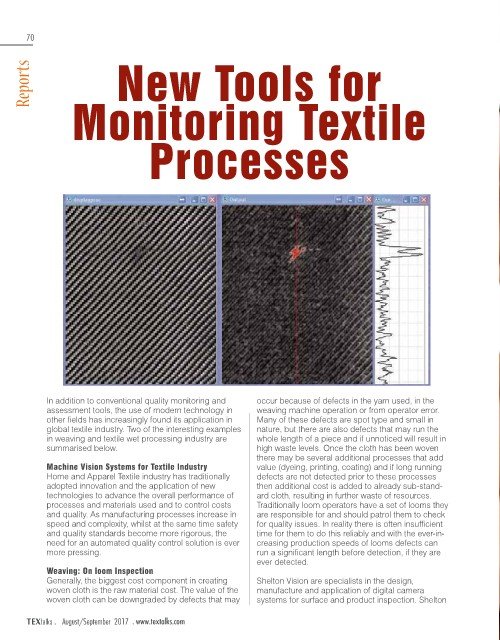
            Generally, the biggest cost component in creating   Shelton Vision are specialists in the design,
            woven cloth is the raw material cost. The value of the   manufacture and application of digital camera
            woven cloth can be downgraded by defects that may   systems for surface and product inspection. Shelton

                August/September  2017                                                                                                                                                                    August/September  2017


 Vision have applied the power of high speed cloth   product is transported to the consumer). The tool can
 inspection to slow moving webs at a commercially   be accessed at
 realistic price level to detect defects in cloth at an   https://watercalculator.dnvgl.com/Home/Form. The
 early stage and limit the severity to manageable   Global Network for Resource Efficient and Cleaner
 levels. This means that machine vision systems can   Production (RECPnet), supporting organizations in over
 be fitted to every loom to eliminate long running and   60 developing countries, will facilitate the use of the tool,
 repetitive defects. In addition, defect maps are   which primarily targets small and medium-sized
 created that can be used to efficiently find repairable   companies. It will guide companies on the use of the
 defects in high value cloth. The system claims to:  tool and interpretation of results. In Pakistan, the
 • Reduce in waste material being scrapped.  RECPnet network member is National Cleaner
 • Complete orders on time.  Production Centre (NCPC) Foundation, Rawalpindi
 • Increase throughput of repaired cloth.  (http://www.ncpc.com.pk/). The tool consists of:
 • Transmit reliable quality data to the next process, or   • Introduction step: provide background information
 customer.  about your business: company size production, annual
 production, raw material (fibre type), product, relevant
 Textile Wet Processing: Water Calculation Tool  manufacturing processes, water source and treatment.
 Water scarcity affects more than 40 per cent of the   • Water data: provide process specific data of water
 global population, a number which is projected to   consumption and quality, based on batch or
 rise. While about 2.5 per cent of the world’s water is   continuous processing, depending on the availability
 of data (estimation, process control, measured data)
 • Chemicals and discharge: provide information on
 used chemicals and amount and quality of
 discharged waste water
 • The resulting report gives you an overview of your
 water consumption, and compare it with regional
 available indicators of best practice.

 UNIDO is the specialized agency of the United
 Nations that promotes industrial development for
 poverty reduction, inclusive globalization and


 freshwater, only 0.5 per cent of that amount is made
 available to satisfy society’s needs. Water is also an
 important resource in manufacturing processes,
 including in the textile sector. Reducing water
 consumption by establishing sustainable production
 processes can therefore be an advantage for   environmental sustainability. UNIDO meets the
 companies as well as the communities they operate   industrial development needs of its Member States
 in. This is widely reflected in the United Nations’   through a variety of highly specialized and
 Sustainable Development Goals, which aim, among   differentiated services that promote social inclusion,
 other things, to ensure sustainable production by   economic competitiveness and environmental
 companies and water access for all by 2030.  sustainability, as well as cross-cutting activities in the
 fields of industrial statistics, research and policy, and
 UNIDO and DNV GL - Business Assurance have   the promotion of knowledge networks and
 joined forces to develop and implement projects in   institutional partnerships.
 the field of water footprint measurement and
 promotion of water management best practices.   DNV GL enables organizations to advance the safety
 Foreseen projects include developing a water   and sustainability of their business. It provides
 footprint self-assessment tool to assist small and   classification, technical assurance, software and
 medium size enterprises (SMEs) in developing   independent expert advisory services to the maritime,
 countries to evaluate their water footprint in restricted   oil & gas and energy industries. It also provides
 stages of a product life cycle, specifically the   certification services to customers across a wide
 so-called ‘cradle-to-gate’ assessment from   range of industries. Operating in more than 100
 agricultural production through processing and   countries, with experts dedicated to help customers
 production up to the factory gate (i.e. before the   and make the world safer, smarter and greener.

