


Page 61 - February-March-2017
P. 61
Sustainability potential   with the goal of creating a better quality of life in the   jersey fabric. This worldwide average is unlikely to   61


             interest of people and the environment.
                                                              have decreased rapidly. As early as 2004 the energy
 of German technology  A Cotton T-shirt for All               efficiency of German machinery clearly exceeded –
                                                              as expected – the values stated in the eco study. In
             Cotton T-shirts are basic garment, worn under shirts
                                                              the balance sheet machinery of VDMA member
             in the office or as casual clothing. If every-one of the
                                                              companies consumed that time only 6.0 kWh/kg per
  A cotton T-shirt for everyone  seven billion people on the globe bought one single   kilogram of T-shirt fabric from spinning to finishing.
                                                              This value further moved down to 4.3 kWh/kg in 2014.
             cotton T-shirt per year, 1.24 million tons of jersey
             fabric would have to be knitted worldwide. If all T-shirt
             manufacturers of the world made use of today’s   In order to assure that such a comparison of
             progress in German technology, huge saving       sustainability is comparable, all parameters,
             potentials could be obtained: Under the theme    processes and machinery technology for the
             “World population multiplied by one T-shirt per year”   manufacture of the jersey fabric had to be defined
             and “German technology, in recent years, compared   exactly. Starting point was a medium staple cotton.                                                                 enable economic handling of the most different fibre
             to machinery standard 20 years ago” engineers from   Yarn manufacture begins at the spinning preparation                                                                raw materials from virgin cotton over blends and
             Germany have calculated the possible energy saving   with fully automatic bale pluckers. The fibre material                                                             regenerates up to 100 per cent chemical fibres.
             of 19,354,000 million watts per hour and the water   is opened fully-automatically, blended and cleaned.                                                                Production reaches a rotor speed of more than
             consumption reduced by 127 Mio. m3 and searched   Carding machines, pre-drawing machines and                                                                            180,000 rpm and delivery speeds of 300 m/min. On
             for comparisons: In total 14 coal power plants with an   drawing machines follow downstream. The                                                                        such machines knitting yarns, as they are normally
             average output of 600 MW each could be completely   calculation example is based on a softly twisted yarn                                                               used for T-shirts, can be produced with very high
             turned off. And they underline an additional     with a yarn count of Ne 30, which is produced on                                                                       process efficiency. Even raw fibre qualities which
             advantage: Using German machinery technology for   open-end rotor spinning machine with a rotor speed                                                                   could cause a minor spinning stability can be
             jersey production of the global demand for cotton T-shirts,   of 150,000 rpm. The yarn produced this way is                                                             transformed into high quality yarns in a most
             the annual quantity of water that 2 million inhabitants of   wound on a package of up to 350 mm diameter                                                                economical way using the suitable spinning media
             Shanghai consume can be saved every year.        within the same process step. The yarn is knitted on                                                                   and spinning parameters. In addition, latest machine
                                                              single-jersey circular knitting machines with a                                                                        generations have a further optimised package      to reduce this consumption significantly for both
                                                              diameter of 34 inches and a machine gauge of E 28.                                                                     built-up, so that perfect dye packages – like those   dyeing and drying. One index to describe the water
                                                              With the following finishing process the knitted fabric                                                                only known from ring spun yarn up to date – can be   consumption of a discontinuous dyeing machine is
 VDMA (Verband Deutscher Maschinen- und   engineering industry, are as follows:  is dyed as desired (in this example black dyeing with                                               produced in one single process step. Throughout the   the liquor ratio of this machine. The figure describes
 Anlagenbau, Mechanical Engineering Industry                  reactive dye stuffs); at the same time its processing                                                                  last years the rotor spinning machines have been   the ratio of water and the fabric weight by which
 Association) represents more than 3,200 mostly   1. The mechanical and plant engineering industry   properties and its functional characteristics are                               optimised consequently regarding quality, operator   operation of the machine is possible in theory. A ratio
 medium-sized companies in the capital goods   uses sustainable engineering to ensure that its   improved. Finishing is made on the rope, which is slit                              ergonomics, energy consumption and efficiency so   of 1 : 5 means that for filling of the machine with 1 kg
 industry, making it the largest industry association in   responsibility for a livable world can be fulfilled by   before drying. The dyeing itself comprises the                   that they offer today more and more an alternative to   of fabric, 5 litres of water are required. The less water
 Europe. Blue Competence is a sustainability initiative   focus on ecological, social and economic objectives.  process steps pre-bleaching, dyeing and washing of                   the conventional ring spinning machines. This is   is necessary (i.e. the smaller is the liquor ratio) the
 of VDMA. The initiative connects professional   2. To us, social responsibility means improving our   the T-shirt material. All over the world in most cases                        mainly due to decrease in process steps compared   higher is saving in water and energy since smaller
 associations, institutions, and companies to create   quality of life on the basis of human rights and   so-called rope dyeing machines (jet dyeing                                 to the ring spinning procedure, the high degree of   water volumes have to be heated. In their company
 an efficient network for sustainable productions and   compliance with laws and standards. In particular, we   machines) are used. Making-up and drying are                         automation, the use of spinning agents            brochures some dyeing machinery manufacturers
 products - about 400 organizations are presently   are responsible for providing the best possible working   further process steps, which the fabric has to pass                    corresponding to the fabric and the integrated    engage a real competition regarding the liquor ratios.
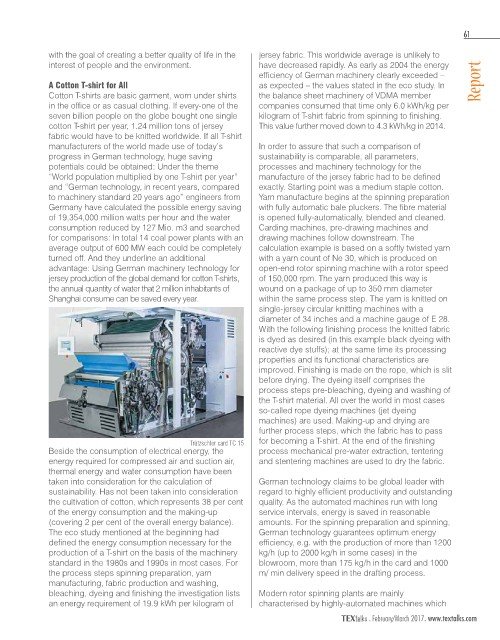
 part of Blue Competence.  conditions for our employees, supporting their further   Trützschler card TC 15  for becoming a T-shirt. At the end of the finishing                      quality monitoring.                               It is questionable as to whether process safety and
 training and lifelong learning, and creating jobs in order   Beside the consumption of electrical energy, the   process mechanical pre-water extraction, tentering                                                                    care of material are sufficiently taken into consideration.
 Blue Competence Sustainability Code  to improve people’s career opportunities.  energy required for compressed air and suction air,   and stentering machines are used to dry the fabric.  The single jersey circular knitting machine uses   The German manufacturers of rope dyeing machines
 Blue Competence makes an important contribution   3. Blue Competence makes an important   thermal energy and water consumption have been                                            relative movement technology: Latch needle and    use realistic figures: optimum process safety and
 to improving the global climate, for instance through   contribution to improving the global climate, for   taken into consideration for the calculation of   German technology claims to be global leader with   knock-over sinker make a relative movement to each   careful material transport are ensured.
 the efficient, conservative use of renewable as well   instance through the efficient, conservative use of   sustainability. Has not been taken into consideration   regard to highly efficient productivity and outstanding   other to form the loop. In this way the relative
 as non-renewable resources, by preventing waste   renewable as well as non-renewable resources, by   the cultivation of cotton, which represents 38 per cent   quality. As the automated machines run with long   movement technique has the advantage that smaller   Roland Berger Strategy Consultants, one of the
 and by reusing products and manufacturing   preventing waste and by reusing products and   of the energy consumption and the making-up   service intervals, energy is saved in reasonable   angles for needle clearance can be used. The results   world’s leading consultancies had awarded best
 technologies. For the German mechanical   manufacturing technologies.  (covering 2 per cent of the overall energy balance).   amounts. For the spinning preparation and spinning,   are less wrapping points of the yarn and a reduced   ratings to the German textile technology for increase
 engineering industry, responsibility toward society   4. We realize that a focus on sustainability increases   The eco study mentioned at the beginning had   German technology guarantees optimum energy   friction of the needle.   of energy efficiency. According to Roland Berger,
 and the environment has always been a core   a company’s economic success. Our products and   defined the energy consumption necessary for the   efficiency, e.g. with the production of more than 1200                               further development of German textile technology
 principle of its commercial actions. With the   services are not optimized for the short term, but are   production of a T-shirt on the basis of the machinery   kg/h (up to 2000 kg/h in some cases) in the   Textile finishing processes need much water and   should result in an about 15 per cent higher efficiency
 sustainability code, the companies belonging to the   designed for the entire lifecycle of the value chain.   standard in the 1980s and 1990s in most cases. For   blowroom, more than 175 kg/h in the card and 1000   heating energy. With latest state-of-the-art  until 2020. This product-specific comparison along
 Blue Competence initiative uphold these high social   Thus they represent the most efficient overall   the process steps spinning preparation, yarn   m/ min delivery speed in the drafting process.  ˚technology and process management, the finishing   the overall process chain even proves that German
 and ethical standards, and see them as a   economic solution.  manufacturing, fabric production and washing,                                                                        process of a cotton T-shirt offers several possibilities  technology already today reaches more.
 requirement for long-term business success. The   5. We acknowledge our social responsibility and   bleaching, dyeing and finishing the investigation lists   Modern rotor spinning plants are mainly
 key aspects of the code for German mechanical   emphasize trustworthy actions on a voluntary basis,   an energy requirement of 19.9 kWh per kilogram of   characterised by highly-automated machines which

