


Page 77 - February-March-2018
P. 77
76                                                                                                             77

 New C8 fluorocarbon technology


 free oil repellent coating


 Nano-Care Deutschland, a leading specialist in the production of ready-to-use high-tech coatings and their
 precursors, has developed a new Nanoflex F-Bond coating system for water and oil repellency.

 “Removal of C8 fluorocarbon technology, which will be banned due to its emissions of PFOS and PFOA,
 leaves a significant performance gap in the market,” said Oliver Sonntag, Nano-Care Director. “The great
 challenge for us has been to retain existing high standards of oil repellency – whilst eliminating long-chain   Lenzing unveils sustainable complete shoe concept
 fluorination. We have solved this problem by creating a special silicon dioxide backbone."


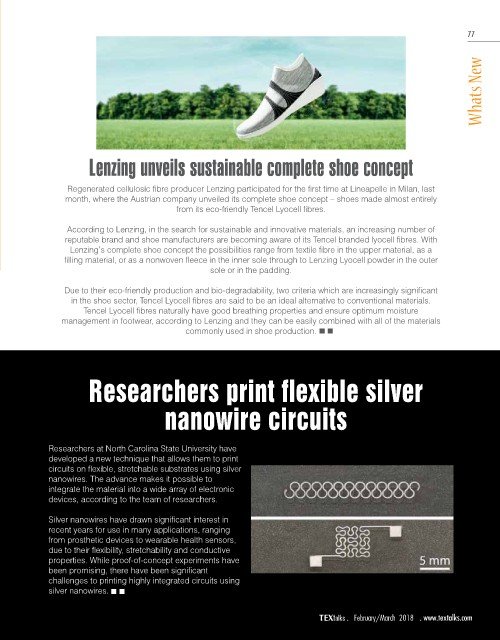
 The Nanoflex F-Bond, marketed under the umbrella brand Intelligent Hybrids, is based on liquid concentrates   Regenerated cellulosic fibre producer Lenzing participated for the first time at Lineapelle in Milan, last
 and is applied using common industrial dipping methods. For many years, there has been strong pressure for   month, where the Austrian company unveiled its complete shoe concept – shoes made almost entirely
 innovation in the textile finishing sector to meet increasing regulation and ecological demands.  from its eco-friendly Tencel Lyocell fibres.

                 According to Lenzing, in the search for sustainable and innovative materials, an increasing number of
                reputable brand and shoe manufacturers are becoming aware of its Tencel branded lyocell fibres. With
                  Lenzing’s complete shoe concept the possibilities range from textile fibre in the upper material, as a
                filling material, or as a nonwoven fleece in the inner sole through to Lenzing Lyocell powder in the outer
                                                   sole or in the padding.

 Accredited and notified bodies in the   Due to their eco-friendly production and bio-degradability, two criteria which are increasingly significant
 Hohenstein certification   product sector of Personal Protective   in the shoe sector, Tencel Lyocell fibres are said to be an ideal alternative to conventional materials.
 Equipment (PPE) are tested at regular
                     Tencel Lyocell fibres naturally have good breathing properties and ensure optimum moisture
 complies with new PPE   intervals and, if the test is successful, are   management in footwear, according to Lenzing and they can be easily combined with all of the materials
 granted renewed approval for
                                             commonly used in shoe production.
 accreditation and notification. The
 regulation  Hohenstein Group has successfully
 passed this test and may continue to
 certify in accordance with the new PPE
 regulation.          Researchers print flexible silver

 Personal protective equipment has a
 preventative health function in the world of
 work - for those working in trades and   nanowire circuits
 crafts as well as laboratory technicians
 and the fire brigade: the high quality and
 special technology of PPE protects them   Researchers at North Carolina State University have
 from possible risks. For this reason it is   developed a new technique that allows them to print
 important that protective clothing   circuits on flexible, stretchable substrates using silver
 complies with the high demands of   nanowires. The advance makes it possible to
 harmonised standards. The new   integrate the material into a wide array of electronic
 regulation now expands the application   devices, according to the team of researchers.
 area to include private use so that these
 users too can benefit from the same level   Silver nanowires have drawn significant interest in
 of protection.  recent years for use in many applications, ranging
            from prosthetic devices to wearable health sensors,
 The Hohenstein Group can carry out   due to their flexibility, stretchability and conductive
 these EU type examinations for your PPE.   properties. While proof-of-concept experiments have
 In doing this, we confirm that your PPE   been promising, there have been significant
 meets the relevant provisions of the   challenges to printing highly integrated circuits using
 regulation.  silver nanowires.

 February/March  2018                                                                February/March  2018

