


Page 78 - February-March-2018
P. 78
78                                                                                                                                                                                                                             79

                           New Pampers range made


                         with 0% chlorine bleaching


                The Procter & Gamble Company, has announced a new line of diapers and wipes made with premium
                 cotton and other thoughtfully selected materials, stylish prints, and featuring the Pampers protection.
               The company says the new Pampers Pure Collection started with Sara Giovanni, a scientist at Pampers.

                 Pampers Pure diapers and wipes are made without chlorine bleaching, fragrance, lotion, parabens,
               natural rubber latex and the 26 allergens identified by the EU. They are also dermatologically tested and                         Dystar and Rotaspray develop
                   clinically proven hypoallergenic and gentle for baby’s delicate skin, and are made with Pampers
                                              leakage and dryness protection                                                                             saltless dyeing solution


                Pampers Pure Protection diapers are also independently reviewed and accredited as skin safe by the
                  Skin Health Alliance. Each size option of Pampers Pure Protection diapers features different prints              DyStar and RotaSpray are announcing a saltless dyeing solution for the denim industry. This new technology is
                                    (llamas, corgis, and sloths), and the Wetness Indicator.                                        awarded important ECO certificates and offers high flexibility for dyeing small lot sizes, reduced water usage
                                                                                                                                         and effluent discharge lower impact on yarn in the dyeing process and simplified recipe changes.

                                                                                                                                     The companies developed their indigo spray dyeing procedure for production on a bulk level, which allows
                                                                                                                                        denim producers to significantly reduce their environmental impact, according to the manufacturers.

                                                                                                                                       The new Spray dyeing technology combines DyStar Indigo Vat 40% Solution, Sera Con C-RDA organic
                                                                                                                                        reducing agent and the optimisation of spraying parameters of the EPO patented RotoDyer and the
                                                                                                                                    RotoCoater spraying technology. Although rotary atomisers have been established for several decades in the
                                                                                                                                     textiles industry, they were mainly used for rewetting textiles with moisture. But recent cost pressure and a
                       PrimaLoft presents PrimaLoft                                                                                global demand for more sustainable solutions were motivators for the R&D of the industry and led to the recent
                                                                                                                                                                            technology leap.

                              Gold Insulation Active+                                                                              Sanitized presents a new dimension to

                                                                                                                                   odour-management for functional polyester
                                                                                                                                   textiles, with its newly developed
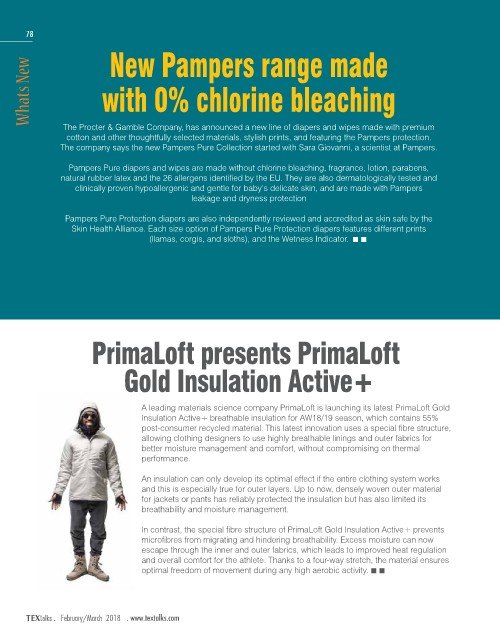
                                   A leading materials science company PrimaLoft is launching its latest PrimaLoft Gold            wash-resistant Sanitized Odoractiv 10 that
                                   Insulation Active+ breathable insulation for AW18/19 season, which contains 55%                 has a dual-action effect: on the one hand, it
                                   post-consumer recycled material. This latest innovation uses a special fibre structure,         prevents the bacteria from docking on the
                                   allowing clothing designers to use highly breathable linings and outer fabrics for              textile, and on the other, it adsorbs odours
                                   better moisture management and comfort, without compromising on thermal                         whilst the garment is being worn.
                                   performance.
                                                                                                                                   “Manufacturers of functional polyester
                                   An insulation can only develop its optimal effect if the entire clothing system works           textiles face the same challenge: freshly
                                   and this is especially true for outer layers. Up to now, densely woven outer material           washed garments develop an unpleasant
                                   for jackets or pants has reliably protected the insulation but has also limited its             odour even after a short wearing period. The
                                   breathability and moisture management.                                                          cause of this undesirable effect is not the
                                                                                                                                   human perspiration itself, but the bacteria   Sanitized develops new
                                   In contrast, the special fibre structure of PrimaLoft Gold Insulation Active+ prevents          that break down the perspiration,” the
                                   microfibres from migrating and hindering breathability. Excess moisture can now                 company explains. The new, dual-action   Odoractiv 10 Dual-Action
                                   escape through the inner and outer fabrics, which leads to improved heat regulation             technology from Sanitzed aims to address
                                   and overall comfort for the athlete. Thanks to a four-way stretch, the material ensures         this problem. The surface of the textile is
                                   optimal freedom of movement during any high aerobic activity.                                   “coated” with Sanitized Odoractiv 10 in the  technology

                                                                                                                                   padding process. This creates a protective
                                                                                                                                   film on the surface of the textile.

               February/March  2018                                                                                                                                                                        February/March  2018

