


Page 63 - TEXtalks. July- August 2023
P. 63
63


                                                            The next-generation


                                                            smart textiles


            Researchers have developed next-generation smart   diodes, and transistors have been fabricated,
            textiles – incorporating LEDs, sensors, energy    encapsulated, and mixed with conventional fibres,
            harvesting, and storage – that can be produced    either synthetic or natural, to build smart textiles by
            inexpensively in any shape or size, using the same   automated weaving. The fibre devices were
            machines used to make conventional clothing.      interconnected by an automated laser welding
                                                              method with electrically conductive adhesive.
            Last year, some of the researchers demonstrated that
            if the fibres used in smart textiles were coated with   The processes were all optimized to minimize
            materials that can withstand stretching, they could be   damage to the electronic components, which in turn
            compatible with conventional weaving processes.   made the smart textiles durable enough to withstand
            Using this technique, they produced a 46-inch woven   the stretching of an industrial weaving machine. The
            demonstrator display.                             encapsulation method was developed to consider
                                                              the functionality of the fibre devices, and the
            Now they have shown that smart textiles can be    mechanical force and thermal energy were
            made using automated processes, with no limits on   investigated systematically to achieve automated
            their size or shape. Multiple types of fibre devices,   weaving and laser-based interconnection,
            including energy storage devices, light-emitting   respectively.


              Smart clothing


                   for industrial


                                     robots


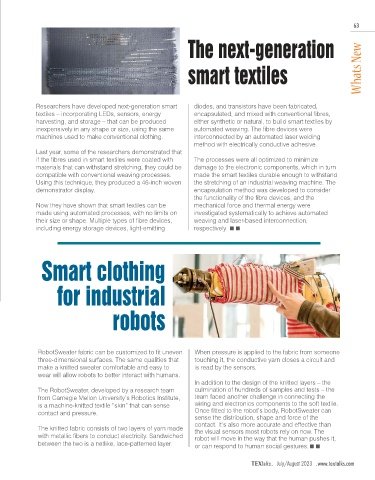
             RobotSweater fabric can be customized to fit uneven   When pressure is applied to the fabric from someone
             three-dimensional surfaces. The same qualities that   touching it, the conductive yarn closes a circuit and
             make a knitted sweater comfortable and easy to   is read by the sensors.
             wear will allow robots to better interact with humans.
                                                              In addition to the design of the knitted layers – the
             The RobotSweater, developed by a research team   culmination of hundreds of samples and tests – the
             from Carnegie Mellon University’s Robotics Institute,   team faced another challenge in connecting the
             is a machine-knitted textile “skin” that can sense   wiring and electronics components to the soft textile.
                                                              Once fitted to the robot’s body, RobotSweater can
             contact and pressure.
                                                              sense the distribution, shape and force of the
                                                              contact. It’s also more accurate and effective than
             The knitted fabric consists of two layers of yarn made
                                                              the visual sensors most robots rely on now. The
             with metallic fibers to conduct electricity. Sandwiched
                                                              robot will move in the way that the human pushes it,
             between the two is a netlike, lace-patterned layer.
                                                              or can respond to human social gestures.
                                                                                        July/August 2023

