


Page 11 - TEXtalks International June/July-2025
P. 11
10                                                                                                             11
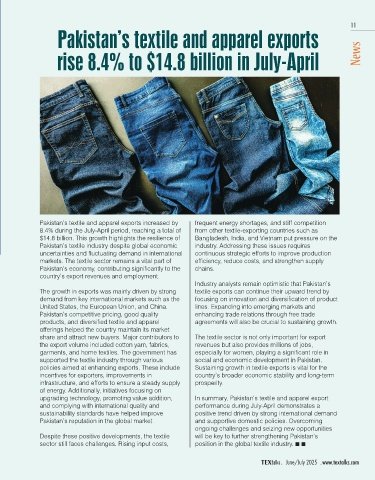
                   Pakistan’s textile and apparel exports

 ITMA Asia + CITME Singapore 2025   rise 8.4% to $14.8 billion in July-April


 publishes exhibitor list


 The exhibitor list for ITMA Asia + CITME Singapore 2025 has been released exclusively through a newly
 launched mobile app, available for both Android and iOS users. The exhibition, scheduled from October 28 to
 31, 2025, at Singapore Expo, has attracted over 770 exhibitors from 31 countries and regions, covering 70,000
 square meters of exhibition space. The event will showcase innovations across 19 product sectors,
 representing the entire textile manufacturing value chain.

 The mobile app offers features such as a personalized itinerary planner, a bookmark function, and a built-in
 wayfinder to map out optimal booth visit routes. These tools also support exhibitor networking by simplifying
 partner discovery. Currently, the exhibitor list is available only on the app, with a web version expected to be
 released on the official website by the end of June.

 ITMA Asia + CITME Singapore 2025 is owned by CEMATEX and its Chinese partners, the China Textile
 Machinery Association (CTMA) and the Sub-Council of Textile Industry, CCPIT (CCPIT TEX). The show is
 organized by ITMA Services Pte Ltd, co-organized by Beijing Textile Machinery International Exhibition Co., Ltd
 (BJITME), with the Japan Textile Machinery Association (JTMA) as a special partner.


              Pakistan’s textile and apparel exports increased by   frequent energy shortages, and stiff competition
              8.4% during the July-April period, reaching a total of   from other textile-exporting countries such as
              $14.8 billion. This growth highlights the resilience of   Bangladesh, India, and Vietnam put pressure on the
              Pakistan’s textile industry despite global economic   industry. Addressing these issues requires
              uncertainties and fluctuating demand in international   continuous strategic efforts to improve production
 Aid by Trade Foundation completes €2.8   markets. The textile sector remains a vital part of   efficiency, reduce costs, and strengthen supply
                                                               chains.
              Pakistan’s economy, contributing significantly to the
              country’s export revenues and employment.
 million project for climate-resilient   The growth in exports was mainly driven by strong   Industry analysts remain optimistic that Pakistan’s
                                                               textile exports can continue their upward trend by
              demand from key international markets such as the
                                                               focusing on innovation and diversification of product
 agriculture in Africa  United States, the European Union, and China.   lines. Expanding into emerging markets and
                                                               enhancing trade relations through free trade
              Pakistan’s competitive pricing, good quality
              products, and diversified textile and apparel    agreements will also be crucial to sustaining growth.
 The Aid by Trade Foundation (AbTF) has successfully   boosting incomes by approximately €509.  offerings helped the country maintain its market
 concluded its €2.8 million CAR-iSMa project, aimed   share and attract new buyers. Major contributors to   The textile sector is not only important for export
 at enhancing climate resilience in African cotton   The project also explored carbon sequestration   the export volume included cotton yarn, fabrics,   revenues but also provides millions of jobs,
 farming. Over three years, more than 100,000   through soil improvements, potentially opening new   garments, and home textiles. The government has   especially for women, playing a significant role in
 smallholder farmers across Côte d'Ivoire, Zambia,   income streams via carbon credits. Women played a   supported the textile industry through various   social and economic development in Pakistan.
 and Mozambique participated in trials of regenerative   pivotal role, leading compost production initiatives   policies aimed at enhancing exports. These include   Sustaining growth in textile exports is vital for the
 agricultural practices. These included composting,   and becoming local champions of sustainable   incentives for exporters, improvements in   country’s broader economic stability and long-term
 biochar application, crop rotation, and integrated   practices. Funded by Germany’s BMZ and   infrastructure, and efforts to ensure a steady supply   prosperity.
 pest management.  of energy. Additionally, initiatives focusing on
 implemented with GIZ and LDC Suisse, CAR-iSMa   upgrading technology, promoting value addition,   In summary, Pakistan’s textile and apparel export
 In Côte d'Ivoire, demonstration plots showed up to a   underscores AbTF’s commitment to sustainable   and complying with international quality and   performance during July-April demonstrates a
 37% increase in yields compared to untreated fields.   agriculture and climate adaptation in Africa. The   sustainability standards have helped improve   positive trend driven by strong international demand
 Following a pest-afflicted 2022/2023 season,   initiative aligns with the Sub-Saharan Cotton Initiative   Pakistan’s reputation in the global market.  and supportive domestic policies. Overcoming
 participating farmers saw average yields rise from   and continues to influence sustainable farming   ongoing challenges and seizing new opportunities
 272 to 1,007 kilograms per hectare in 2023/2024,   practices across the region.  Despite these positive developments, the textile   will be key to further strengthening Pakistan’s
              sector still faces challenges. Rising input costs,   position in the global textile industry.

 June/July 2025                                                                            June/July 2025

