


Page 13 - TEXtalks International June/July-2025
P. 13
12                                                                                                             13


 ICAC projects steady global


 cotton production and consumption

 for 2025–26


 The International Cotton Advisory Committee (ICAC) has released its projections for the 2025–26 cotton
 season, forecasting global cotton production to reach about 26 million tonnes and consumption around
 25.7 million tonnes. This indicates a balanced market with a slight surplus in production.

 Regionally, production is expected to increase in Brazil, the United States, and West Africa. However, these
 gains may be offset by a small decline in China’s cotton output, which is projected at around 6.3 million
 tonnes. Despite China’s record cotton yield of 2,257 kilograms per hectare in the current season, its   G7 to jointly boost AI adoption in
 production is expected to decrease slightly in 2025–26.

 Global cotton trade is forecast to rise by 2%, reaching approximately 9.65 million tonnes. This increase is   public sector and support SMEs
 driven by higher stocks from the current season combined with expected mill demand. Nevertheless,
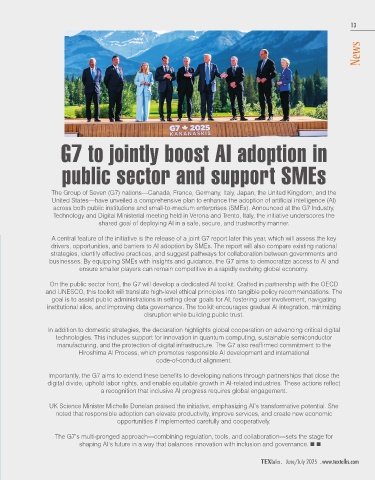
 international trade agreements and tariffs could influence the trade outlook for the upcoming season. The   The Group of Seven (G7) nations—Canada, France, Germany, Italy, Japan, the United Kingdom, and the
 ICAC’s price forecast for 2025–26 ranges from 56 to 95 cents per pound, with a midpoint estimate of 73   United States—have unveiled a comprehensive plan to enhance the adoption of artificial intelligence (AI)
 cents. This range reflects uncertainties surrounding supply and demand factors worldwide. Overall, the   across both public institutions and small-to-medium enterprises (SMEs). Announced at the G7 Industry,
 ICAC’s projections suggest a stable global cotton market for 2025–26, characterized by balanced   Technology and Digital Ministerial meeting held in Verona and Trento, Italy, the initiative underscores the
 production and consumption, moderate trade growth, and steady price expectations.
                                shared goal of deploying AI in a safe, secure, and trustworthy manner.

                 A central feature of the initiative is the release of a joint G7 report later this year, which will assess the key
                 drivers, opportunities, and barriers to AI adoption by SMEs. The report will also compare existing national
                 strategies, identify effective practices, and suggest pathways for collaboration between governments and
                 businesses. By equipping SMEs with insights and guidance, the G7 aims to democratize access to AI and
                          ensure smaller players can remain competitive in a rapidly evolving global economy.
 Hohenstein releases 2024   On the public sector front, the G7 will develop a dedicated AI toolkit. Crafted in partnership with the OECD

 sustainability report,   and UNESCO, this toolkit will translate high-level ethical principles into tangible policy recommendations. The
                 goal is to assist public administrations in setting clear goals for AI, fostering user involvement, navigating
 sets 2025 goals  institutional silos, and improving data governance. The toolkit encourages gradual AI integration, minimizing
                                              disruption while building public trust.

                In addition to domestic strategies, the declaration highlights global cooperation on advancing critical digital
 Hohenstein has published its 2024 Sustainability Report outlining key achievements and plans for 2025. The   technologies. This includes support for innovation in quantum computing, sustainable semiconductor
 report highlights environmental, social, and corporate governance efforts across its global locations. On the   manufacturing, and the protection of digital infrastructure. The G7 also reaffirmed commitment to the
 environmental front, Hohenstein installed a combined heat and power plant and photovoltaic system at its   Hiroshima AI Process, which promotes responsible AI development and international
 German headquarters.                             code-of-conduct alignment.

 It also recorded its greenhouse gas emissions (Scope 1, 2, and 3) globally for the first time. An   Importantly, the G7 aims to extend these benefits to developing nations through partnerships that close the
 environmental team and officer were appointed to implement the Eco-Management and Audit Scheme   digital divide, uphold labor rights, and enable equitable growth in AI-related industries. These actions reflect
 (EMAS). Using this data, the company will set reduction targets and further improve sustainability. Socially,   a recognition that inclusive AI progress requires global engagement.
 an internal employee survey showed 85% satisfaction with Hohenstein as an employer. The company has
 acted on many employee suggestions to improve workplace conditions. Focus remains on work-life balance   UK Science Minister Michelle Donelan praised the initiative, emphasizing AI’s transformative potential. She
 and transparent communication with staff worldwide.  noted that responsible adoption can elevate productivity, improve services, and create new economic
                                      opportunities if implemented carefully and cooperatively.
 CEO Dr. Stefan Droste emphasized the importance of environmental responsibility amid rising extreme
 weather events. Hohenstein aims to maintain its sustainability commitment and assist clients   The G7’s multi-pronged approach—combining regulation, tools, and collaboration—sets the stage for
 with evolving regulations.  shaping AI’s future in a way that balances innovation with inclusion and governance.


 June/July 2025                                                                            June/July 2025

