


Page 61 - TEXtalks International June/July-2025
P. 61
60                                                                                                             61


 The Flax Company leads the way                      Nature Coatings


 as global demand for hemp and                       introduces BioBlack:


 linen fibers surges                                 A carbon-negative

                                                     pigment


                                                     revolutionizing


                                                     sustainable colorants


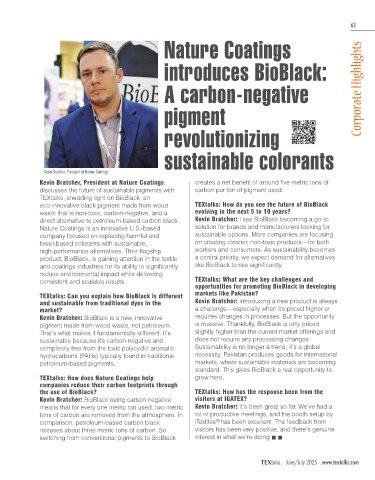
               Kevin Bratcher, President at Nature Coatings
              Kevin Bratcher, President at Nature Coatings,    creates a net benefit of around five metric tons of
              discusses the future of sustainable pigments with   carbon per ton of pigment used.
              TEXtalks, shedding light on BioBlack, an
              eco-innovative black pigment made from wood      TEXtalks: How do you see the future of BioBlack
              waste that is non-toxic, carbon-negative, and a   evolving in the next 5 to 10 years?
              direct alternative to petroleum-based carbon black.   Kevin Bratcher: I see BioBlack becoming a go-to
 Herve Denoyelle, Managing Director, The Flax Company  Nature Coatings is an innovative U.S.-based   solution for brands and manufacturers looking for
              company focused on replacing harmful and         sustainable options. More companies are focusing
 Herve Denoyelle, Managing Director, The Flax   well-known in Pakistan and is the only sustainable   fossil-based colorants with sustainable,   on creating cleaner, non-toxic products—for both
 Company, discusses the rising global interest in   hemp fiber certified at the Cradle to Cradle (C2C)   high-performance alternatives. Their flagship   workers and consumers. As sustainability becomes
 sustainable flax and hemp fibers and their growing   platinum level with a full Life Cycle Assessment   product, BioBlack, is gaining attention in the textile   a central priority, we expect demand for alternatives
 role in the textile industry with TEXtalks. With more   (LCA). The other is Smart Linen, a new product in   and coatings industries for its ability to significantly   like BioBlack to rise significantly.
 than three decades of expertise in the flax and linen   Pakistan, which is the only Global Recycled   reduce environmental impact while delivering
 industry, Herve Denoyelle leads this enterprise that   Standard (GRS) certified recycled linen fiber   consistent and scalable results.  TEXtalks: What are the key challenges and
 has become a major player in the global sustainable   available.  opportunities for promoting BioBlack in developing
 fiber market. The company has built a strong   TEXtalks: Can you explain how BioBlack is different   markets like Pakistan?
 reputation for its commitment to quality, innovation,   TEXtalks: How do you see the future of flax-based   and sustainable from traditional dyes in the   Kevin Bratcher: Introducing a new product is always
 and environmental responsibility. It has expanded its   textiles evolving over the next 5 to 10 years?  market?  a challenge—especially when it's priced higher or
 global reach, including into emerging markets such   Herve Denoyelle: Flax has shifted from being   Kevin Bratcher: BioBlack is a new, innovative   requires changes in processes. But the opportunity
 as Pakistan, by offering innovative fiber solutions like   considered a fashion fiber to becoming a   pigment made from wood waste, not petroleum.   is massive. Thankfully, BioBlack is only priced
 certified sustainable hemp and recycled linen.  commodity, which supports steady growth. We have   That’s what makes it fundamentally different. It’s   slightly higher than the current market offerings and
 seen consistent increases in demand over recent   sustainable because it's carbon-negative and   does not require any processing changes.
 TEXtalks: How has the demand for hemp and linen   years, and we expect this trend to continue steadily.  completely free from the toxic polycyclic aromatic   Sustainability is no longer a trend; it’s a global
 evolved with the rise of sustainable fashion and   hydrocarbons (PAHs) typically found in traditional   necessity. Pakistan produces goods for international
 textiles?    petroleum-based pigments.                        markets, where sustainable materials are becoming
 Herve Denoyelle: Linen has been growing very fast   TEXtalks: How do you see Pakistan as a potential   standard. This gives BioBlack a real opportunity to
 market, considering its interest in sustainable
 over the last two to three years, with huge demand   materials?  TEXtalks: How does Nature Coatings help   grow here.
 globally. Hemp demand is increasing steadily as   companies reduce their carbon footprints through
 well, though not as quickly as linen. Both fibers are   Herve Denoyelle: Pakistan is a large and developing   the use of BioBlack?  TEXtalks: How has the response been from the
 now becoming commodities in the textile market.  market for us, especially in the denim industry and   Kevin Bratcher: BioBlack being carbon negative   visitors at IGATEX?
 increasingly in home furnishings. However, the   means that for every one metric ton used, two metric   Kevin Bratcher: It’s been great so far. We’ve had a
 TEXtalks: What are some recent innovations at The   domestic market in Pakistan is still emerging   tons of carbon are removed from the atmosphere. In   lot of productive meetings, and the booth setup by
 Flax Company that you would like to share with us?  compared to India, where much flax fiber is   comparison, petroleum-based carbon black   iTextiles   has been excellent. The feedback from
                                                                      R
 Herve Denoyelle: We have two key innovations   consumed locally. We see strong potential for   releases about three metric tons of carbon. So   visitors has been very positive, and there’s genuine
 gaining traction. One is Marmara Hemp, which is   growth as sustainability gains more focus here.  switching from conventional pigments to BioBlack   interest in what we’re doing.


 June/July 2025                                                                            June/July 2025

