


Page 66 - TEXtalks March/April 2022
P. 66
66                                                                                                                                                                                                                             67

                                                                                                                                   Commerce and Finance Division.                    collaboration with the stakeholders. Ministry of
                                                                                                                                                                                     Commerce will encourage Hedge Trading initiation;
                                                                                                                                   The industrials are praising that DLTL/DDT scheme   however, various stakeholders' reservations would be
                                                                                                                                   will be continued for exports of value-added      considered. Apart from Cotton, a committee would
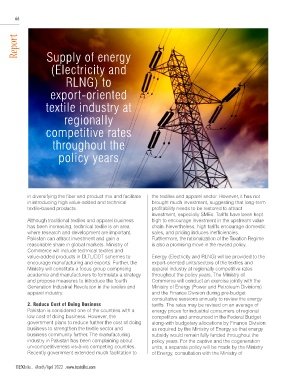
                    Supply of energy                                                                                               products only, i.e., technical textiles, apparel,   be constituted to develop wool, jute, silk, hemp, and
                                                                                                                                   made-ups, and carpets. Ministry of Commerce will
                                                                                                                                                                                     other natural fiber-based textiles and apparel value
                     (Electricity and                                                                                              further pursue SBP and FBR to automate the        chain. Till the development of these sectors, the raw
                                                                                                                                                                                     and semi-processed raw materials will be placed in
                                                                                                                                   disbursements process of the duty drawback
                           RLNG) to                                                                                                schemes on the lines of custom duty drawback      zero import tariffs. Support will be provided for
                                                                                                                                                                                     man-made fibers. Man-made fibers and
                                                                                                                                   mechanism where payments are made directly to
                     export-oriented                                                                                               exporter accounts by SBP on receipts of foreign   filament-based value-chain has confined themselves
 The Pakistani government has approved the   the Finance Division would necessarily be required to                                 exchange for notified products exported, subject to   to the domestic market only. Tariff and custom duty
 much-awaited pro-industry Textiles and Apparel   keep intact the due support on proposed                                          allocation of funds by the Ministry of Finance. The   drawback rates of this value chain will be
 Policy (TAP) 2020-25, which aims to achieve the   interventions throughout the policy years to achieve   textile industry at      textile sector's progress is related to the smooth   rationalized. International companies will be invited
 target of US$ 40 billion for textile exports by 2025.   set milestones. As the TAP 2020-25 has increased                          operations of the allied industries. The textiles and   for investment to bridge the demand and supply gap
 China's global market for textile exports is dominated   the expectations from the textile sector, it has also   regionally       apparel industry has become Pakistan's single     in fiber/ filament production.
 by a 32% share of textile trade of $302 billion.   highlighted some strategies to achieve those targets,                          largest manufacturing sector. However,
 Pakistan's share is only 1.6% in the global textile   including:  competitive rates                                               manufacturing industries could not be developed   4. Human Resource Development
 trade, targeted at 3% over the next five years. Under                                                                             proportionally, textiles and apparel machinery, dyes   HR development is one of the areas where Pakistan
 the textile policy, the formation of Specialized   1. Capacity Building  throughout the                                           and chemicals, spare parts, and accessories. Most   lacks. Thus, in collaboration with MoFEPT/NAVTTC
 Economic Zones (SEZs) will be ensured to accelerate   Capacity building is one of the crucial strategies used                     of the demands in these areas are managed through   and TEVTA, the Ministry of Commerce will initiate
 exports by providing Plug and Play facilities,   to develop any country/firm. In TAP 2020-25,   policy years                      imports. Ministry of Commerce will provide        mass level training programs for textiles and apparel
 especially for garment units. The textile and clothing   particular emphasis has been given to capacity                           appropriate incentives to strengthen the allied   value-chain, especially in industrial stitching and,
 industry in Pakistan is of significant importance to the   building for technology, infrastructure, small and                     industries to ensure indigenous supply of machinery   importantly, for women. EDF-funded textiles and
 country's economy. Textile and clothing exports   medium enterprises, marketing, product                                          and materials at competitive prices.              apparel institutes will also be strengthened, and a
 account for over 61% of Pakistan's total exports, and   diversification towards technical textiles, International                                                                   particular emphasis will be given to women's
 the industry provides direct employment for about   and National Regulatory Regimes, and R&D. The                                 Under the newly placed mechanism to link provisions   empowerment.
 40% of the country's total industrial workforce. The   strengthening of small and medium enterprises                              of energy supplies for textile exports with
 industry also provides support for over 10 million   (SMEs) has been considered as in important aspect   in diversifying the fiber and product mix and facilitate   the textiles and apparel sector. However, it has not   international competitive prices, the government has   5. Others
 farming families.  in the policy. The most prominent step government   in introducing high value-added and technical   brought much investment, suggesting that long-term   extended guarantees for continuous provisions of   The Ministry of Commerce will strengthen Trade
 will take to boost value-added exports is to allow   textile-based products.    profitability needs to be restored to attract     gas and electricity at "internationally and regionally   Dispute Resolution Organization (TDRO) to address
 TAP 2020-25 has shown a holistic approach to tackle   back-to-back LCs, and this would be the basis for   investment, especially SMEs. Tariffs have been kept   competitive prices" from the next budget 2022-23   trade disputes between suppliers and buyers.
 issues confronting the textiles and apparel sector   development and provide a launching pad to SMEs.   Although traditional textiles and apparel business   high to encourage investment in the upstream value   instead of supplying at existing fixed rates. It   Moreover, an online portal will be established to
 amid COVID-19 that has resulted in supply chain   A special focus has been dedicated to enhancing the   has been increasing, technical textile is an area   chain. Nevertheless, high tariffs encourage domestic   indicates that gas and electricity prices for the textile   register the trade complaints. Textiles and Apparel
 disruptions and affected global prices of   marketing aspects by providing help in exhibitions,   where research and development are important.   sales, and pricing induces inefficiencies.   sector may be revised upward from the next fiscal   associations will also be involved to settle the trade
 commodities and trade adversely, and addressed   e-commerce, digital marketing, market access,   Pakistan can attract investment and gain a   Furthermore, the rationalization of the Taxation Regime   year 2022-23 starting from July 1, 2022. Now the   disputes. Another plus point in TAP 2020-25 is
 withdrawal of SRO-1125 and cost of doing business   international buying houses, and promoting the   reasonable share in global markets. Ministry of   is also a promising move in the revised policy.  rates of gas and electricity will be fixed on an   strengthening the textile associations. The Ministry of
 related matters. Furthermore, the Policy would attract   country's right image. The textile sector has   Commerce will include technical textiles and   annualized basis to align them with competitive   Commerce will play its part to emphasize and
 domestic and foreign investments in textiles and   welcomed the Policy, and they are hopeful that it will   value-added products in DLTL/DDT schemes to   Energy (Electricity and RLNG) will be provided to the   international prices on the occasion of every budget   strengthen the role of textiles and apparel
 apparel supply-chain and development of   bring a positive change for the textile sector and the   encourage manufacturing and exports. Further, the   export-oriented units/sectors of the textiles and   announcement.   associations in providing awareness to industry to
 value-added sectors, with a prime focus on SMEs.   country. Thus, stakeholders are asking for the speedy   Ministry will constitute a focus group comprising   apparel industry at regionally competitive rates   promote technology up-gradation, compliance with
 implementation of the Textile and Apparel Policy   academia and manufacturers to formulate a strategy   throughout the policy years. The Ministry of   3. Strengthening of Textiles and Apparel Value   quality, social, and environmental standards, product
 Ministry of Commerce has undertaken an exercise of   2020/25 to reach the export targets.    and propose measures to introduce the fourth   Commerce will conduct an exercise jointly with the   Chain- Sector Specific Initiatives  and market diversification, resource efficiency,
 thorough consultations with private stakeholders and   Generation Industrial Revolution in the textiles and   Ministry of Energy (Power and Petroleum Divisions)   As Cotton remains the mainstay and significant   sustainability, lean and agile manufacturing, cost
 proposed to set an export target of US$ 20 billion for   For researchers seeking funding for the development   apparel industry.   and the Finance Division during pre-budget   comparative advantage of textiles and apparel value   reduction, process improvement, Industry 4.0,
 the textiles and apparel industry during FY 2021-22.   of the textile sector, there is good news regarding the   2. Reduce Cost of Doing Business  consultative sessions annually to review the energy   chain, the Ministry of Commerce will attract   digitalization and automation, E-Commerce, human
 The Prime Minister has also approved the   initiation of new research funding. Earlier, most   Pakistan is considered one of the countries with a   tariffs. The rates may be revised on an average of   international and domestic seed companies to   resource development, gender diversity and women   will engage stakeholders in policy implementation   Minister. Textile Wing in Ministry of Commerce will be
 afore-mentioned target. The export target for FY   research depended on grants from Higher Education   low cost of doing business. However, the   energy prices for industrial consumers of regional   introduce the latest seed technology in Pakistan. An   empowerment, and corporate social   and propose measures while considering domestic   provided necessary resources for implementing
 2021-22 is further cascaded till FY 2024-25 with a   Commission which involves a bureaucratic process   government plans to reduce further the cost of doing   competitors and announced in the Federal Budget   increase in yield will also address the issue of   responsibility (CSR).         and international trade dynamics. Ministry of    Textiles and Apparel Policy as per requirement.
 projection to double textiles and apparel exports to   and limited funds and further takes enough time for   business to strengthen the textile sector and   along-with budgetary allocations by Finance Division   profitability in Cotton farming. Another initiative that                      Commerce will be responsible for implementing    Moreover, the EDF allocations will have an equitable
 US$ 40 billion. However, long-term commitments   approval and implementation. Ministry of Commerce   business community further. The manufacturing   as required by the Ministry of Energy so that energy   can stabilize Cotton prices will be the re-introduction   6. Implementation Strategy  policy and submitting a bi-annual report to the   share for textiles and apparel Value Chains for
 from the Federal Government, robust implementation   will establish a research and product development   industry in Pakistan has been complaining about   subsidy would remain fully funded throughout the   of Cotton Hedge Trading to facilitate farmer and   Textile Division has been merged with Commerce   Advisor to the Prime Minister on Commerce and   implementing projects. Thus, it is hopeful that the
 of policy interventions by relevant ministries/divisions   fund to introduce new products and improve the   un-competitiveness vis-à-vis competing countries.   policy years. For the captive and the cogeneration   value-added exporters. This model has successfully   Division to augment resources and coherence   Investment for onward submission to National Export   policy could bring fruits for the textile sector and the
 departments, and complete financial support from   quality of existing products. This would also facilitate   units, a separate policy will be made by the Ministry   been operating in other countries. The previous   among various departments. Sectoral Councils /
            Recently government extended much facilitation to   of Energy, consultation with the Ministry of                       Policy was intended to reintroduce Hedge Trading in   Committees, particularly for the value-added sector,                                                      Development Board (NEDB) chaired by the Prime    country if implemented with its true spirit.

               March/April 2022                                                                                                                                                                                March/April 2022

