


Page 153 - TEXtalks. May-June 2023
P. 153
152                                                                                                            153
 Enzymatic recycler: Recycle colored plastics   Programmable fabric that changes color

 and fibers and mixed bales of productscraps  and shape when stimuli applied


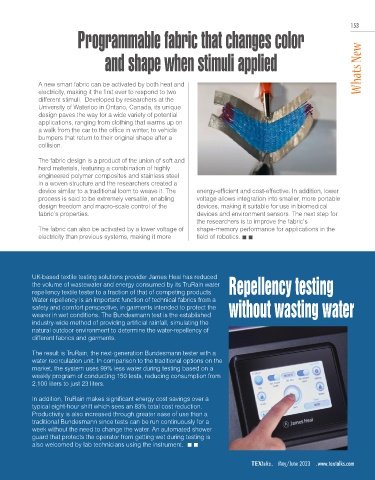
             A new smart fabric can be activated by both heat and
             electricity, making it the first ever to respond to two
             different stimuli.  Developed by researchers at the
             University of Waterloo in Ontario, Canada, its unique
             design paves the way for a wide variety of potential
             applications, ranging from clothing that warms up on
             a walk from the car to the office in winter, to vehicle
 Apparel brand Lululemon has announced a partnership with enviro-tech startup Samsara Eco, headquartered   bumpers that return to their original shape after a
 in Sydney, Australia. The company’s technology uses enzymes that attack complex plastic polymers and revert   collision.
 them back to their original monomer chemical building blocks.
             The fabric design is a product of the union of soft and
 The multi-year collaboration is based on scaling up textile-to-textile recycling and Samsara Eco creating the   hard materials, featuring a combination of highly
 world’s first infinitely recyclable nylon 6.6 and polyester made from apparel waste.  engineered polymer composites and stainless steel
             in a woven structure and the researchers created a
 Plastic waste is sourced and prepared for recycling by cold washing with hard plastics chipped and textiles   device similar to a traditional loom to weave it. The   energy-efficient and cost-effective. In addition, lower
 shredded, prior to the enzymatic depolymerization. To prepare the brand-new monomers for re-manufacture   process is said to be extremely versatile, enabling   voltage allows integration into smaller, more portable
 into new plastics and fibers, they are then separated from any other additives, such as colorants. This is a   design freedom and macro-scale control of the   devices, making it suitable for use in biomedical
 game-changer compared to traditional recycling, which cannot recycle colored plastics or mixed bales, the   fabric’s properties.  devices and environment sensors. The next step for
 company says. Nylon and polyester make up roughly 60% of the clothing produced today.  the researchers is to improve the fabric’s
             The fabric can also be activated by a lower voltage of   shape-memory performance for applications in the
 The ability to infinitely recycle textiles, including nylon, is an essential solution to tackling the enormous   electricity than previous systems, making it more   field of robotics.
 challenge of textile waste in the apparel industry. The agreement marks Samsara Eco’s first partnership within
 the apparel industry following its $56 million Series A funding last year, as it pursues the aim of recycling 1.5
 million tons of plastic annually by 2030.

           UK-based textile testing solutions provider James Heal has reduced
 Printed sensors take   repellency textile tester to a fraction of that of competing products.  Repellency testing
           the volume of wastewater and energy consumed by its TruRain water
           Water repellency is an important function of technical fabrics from a
 the lead in e-textiles   wearer in wet conditions. The Bundesmann test is the established  without wasting water
           safety and comfort perspective, in garments intended to protect the

           industry-wide method of providing artificial rainfall, simulating the
           natural outdoor environment to determine the water-repellency of
 Eliminating all wires for substrates with circuits that   The element is printed onto a transfer sheet, which   different fabrics and garments.
 are thin, light, stretchable, cost-effective, washable,   can then be heat pressed onto the seat material
 and comfortable. Atlantic Therapeutics, based in   before the transfer is peeled off. The use of a   The result is TruRain, the next-generation Bundesmann tester with a
 Galway, Ireland, has established the Innovo brand as   reflective layer makes the heating element highly   water recirculation unit. In comparison to the traditional options on the
 the leading innovation in non-invasive, wearable   efficient, with its effect felt in a matter of seconds   market, the system uses 99% less water during testing based on a
 neuromuscular electrical stimulation. The pants act to   once turned on.  weekly program of conducting 150 tests, reducing consumption from
 strengthen the pelvic floor and thereby treat the   2,100 liters to just 23 liters.
 underlying cause of bladder weakness.  The potential use cases in interior applications are
 endless, and Conductive Transfers used a steering   In addition, TruRain makes significant energy cost savings over a
 “The company’s printable seat heating elements use   wheel with sensors applied to show how they can be   typical eight-hour shift which sees an 83% total cost reduction.
 a positive temperature coefficient ink, which means it   used for HOD (hands-on driving) detection as part of   Productivity is also increased through greater ease of use than a
 is self-regulating,” explained the company’s   ADAS integration. Many other med-tech businesses   traditional Bundesmann since tests can be run continuously for a
 commercial director, Mark Catchpole. “We have also   and researchers globally to bring new medical smart   week without the need to change the water. An automated shower
 put a reflective layer into the stack of ink, with the   garments with valuable sensing and treatment   guard that protects the operator from getting wet during testing is
 whole element just 0.1mm thick.”  technologies to market.  also welcomed by lab technicians using the instrument.

 May/June 2023                                                                           May/June 2023

