


Page 149 - TEXtalks. May-June 2023
P. 149
148                                                                                                            149
                      Denim jeans produced from


 First CO2 dyeing plant in Europe  sustainable materials


                  Pakistani denim company Naveena Denim (NDL) has launched Swift n’ Sway, a range of denim with
                    Tencel-branded lyocell from Lenzing at their core, designed to offer both fashion and function.

              Naveena Denim Limited is known for its innovative designs, high-quality products, and exceptional customer
             service. They have a strong customer base in Pakistan and also export their products to other countries around
              the world. The company has received numerous awards for its contribution to the textile industry in Pakistan
                                    and for promoting sustainable practices in its operations.


 Circotex, a new sustainable dyeing and finishing company based in Hoofddorp, The Netherlands, and   Importantly, the presence of Tencel lyocell gives Swift n’ Sway fabrics inherent moisture-wicking, absorbing, and
 Borgstena Textile of Nela, Portugal, have teamed up to develop a complete water-free dyeing process for   cooling performance properties, “to keep skin and jeans at equilibrium,” NDL explained. The use of “all-natural”
 automotive textiles. Circotex was founded by experienced entrepreneur Reinier Mommaal, who has   and biodegradable, wood-based fibers further show how polyester can be effectively designed out of
 worked in the sustainable textile production industry for over 12 years. The process will reduce water   denim-making.
 consumption to zero, eliminate the use of additive chemicals for the dyeing process and reduce the
 overall carbon footprint.  Tested to different degrees of washing, to be certain of their moisture management efficacy, the fabrics retain
                                         the soft hand feel expected of lyocell blends.
 Circotex is aiming to use the best available technologies for a water-free process. For the dyeing
 process, they will initially use the CO2 dyeing technology developed by DyeCoo Textile Systems also
 from The Netherlands.  Circotex is finalizing the tests with technologies and eliminating water use for the
 scouring and reduction-clearing process.  Polymers for personal hygiene fabrics

 Over the past two years, the two companies have conducted numerous tests for the CO2 dyeing process
 together with Circotex partner Yeh Group in Thailand.  Newly-developed dyes and UV absorbers have   made from waste and residue
 been tested according to the standards used in the automotive industry. Circotex now plans to build
 Europe’s most sustainable polyester textile coloring factory in the Amsterdam region, with an initial focus   Borealis Bornewables™ polymers for personal
 on the automotive and technical textile markets. Circotex now plans to build Europe’s most sustainable   hygiene fabrics help PFNonwovens Group accelerate
 polyester textile coloring factory in the Amsterdam region, with an initial focus on the automotive and   its journey towards climate neutrality. Bornewables
 technical textile markets.  can be used as direct drop-in replacements for
             comparable fossil-based polyolefins and in PFN’s
             nonwoven production required no changes to the
             existing manufacturing process while delivering the
             same high quality and performance as
 Kaleido 3 Outdoor; Low energy and an all-weather solution  non-renewable virgin materials.


             Borealis has adopted the mass balance approach for
 E Ink, the Billerica, Massachusetts-based pioneer of   on black and white electronic paper film to provide   its renewable and chemically recycled polymers to
 ePaper technology, is introducing Kaleido 3 Outdoor,   4,096 color options, without the need for expensive,   provide products addressing climate change and
 a new print-color ePaper designed specifically for   high-energy-consuming heating or cooling devices.   circularity. The approach allows manufacturers to
 outdoor advertising signage in temperatures ranging   When used for outdoor information displays, it also   trace the exact share of sustainable feedstock
 from –15°C to 65°C. Many European countries are   allows for quick and easy information updates and is   allocated to their products and ISCC PLUS
 facing an energy crisis and new regulations have been   much more functional and environmentally friendly   certificates are audited annually to ensure that all
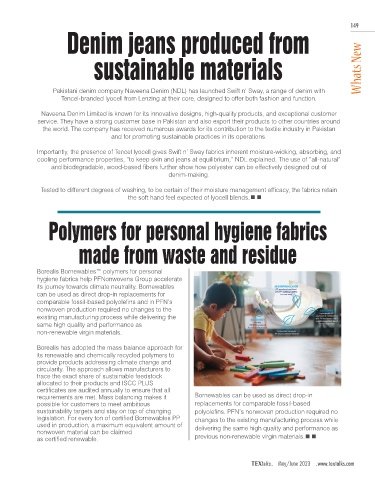
 put in place to limit the operating hours of digital   than traditional paper posters and display boards.  requirements are met. Mass balancing makes it   Bornewables can be used as direct drop-in
 signage. E Ink Kaleido 3 Outdoor, however, uses very   possible for customers to meet ambitious   replacements for comparable fossil-based
 little power and can even run on renewable energy from   It is working towards the global trend of low-carbon   sustainability targets and stay on top of changing   polyolefins. PFN’s nonwoven production required no
 solar panels.  and sustainable digital development, ePaper’s   legislation. For every ton of certified Bornewables PP   changes to the existing manufacturing process while
             used in production, a maximum equivalent amount of
 ultra-low power consumption and non-light pollution   nonwoven material can be claimed   delivering the same high quality and performance as
 It offers dynamic color display capabilities and   characteristics make it a viable option to display   as certified renewable.  previous non-renewable virgin materials.
 poster-like visual quality via an RGB color filter array   solution for outdoor advertising signage.

 May/June 2023                                                                           May/June 2023

