


Page 75 - TEXtalks. May-June 2023
P. 75
74                                                                                                             75
            Create new effects and designs                    a process development company specifically for the
            Contactless rotor spray dyeing opens up completely   textile industry. RotaSpray is a 100% member of the
            new possibilities in fashion design - directly in the   WEKO Group who is manufacturing rotor spray
            dyeing process. For example, one-sided dyeing or   application systems and spray nozzle systems for
            overdyeing without penetration. Multicolor dyeing   powders for diverse industries such as Nonwoven,
            uses several dyes in one liquor or one after the other   Textile, Paper, Tissue, wood panel boards, Foils,
            (dye baths are without contact and remain         metal, and many more. Both companies together
            contamination-free). Deliberate creation of vintage,   offer you the latest spray dyeing and spray finishing
            salt & pepper, slub yarn look, and much more only by   technologies for textile processing with in total more
            varying the spray parameters. Open up new
            possibilities for your customers.                 than 400 installations worldwide in the textile market.
                                                              In finishing the companies offering solutions for
            Small scrap                                       stenter frame lines to substitute the padding process
            Due to the larger number of spray points,         and work with strongly reduced pick-up on the same
            homogeneous dyeing is produced without tailing or   quality result.
            side-center variations. Due to the non-contact
            application, liquor contamination, different      ITMA 2023
            substantivity behavior of the dyes, or even possible   Experience the new rotor spray dyeing and finishing
            hydrolysis do not play a role. In particular, the   method live at ITMA 2023 and visit us at RotSpray /
            separation of certain processes ensures a stable and   WEKO booth B103 in hall 14. The team looks forward
            easily reproducible result.                       to having a coffee with you!

            Who is RotaSpray?                                 Contact: RotaSpray GmbH . Tobias Schurr
            RotaSpray GmbH is a German machinery              info@rotaspray.de . www.rotaspray.com
            manufacturer of rotor spray application systems and   www.weko.net
 Today's processes often have the problem that small   Today's standard - Pad-Dry-Pad-Steam process for
 lots can't be produced cost-efficiently because the   fabric
 start-up scrap is too high and the preparation   The Pad-Dry-Pad-Steam process (PDPS) is
 sometimes takes too long.  considered the worldwide standard in continuous
 dyeing with reactive and vat dyes and is very widely
 With the latest German developments of the   used in the main textile countries for mass
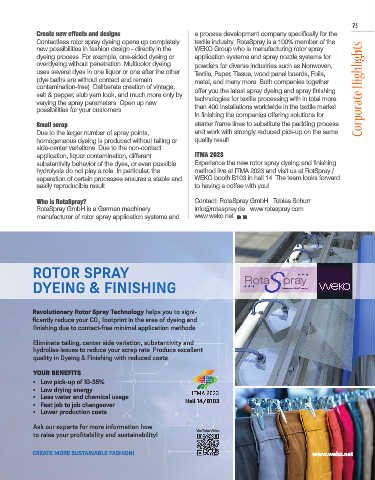
 RotaSpray PS² process, the continuous dyeing   production. The PDPS process covers the entire   ROTOR SPRAY
 process is rethought and enables sustainable, easily   color space in all color depths. In Europe, this   Rota  pray
 reproducible, and waste-minimized production.   process can hardly be used economically anymore   problems and high wastewater treatment costs.  excellent transfer from laboratory to production.  DYEING & FINISHING  Member of WEKO Holding
 Especially for reactive, VAT and disperse dyes.  due to the ever-decreasing batch sizes. Because this
 process is not suitable for small-lot production   The new standard - PS² (Pad-Spray-Steam) for fabrics  Short steaming time and salt-reduced to salt-free
 Due to the non-contact rotor spray application, dyes   because of a strong tendency for tailing at the start of   Instead of the two-bath application of dye and fixation   production  Revolutionary Rotor Spray Technology helps you to signi-
 and auxiliaries are applied homogeneously on one or   each batch. Also, it is a very energy-intensive   bath with energy-intensive intermediate drying   To increase reactivity, it is possible to increase the   ficantly reduce your CO  footprint in the area of dyeing and

                                2
 both sides. The penetration level can be adjusted by   process based on intermediate Thermosol   (Thermosol), the rotor spray process can be used to   alkalinity of the alkali by up to one pH level compared   finishing due to contact-free minimal application methode.

 using the flexible rotor spray parameters and the   processing. The high amounts of salt used in the dye   apply the respective fixing bath directly after the dye   to the standard recommendation. This allows
 selection of the correct auxiliaries as required.  recipe for reactives lead to additional ecological   bath without intermediate steps - because the   reduced steaming time by up to -50%. Keep in mind   Eliminate tailing, center side variation, substantivity and
 non-contact application means that the dye remains   the overall footprint of a PS² line is much more   hydrolise issues to reduce your scrap rate. Produce excellent
 stable on the fabric and the fixing chemistry is not   compact and investment is far less than in a   Tobias Schurr. Sales and Marketing Director. Weitmann & Konrad GmbH & Co. KG. Germany  quality in Dyeing & Finishing with reduced costs.
 contaminated or affected in any way. This helps to   conventional PDPS line. A so-called dilution effect
 drastically reduce energy costs and CO² emissions.  due to padder and wet-on-wet spray application and   Reduced migration tendency, better long-term quality  the use of water, wastewater, energy auxiliaries, and   YOUR BENEFITS
 time are parallel resulting in a cost-cutting industrial
 an associated loss of fixing yield in deeper shades   The lack of intermediate drying additionally reduces   dyeing process with lower CO² emission.
 Small scrap  should not become unmentioned here. This loss of   the migration tendency of the dyes to the surface of   •   Low pick-up of 10-35%
 In addition the PS² process is mainly characterized   yield in darker shades can be compensated by   the fabric and leads to a better full-body dyed quality.   •   Low drying energy
 by the minimization of the tailing during the start-up   adding only a small amount of Glauber's salt (up to   After several household washes, this effect turns out   After use, only 8 - 25 l of fluid has to be emptied, but   •   Less water and chemical usage  Hall 14 / B103
 of the dye set. These are mainly caused by hydrolysis   to be very positive.  this is not contaminated by the WEKO process and,   •   Fast job to job changeover
 and substantivity effects with reactive dyes and are   80 g/l) to the spray liquor. Light to medium shades   depending on the type, can possibly be re-used.  •   Lower production costs
 almost unavoidable despite optimum dye selection in   are dyed salt-free. In general, the leachability of the   Sustainable spray dyeing solution
 the classic pure padder process. In the PS² process,   reactive dyes in the PS² process is greatly improved   With the latest developments of RotaSpray and   Especially for large dye baths as in the DENIM   Ask our experts for more information how   YouTube Video

 tailing can be reduced from up to 200 m in padding   by the reduced salt load, thus reducing water   WEKO, the entire dyeing process is revolutionized   slasher area, the water reprocessing plants can also   to raise your profitability and sustainability!
 down to 2-20 m in rotor spray technology with   consumption.  and made more sustainable. A strong reduction in   be massively relieved.
           CREATE MORE SUSTAINABLE FASHION!                                                        www.weko.net
 May/June 2023

