


Page 56 - November-December-2017
P. 56
56 57
Limits & Problems of Past Years
Skiing Swimwear Inlet Blouse Trousers Coat Kintwear Pyjamas Skirt Blazer Underwear
anorak
REVOFIX WET forms a film around the fibre - Finishing
3 3 3 3,5 3 3 3,5 3
Rubbing preventing thus the abrasion of fibre/dye. - Moisture when rubbing
Dry 4 4 4 4 4 4 4 4 4 4 4
Fastness
The fastness to light, washing and contact of the The examinations have shown that poor rubbing
Rubbing 4 4 4 4,6 4 4 4,6 4 treated textiles are not impaired and the shade fastnesses are not only caused by abraded dye, but
Wet 3 3-4 3 3-4 3-4 3-4 3-4 3-4 3-4 3-4 3-4 intensification is tolerable. The handle of the fabric is also by abraded fibre material, especially from
Fastness
REVOFIX WET *Staining This is the table of a document: The fastness demands of Foot note! REVOFIX WET forms a film around the fibre dyeings/prints: A poor wet rubbing fastness strongly
natural fibres. The following applies for some
hardly impaired by the application of REVOFIX WET.
tends to a wash-out effect, especially with multiple
preventing the color abrasion and at the same time
3 = for full colours grade 3
the clothes manufacturers had to be marked with footnotes.
4 = for full colours grade 2-3 !
reduces the fibre abrasion. This results in a perfect
washings.
6 = for denim grade 2
Fixing agent for revolutionary All of the amazing technologies are brought together Limits & Problems of Past Years interplay of elasticity, adhesion and formation of a Recommendations for use
gliding film.
The product is applied with the exhaust process from
All of the amazing technologies are brought together
a fresh bath after dyeing. Work at a liquor ratio of
REVOFIX WET can be applied for the after-treatment
with an excellent environmental compatibility.
Limits and Problems of Past Years
with an excellent environmental compatibility.
rubbing fastness properties REVOFIX WET reduces the colour abrasion from CO/PES disperse/vat woven wear colour black: Wet of dyeings and prints and is universally applicable 1:10 with 3.0 - 5.0 % REVOFIX WET. The optimal pH
REVOFIX WET reduces the colour abrasion from
CO/PES disperse/vat woven wear colour black:
value is between 5.0 and 5.5. The process is carried
- Fixing agent for dyeing cellulose fibres, synthetic
dyed cellulose fibres, synthetics and their blends.
dyed cellulose fibres, synthetics and their blends.
Dry
Wet
Wet
Dry
out for 20 minutes at 40 °C.
Dry
Dry
Wet
fibres and their blends
The innovative fixing agent of the CHT Group
The innovative fixing agent of the CHT Group
increases the wet rubbing fastness of dyeing nearly
increases the wet rubbing fastness of dyeing nearly
- For reactive, vat, sulphur, dispersion dyes and
by up to two grades. It not only increases the fabric 4-5 4-5 2-3 2-3 - Wet rubbing fastness increases by up to 2 grades In the padding process we recommend a liquor
by up to two grades. It not only increases the fabric
quality, but also the coolness of your customers. pigments pick-up of 60 - 100 % at an application amount of 30
quality, but also the coolness of your customers.
- Applicable by exhaust and continuous procedures - 60 g/l REVOFIX WET and a pH value of 5.0 - 5.5.
The right path to innovation For utmost dyeing processes we recommend the
The right path to innovation
CO/EL knitwear colour black
Aside from the dye class and colour depth, the CO/EL knitwear colour black The environmental compatibility of REVOFIX WET is addition of the following products:
Aside from the dye class and colour depth, the
rubbing fastness also depends on the following Dry Wet Dry Wet self-speaking. The product fulfils the demands of
rubbing fastness also depends on the following
factors: Dry Wet Dry Wet Oeko-Tex® and ZDHC MRSL and is also bluesign® 1- REWIN ACP increases the washing and wet
factors:
- Substrate (polyester, cotton,....) approved. fastness properties on dyeings with reactive and
- Substrate (polyester, cotton,....)
- Material structure (smooth fabric, knitwear,....) 5 2-3 direct dyes on natural and regenerated cellulose
- Material structure (smooth fabric, knitwear,....)
- Dyeing process 5 2-3 Performance of REVOFIX WET: fibres. REWIN ACP meets the highest fastness
- Dyeing process
- Post-treatment While talking about the performance of the REVOFIX demands presently made on a cationic
- Post-treatment
- Finishing Limits and Problems of Past Years WET; With REVOFIX Wet, wet friction produces a after-treatment agent.
- Finishing
- Moisture when rubbing gliding film: after applying the product, the textile is 2- BEIZYM SPELL to avoid fibre abrasion. Cellulase
- Moisture when rubbing
Limits & Problems of Past Years
CO/PES woven wear covered by a surface film which adheres to the textile mixture for bio-finish on CO and CV with magical
Vat/disperse Dry Wet Dry Wet
Examinations have shown that poor rubbing due to its specific product properties. The dry film is spectrum and with lint dispersing and hydrophilic
Examinations have shown that poor rubbing
fastnesses are not only caused by abraded dye, but CO/PES woven wear 4-5 2-3 elastic and therefore gives the textile a mechanical effect.
Without
fastnesses are not only caused by abraded dye, but
aftertreatment
also by abraded fibre material, especially from protection. Wet friction produces a gliding film that 3- COTOBLANC PCS removes non-fixed reactive dyes
also by abraded fibre material, especially from
natural fibres. Vat/disperse 1.5 grades ! Dry Wet Dry Wet reduces the friction between the textile and the from cellulose substrates. The product has the
natural fibres.
5.0% REVOFIX WET 4-5 4 friction body. While on the other hand Dye and fibre feature to hold back the hydrolysate in the bath and
30 min at 40o C
The following applies for some dyeings/prints: A poor abrasion are greatly reduced by these specially to prevent its reabsorption. A special property of
The following applies for some dyeings/prints: A poor
wet rubbing fastness strongly tends to a wash-out Without 4-5 4-5 2-3 designed product properties, dry and especially wet, COTOBLANC PCS is its efficiency also in the presence
wet rubbing fastness strongly tends to a wash-out
50g/l REVOFIX WET
4
aftertreatment
Padding
effect, especially with multiple washings. thus improving the rubbing fastnesses. of electrolytes such as residual salt and alkali.
effect, especially with multiple washings.
4- ARRISTAN 71 is a high-grade softener for an
1.5 grades !
REVOFIX WET is a revolutionary masterpiece for; CO/EL knitwear Dry Wet Dry Wet According to the manufacturers the REVOFIX WET is excellent handle. The following properties stand out
REVOFIX WET is a revolutionary masterpiece for;
Reactive
- All major dye classes: reactive, sulphur, vat, 5.0% REVOFIX the right path to innovation, side from the dye class for ARRISTAN 71:
- All major dye classes: reactive, sulphur, vat,
Without
pigment dyes
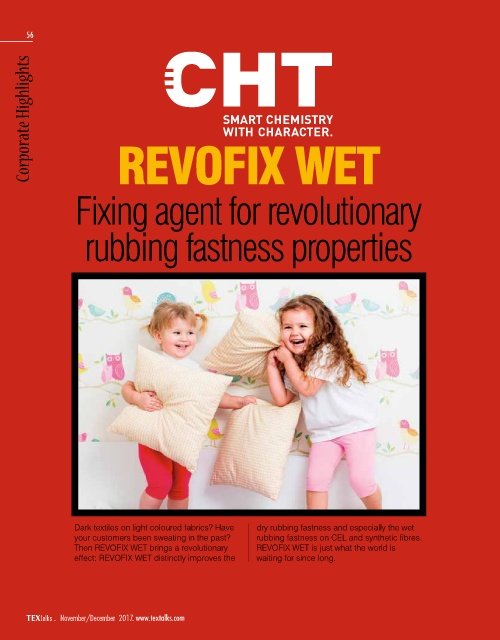
Dark textiles on light coloured fabrics? Have dry rubbing fastness and especially the wet pigment dyes WET o 5 4-5 2-3 4 and colour depth, the rubbing fastness also depends - very soft, flowing handle with distinct surface slip
aftertreatment
on the following factors:
- outstanding resistance to yellowing and therefore
30 min at 40 C
- On various fibre types
your customers been sweating in the past? rubbing fastness on CEL and synthetic fibres. - On various fibre types 1 grade ! - Substrate (polyester, cotton,....) particularly suited for ultra-white articles
- No impact on the other fastnesses and on the
Then REVOFIX WET brings a revolutionary REVOFIX WET is just what the world is - No impact on the other fastnesses and on the 5.0% REVOFIX WET 5 3-4 - Material structure (smooth fabric, knitwear,....) - improves the resilience of knitwear
handle
30 min at 40o C
effect: REVOFIX WET distinctly improves the waiting for since long. handle 50g/l REVOFIX
- Hardly any impact on the shade WET 4-5 4 - Dyeing process - improves the sewability and thus further processing
- Hardly any impact on the shade
- Improves the wet rubbing fastness by up Padding 5 3-4 - Post-treatment of textiles
50g/l REVOFIX WET
- Improves the wet rubbing fastness by up
Padding
to 2 grades
to 2 grades
November/December 2017 November/December 2017

