


Page 79 - October-November-2017
P. 79
78                                                                                                             79
            select the appropriate certified fabric to meet their needs.  each IP-protected index. As a result, designers will be
 such compounds is questionable with respect to   Fabric goes through a rigorous testing process to   able to create the perfect casual bra that delivers the   Whats New
 Whats New  Hohenstein Group reports.  apparel reduces labor by 50%
                                                              shape and support women need, and the comfort
 possible adverse ecological and toxicological
            ensure it meets the predetermined parameters of
                                                              they want, the company explains.
 effects. In addition, these compounds are
 generally expensive, said is so by the
 A new research project at the Hohenstein Group
                        Gerber’s AutoMatch™ for
 deals with antimicrobial effects of Lewis acids
 that are applied on textile surfaces. According to
 the information provided by the group, the
 results of this work may significantly contribute to
 countermeasures against multi-resistant bacteria
 as found, for example, in medical facilities.

 Lewis acids exhibit an acidic surface effect and
 an antimicrobial effect has been demonstrated
 as well. Therefore, these compounds can
 already be found in applications such as the
 cleaning of floors in hospitals. However, they
 have not been applied on textile surfaces. In
 presence of moisture, Lewis acids (metal oxides,
 New   e.g. zinc oxide) generate low pH-values on their
 surfaces resulting in antimicrobial effects
 antimicrobial   comparable to the natural protective acid mantle
 of human skin.
 solution for   Compared to commercially available
 antimicrobial substances, Lewis acids have
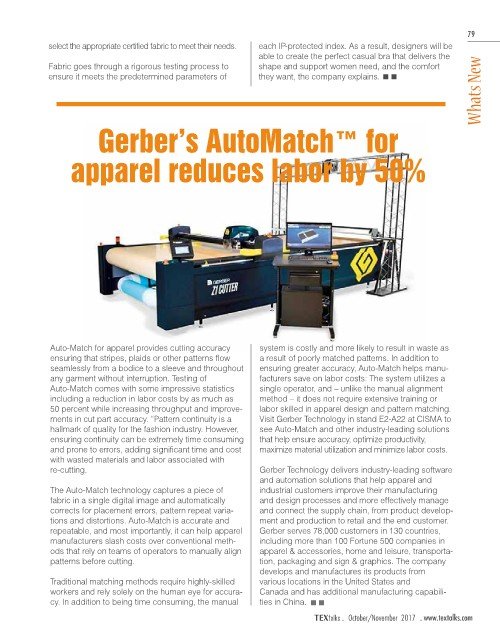
 textiles  proven to be useful against different pathogens   Auto-Match for apparel provides cutting accuracy   system is costly and more likely to result in waste as
 like fungi, bacteria and even viruses.
                                                              a result of poorly matched patterns. In addition to
             ensuring that stripes, plaids or other patterns flow
 and stable even during exposure to human
 Anti-microbial protection is something   Furthermore, they have found to be very effective   seamlessly from a bodice to a sleeve and throughout   ensuring greater accuracy, Auto-Match helps manu-
                                                              facturers save on labor costs: The system utilizes a
             any garment without interruption. Testing of
 demanded both in professional and personal   sweat and proteins. Besides, estimations   Auto-Match comes with some impressive statistics   single operator, and – unlike the manual alignment
 life. Such effect on textile surfaces is recently   suggest that the use of Lewis acids in   including a reduction in labor costs by as much as   method – it does not require extensive training or
 achieved by using silver or ammonium   antimicrobial textile coatings may result in   50 percent while increasing throughput and improve-  labor skilled in apparel design and pattern matching.
 containing compounds. However, the use of   cost-reductions of up to 90%.
             ments in cut part accuracy. “Pattern continuity is a   Visit Gerber Technology in stand E2-A22 at CISMA to
             hallmark of quality for the fashion industry. However,   see Auto-Match and other industry-leading solutions
             ensuring continuity can be extremely time consuming   that help ensure accuracy, optimize productivity,
             and prone to errors, adding significant time and cost   maximize material utilization and minimize labor costs.
 Introducing Lycra Bra   with wasted materials and labor associated with   Gerber Technology delivers industry-leading software
             re-cutting.
 Fabric Finder  The Auto-Match technology captures a piece of   and automation solutions that help apparel and
                                                              industrial customers improve their manufacturing
             fabric in a single digital image and automatically
                                                              and design processes and more effectively manage
 Invista says it has developed the Lycra Bra Fabric   comfort and support level they need: Active fabrics   corrects for placement errors, pattern repeat varia-  and connect the supply chain, from product develop-
 Finder in response to the current consumer-driven   are meant for high support and medium comfort;   tions and distortions. Auto-Match is accurate and   ment and production to retail and the end customer.
 shift towards casual bras. Invista, owner of the   Everyday fabrics grant a mix between comfort and   repeatable, and most importantly, it can help apparel   Gerber serves 78,000 customers in 130 countries,
 original elastane Lycra fibre, aims to strengthen its   support; Leisure fabrics provide high comfort and   manufacturers slash costs over conventional meth-  including more than 100 Fortune 500 companies in
 leadership position in the intimate apparel category   medium support.  ods that rely on teams of operators to manually align   apparel & accessories, home and leisure, transporta-
 with the development of a new proprietary tool: the   patterns before cutting.  tion, packaging and sign & graphics. The company
 Lycra Bra Fabric Finder.  This is then followed by the shaping type – either   develops and manufactures its products from
 natural shaping for a softer, truer silhouette, or power   Traditional matching methods require highly-skilled   various locations in the United States and
 First of all, casual bra designers identify the desired   shaping for more defined curves. Then, they can   workers and rely solely on the human eye for accura-  Canada and has additional manufacturing capabili-
             cy. In addition to being time consuming, the manual   ties in China.
 October/November  2017                                                            October/November  2017

