


Page 85 - October-November-2018
P. 85
84  Developments in                                                                                            85


 Reports  Natural Sources


 Fibres from


                                                                                                                                                                             CRAiLAR                                          Kapok fibres in spun yarns
                                                                                                                                                                             CRAiLAR’s expertise begins with planting the seed in   Shanghai-based textile brand Flocus produces
                                                                                                                                                                             the ground and continues with every aspect of the   sustainable yarns blends, fabrics and fillings made
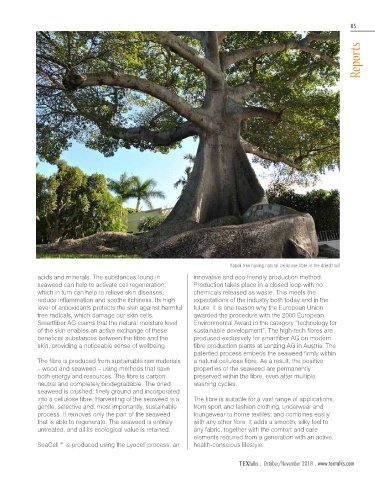
 Thinking on sustainability and textiles is ripe with   EcoVero™ fibres have been certified with the EU                                                                      production chain. Once the plants have been      with kapok, a natural cellulose fibre found in the
 misconceptions. Across the full life cycle (growing,   Ecolabel as meeting high environmental standards                                                                     harvested the fibre is mechanically stripped from the   dried fruit of the kapok tree. Kapok is the most
 manufacturing and specifically usage) natural fibres   throughout their life cycle: from raw material                                                                       stem. This raw fibre is rough and tough and definitely   sustainable fibre in the market leaving no human
 are not necessarily more sustainable than synthetic   extraction to production, distribution and disposal.                                                                  not something you would want to wear or use. The
 fibres. This report covers some of the promising   The fibres can be robustly identified in the final                                                                       fibre is then transformed via CRAiLAR’s proprietary
 sustainable options which are regenerated into fibres   product, assuring you that your purchase contains                                                                   process into a soft and fluffy fibre made up of
 or blended in the existing yarns.  genuine EcoVero™ Viscose fibres. The fibre                                                                                               thousands of individualized bast fibres. It is claimed
 generates up to 50% lower emissions and water                                                                                                                               that they resemble cotton in feel and appearance,
 EcoVero™   impact compared to generic Viscose.                                                                                                                              and outperform cotton on almost every level.
 The fibres are produced using pulp, which is derived
 from the renewable resource wood as raw material.   SeaCell™                                                                                                                Bast fibres are among the most environmentally
 Lenzing purchases wood and pulp derived from   The unique properties of seaweed can help to   Kapok tree having natural cellulose fibre in the dried fruit                  favourable crops on the planet and grow in cool
 responsibly managed forests and certified to come   protect our skin against the harmful environmental   acids and minerals. The substances found in   innovative and eco-friendly production method.   climates without the use of irrigation. The need for
 from sustainable sources. It uses an eco-responsible   influences which we are exposed to in our daily lives.   seaweed can help to activate cell regeneration,   Production takes place in a closed loop with no   chemical inputs is very low – just a fraction of other
 production process by meeting high environmental   The seaweed is pure and rich in essential   which in turn can help to relieve skin diseases,   chemicals released as waste. This meets the   annual textile crops. Bast fibres produce both food
 standards and contributes to a cleaner environment.   substances such as vitamins, trace elements, amino                                                                    and fibre – seeds of hemp and flax are widely
             reduce inflammation and soothe itchiness. Its high   expectations of the industry both today and in the                                                         consumed in food and industrial industries. CRAiLAR
             level of antioxidants protects the skin against harmful   future. It is one reason why the European Union                                                       is Compostable, USDA 100% BioPreferred and Leed
             free radicals, which damage our skin cells.      awarded the procedure with the 2000 European                                                                   Certified. It offers enhanced moisture management
             Smartfiber AG claims that the natural moisture level   Environmental Award in the category “technology for                                                      (naturally wicking), Improved abrasion resistance,
             of the skin enables an active exchange of these   sustainable development”. The high-tech fibres are                                                            Unchanged garment hand feel and drape, no static,
             beneficial substances between the fibre and the   produced exclusively for smartfiber AG on modern                                                              pilling, or lint problems, is machine wash/dryable   footprint behind. Nature has given Kapok numerous
             skin, providing a noticeable sense of wellbeing.  fibre production plants at Lenzing AG in Austria. The                                                         without being wrinkle prone, and offers improved   properties like its silky soft and dry touch of the fibre
                                                              patented process embeds the seaweed firmly within                                                              dye uptake.                                      itself, anti-moth and anti-mite properties as well as
             The fibre is produced from sustainable raw materials   a natural cellulose fibre. As a result, the positive                                                                                                      insulation properties comparable to down, and many
             – wood and seaweed – using methods that save     properties of the seaweed are permanently                                                                      Strong yet soft, CRAiLAR fibre is well suited for   others. With the most advanced technology in the
             both energy and resources. The fibre is carbon   preserved within the fibre, even after multiple                                                                denim, outerwear, footwear, towelling and upholstery.   market, FLOCUS™ can spin the highest kapok %,
             neutral and completely biodegradable. The dried   washing cycles.                                                                                               It can be blended successfully with a wide range of   offer yarns in the finest counts. Utilizing Kapok,
             seaweed is crushed, finely ground and incorporated                                                                                                              natural and synthetic fibres. In textile applications   FLOCUS™ offers products which can reduce the
             into a cellulose fibre. Harvesting of the seaweed is a   The fibre is suitable for a vast range of applications,                                                CRAiLAR fibre would generally be blended in ratios   presence of animal and synthetic products in the
             gentle, selective and, most importantly, sustainable   from sport and fashion clothing, underwear and                                                           of 20-40% with other fibres like cotton, tencel, wool,   market, utilizing a completely natural alternative
             process. It removes only the part of the seaweed   loungewear to home textiles, and combines easily                                                             etc. CRAiLAR can be used in a wide variety of    without abandoning functionality. FLOCUS™ is a
             that is able to regenerate. The seaweed is entirely   with any other fibre. It adds a smooth, silky feel to                                                     nonwoven applications, including; dry laid, needle   100% sustainable ‘open’ source textile concept in
             untreated, and all its ecological value is retained.  any fabric, together with the comfort and care                                                            punched and hydro entangled. In non-woven        which buyers can tailor blend their needs for their
                                                              elements required from a generation with an active,                                                            applications. It finds applications from industrial   sustainable collections. Kapok fruits are hundreds of
             SeaCell™ is produced using the Lyocell process, an   health-conscious lifestyle.                                                                                                                                 pods of about 15 cm each. They contain the seeds
                                                                                                                                                                             wipes, to mop heads, to felted items like insoles.  of the tree protected by a fluffy, silky and soft fibre.
 October/November 2018                                                              October/November 2018

