


Page 78 - September-October-2020
P. 78
78                                                                                                                                                                                                                              79

                   Nanomaterial-based


                   fabric coating for


                   future textiles


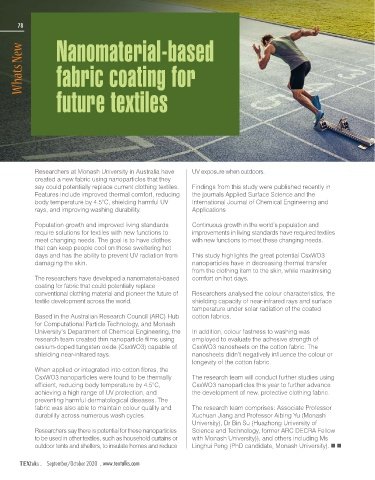
            Researchers at Monash University in Australia have   UV exposure when outdoors.
            created a new fabric using nanoparticles that they
            say could potentially replace current clothing textiles.   Findings from this study were published recently in
            Features include improved thermal comfort, reducing   the journals Applied Surface Science and the                            Nanomaterials for
            body temperature by 4.5°C, shielding harmful UV   International Journal of Chemical Engineering and
            rays, and improving washing durability.           Applications


            Population growth and improved living standards   Continuous growth in the world’s population and                             sustainable water
            require solutions for textiles with new functions to   improvements in living standards have required textiles
            meet changing needs. The goal is to have clothes   with new functions to meet these changing needs.
            that can keep people cool on those sweltering hot
            days and has the ability to prevent UV radiation from   This study highlights the great potential CsxWO3                         repellent fabrics
            damaging the skin.                                nanoparticles have in decreasing thermal transfer
                                                              from the clothing item to the skin, while maximising
            The researchers have developed a nanomaterial-based   comfort on hot days.
            coating for fabric that could potentially replace                                                                       Nanomaterials manufacturer, Promethean Particles,   on to textiles.
            conventional clothing material and pioneer the future of   Researchers analysed the colour characteristics, the         has joined a consortium of organisations to
            textile development across the world.             shielding capacity of near-infrared rays and surface                  research and develop new safe and sustainable    PFOS is a potentially toxic by-product of PFCs and
                                                              temperature under solar radiation of the coated                       water repellent fabrics.                         its use in fabrics is regulated by the European
            Based in the Australian Research Council (ARC) Hub   cotton fabrics.                                                                                                     Union. The best performing PFCs have raised
            for Computational Particle Technology, and Monash                                                                       Today, the highest level of water and oil repellency is   significant health and environmental concerns
            University’s Department of Chemical Engineering, the   In addition, colour fastness to washing was                      achieved by using highly fluorinated chemical    relating to the loss of fluorinated by-products from
            research team created thin nanoparticle films using   employed to evaluate the adhesive strength of                     substances. However, increased concern and       textiles throughout a fabric’s life cycle. Promethean
            cesium-doped tungsten oxide (CsxWO3) capable of   CsxWO3 nanosheets on the cotton fabric. The                           heightened regulation of perfluorocarbons and    says its market-disrupting continuous-flow
            shielding near-infrared rays.                     nanosheets didn’t negatively influence the colour or                  polyfluoroalkyl substances (PFCs and PFASs) is   production process means the nanoparticles
                                                              longevity of the cotton fabric.                                       leading the textile industry to seek alternative   manufactured are reproducible on a large scale,
            When applied or integrated into cotton fibres, the                                                                      chemistries that are more sustainable.           without affecting performance and quality.
            CsxWO3 nanoparticles were found to be thermally   The research team will conduct further studies using                                                                   Thousands of litres in output can be achieved,
            efficient, reducing body temperature by 4.5°C,    CsxWO3 nanoparticles this year to further advance                     The four other partners involved in the Innovate   generating a huge reduction in production costs
            achieving a high range of UV protection, and      the development of new, protective clothing fabric.                   UK-funded project, REPETEX, are North West       compared to a batch process, that can be passed
            preventing harmful dermatological diseases. The                                                                         Textiles Network, Manchester Manufacturing Group,   to textile manufacturers, the company adds.
            fabric was also able to maintain colour quality and   The research team comprises: Associate Professor                  Mexar and The Welding Institute (TWI).
            durability across numerous wash cycles.           Xuchuan Jiang and Professor Aibing Yu (Monash                                                                          The water repellent technology being developed as
                                                              University), Dr Bin Su (Huazhong University of                        As part of the project, Promethean Particles is   part of the REPETEX project is primarily for cotton,
            Researchers say there is potential for these nanoparticles   Science and Technology, former ARC DECRA Fellow            developing functionalised silica (silicon        polyester and cotton-polyester blends but if shown
            to be used in other textiles, such as household curtains or   with Monash University)), and others including Ms         dioxide) nanoparticles that can be incorporated   to be successful, it could be adapted for a wider
            outdoor tents and shelters, to insulate homes and reduce   Linghui Peng (PhD candidate, Monash University).             into a water-based ink for digitally printing    range of fabrics in the future.

                September/October 2020                                                                                                                                                                    September/October 2020

