The Japanese machinery manufacturer will highlight high-speed air-jet spinning, flexible automatic winding and lower-impact equipment manufacturing as mills seek productivity gains and reduced operating costs.
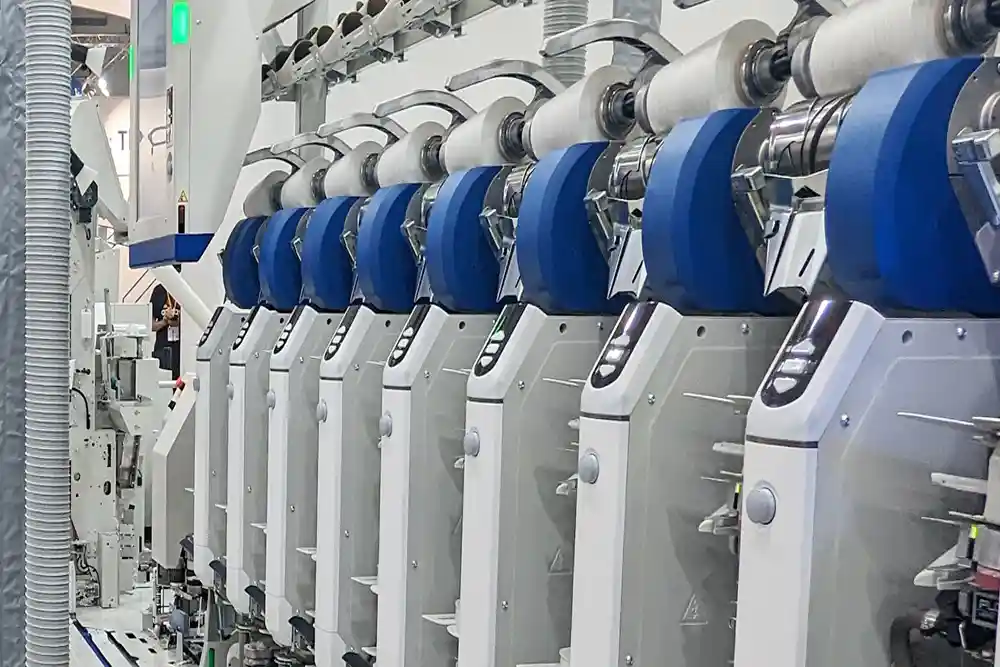
Japanese textile machinery manufacturer Murata Machinery will showcase its PROCESS CONER AIcone automatic winder and VORTEX 870 EX spinning machine at ITMA Asia + CITME 2026, scheduled for November 20–24 in Shanghai, China.
Exhibiting in Hall 5, Booths E01 and E02, the company will emphasise manufacturing flexibility, automation and energy efficiency under its “Right Choice, Bright Future” theme.
AIcone Targets Energy Savings and Faster Changeovers
The PROCESS CONER AIcone incorporates a higher-efficiency electrical converter and optimised standby motor currents to reduce electricity losses.
Its modular winding-unit design accommodates both drum-traverse and arm-traverse systems on the same machine, enabling different package configurations.
A unified operating interface and expanded Visual Operating System (VOS) controls simplify lot changes and reduce manual adjustments.
Murata has also modified equipment manufacturing. Replacing aluminium with resin in an intermediate casing reduces associated production-stage CO₂ emissions by 85%, according to the company.
Separately, an energy-efficient laser welding process is expected to reduce manufacturing emissions by approximately 380 tonnes annually.
VORTEX 870 EX Reaches 550 Metres per Minute
The VORTEX 870 EX offers maximum spinning speeds of 550 metres per minute, depending on fibre composition and yarn count.
It processes cotton, synthetic fibres and blends across a count range of Ne 10–80.
The optional POLYMASTER system improves processing flexibility for challenging synthetic materials, particularly 100% polyester.
A filament-core yarn attachment enables specialised yarn constructions by combining continuous filament cores with staple-fibre coverings.
Standard automation includes yarn-quality monitoring, automatic waste-fibre extraction, doffing and package conveying.
Productivity Becomes the Investment Test
For spinning mills, these technologies offer opportunities to reduce labour requirements, improve machine utilisation and diversify yarn production.
However, Murata’s manufacturing-stage carbon savings should not be confused with reductions in a customer’s operating emissions.
The decisive investment measures will be electricity consumption per kilogram of yarn, achievable production speeds, yarn quality, maintenance costs and total investment payback.
Murata has not disclosed machine prices or comparative commercial operating-cost figures for the exhibition configurations.