

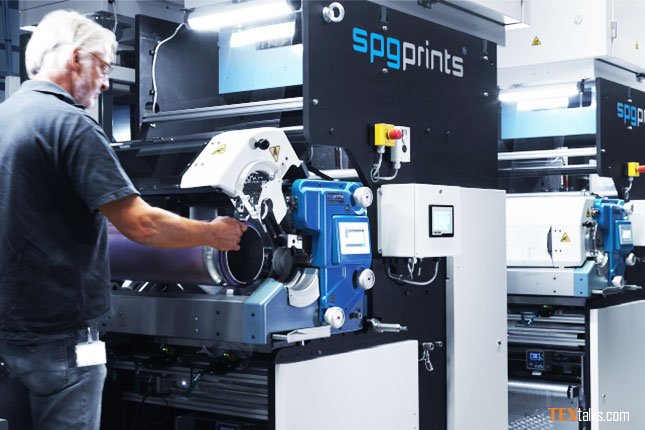
Due to the immense pressure COVID-19 puts on societies worldwide, pharmaceutical companies strive to make rapid test devices available to the public as soon as possible. However, to do so, innovative techniques have to be used to meet the necessary medical requirements. Due to their experience with biosensors and their reputation of creating foolproof, reliable systems, SPGPrints was asked to be involved in the development and delivery of several production lines to produce COVID-19 rapid test strips. Millions of test strips are expected to be produced on both production lines, in which way SPGPrints contributes to a solution for the increased global demand for more test capacity.
The use of biosensors in rapid medical testing
Hank Guitjens, Commercial Manager Label & Industrial printing at SPGPrints explains that the usage of biosensors around the world is not new. For over 30 years, biosensors are a quick tool for analyzing diseases, using just a strip and body fluids. A common application of biosensors in the medical industry is the glucose test strips for diabetes patients. They use these strips to test if their blood sugar levels are deviating from normal.
These biosensor test strips contain an advanced piece of technology. The film used for the test strips must be printed in such a way that it can absorb the body fluid and provide the optimal conditions for this reagent to react with the body fluid. SPGPrints specializes in and holds the correct innovative technique to print the film with the level of precision that is required for these test strips.
The creation of COVID-19 rapid test devices
For this exact reason, SPGPrints was invited by an international pharmaceutical company to be involved in the production of COVID-19 rapid test strips. The goal was to produce a diagnostic test system that — with use of a patient’s saliva — could quickly indicate if a patient suffered from COVID-19 or not. In this international cooperation, it was up to SPGPrints to develop a process for printing on film. In the printing process, high levels of accuracy were crucial since the newly developed chemical reagent could only function properly under optimal conditions.
The collaboration turned out to be very successful. Within less than a year, SPGPrints managed to develop, produce and deliver a custom-made system for their pharmaceutical partner. Despite it being a new, custom-made system, the startup phase was very successful, and a yield was achieved above expectation within weeks. On top of that, newly hired operators needed limited training due to the user-friendliness of the system. Which means the partner could start producing directly. This enabled the pharmaceutical partner to reach their ideal production levels within weeks after the new system had been delivered. Due to a close collaboration between SPGPrints and the client, millions of test strips are expected to be produced in the upcoming months.

