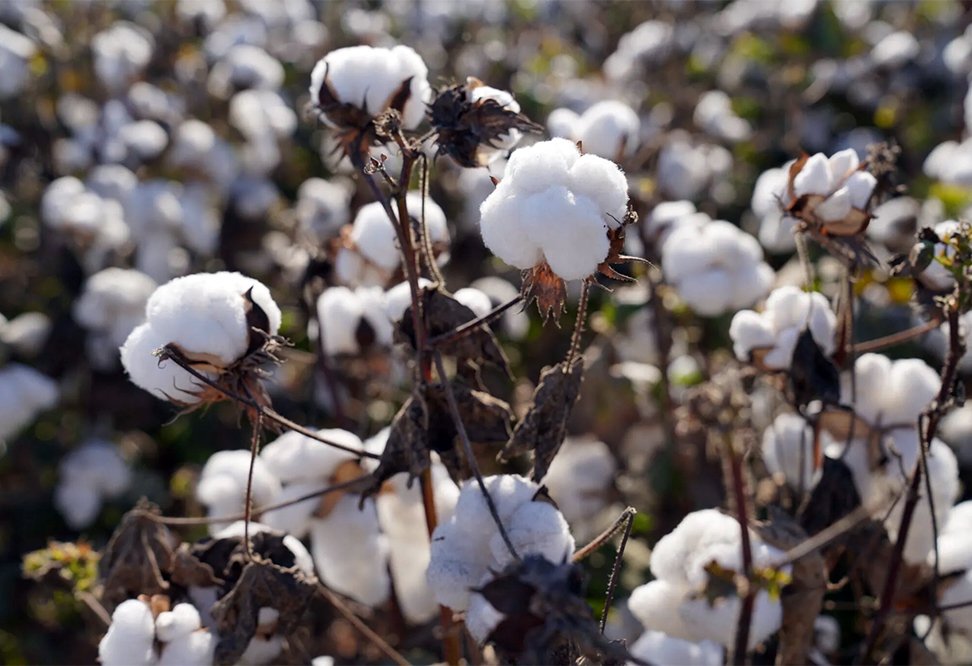
First field-level results from the U.S. Cotton Trust Protocol’s regenerative programme link verified farming practices with carbon, soil and water outcomes that brands can trace to individual cotton bales.
The U.S. Cotton Trust Protocol has released the first measured outcomes from U.S. Regen Cotton, showing lower greenhouse-gas emissions, substantially reduced soil erosion and stronger irrigation efficiency compared with programme baselines. The 2025/26 pilot covered 59,094 harvested acres, 469 fields and 33 growers across seven major US cotton-growing states.
Carbon and soil gains quantified
U.S. Regen fields produced cotton with 20% lower greenhouse-gas emissions, at 1.73 lb CO₂e per lb of cotton versus a 2.17-lb baseline. Modelled soil-carbon storage was 30% higher, at 0.60 versus 0.46 lb CO₂e stored per lb of cotton.
Annual soil loss fell 75%, from 8.9 to 2.2 tonnes per acre, while irrigation water-use efficiency improved 49%, from 0.015 to 0.022 lb of cotton per cubic foot of irrigation water.
The baseline for reductions uses wider Trust Protocol data, including fields without soil-health practices; carbon-removal comparisons use a national MRV dataset containing both regenerative and non-regenerative systems.
Practices move into measurable outcomes
Among participating growers, 91% used reduced-tillage or no-till systems, 56% planted cover crops and 91% applied precision and/or 4R nutrient-management practices. All participating fields were digitally mapped and linked to FSA farm numbers.
The programme combines field data with satellite monitoring and scientific models. Cotton is also traceable to the bale through a USDA-authenticated Permanent Bale Identification number, allowing participating brands to connect sourcing with field-level environmental data and potentially use it for Scope 3 reporting.
Pakistan competitiveness takeaway
The development raises the benchmark for what “regenerative cotton” increasingly means: not simply prescribed practices, but quantified outcomes plus traceability.
For Pakistan, the strategic response should be to build comparable systems linking farm → bale → gin → yarn → fabric, supported by credible MRV for water, fertiliser, soil carbon, pesticide use and GHG emissions.
As buyers demand product-level evidence, cotton-producing countries that can convert farm sustainability into verified, transferable data will hold a stronger position in premium sourcing programmes.