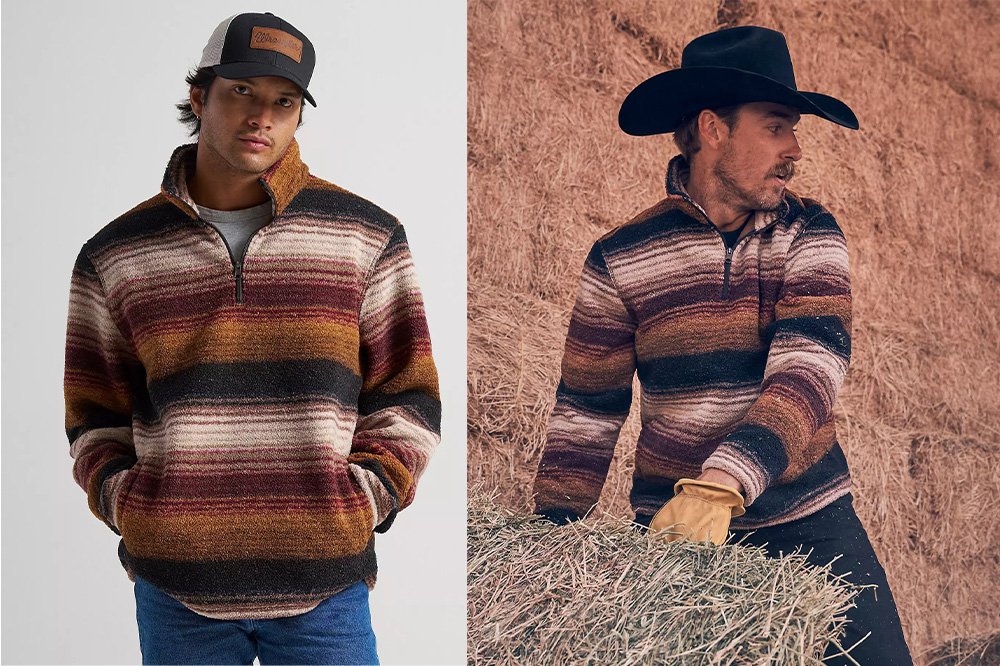
Patent-pending Hay Away technology turns a familiar fleece weakness—its tendency to trap hay, straw and grass—into a product-development opportunity for agricultural and outdoor apparel.
Wrangler has launched Hay Away, a bonded sherpa fabric technology designed to repel hay, straw, mulch, grass and other loose outdoor debris while retaining the warmth and comfort associated with high-pile fleece. The technology is aimed at ranchers, farm workers and outdoor consumers who frequently find conventional sherpa acting as a magnet for plant material.
Function comes from the fabric
Wrangler says the patent-pending functionality is integrated into the fabric construction, rather than relying on a topical coating, wash or temporary finish. The company describes the objective as preventing debris from clinging to synthetic fibres while maintaining insulation and hand.
Current Hay Away garments use 100% polyester sherpa, according to Wrangler product specifications. The collection includes men’s zip jackets and pullovers, women’s jackets and children’s outerwear, with US retail prices ranging from about $40 to $100.
The technology won the Fashion and Beauty category in Fast Company’s 2026 Innovation by Design Awards.
Workwear becomes more application-specific
The commercial significance lies in solving a narrow but persistent user problem rather than adding a generic performance claim.
Wrangler is effectively converting surface architecture, pile behaviour and fibre interaction with debris into a marketable performance attribute. The concept also extends beyond agriculture into hiking, camping and outdoor lifestyle apparel.
For knitwear and fleece manufacturers, the lesson is that performance innovation need not begin with expensive smart textiles. Valuable products can emerge from solving specific end-user problems through pile geometry, fibre selection, bonding, finishing and garment engineering.
Mills supplying workwear and outdoor brands could develop fabrics around measurable needs such as debris release, abrasion resistance, anti-pilling, thermal insulation, moisture transport and easy cleaning.
The higher-value opportunity is to move from selling “polyester fleece” toward selling application-engineered fleece with a clearly defined job to perform.