


The International Cotton Advisory Committee has released the 2026 World Cotton Trade Report, which provides analysis of global cotton trade patterns, key trading relationships, import and export trends, and the geopolitical and policy developments shaping cotton trade flows.
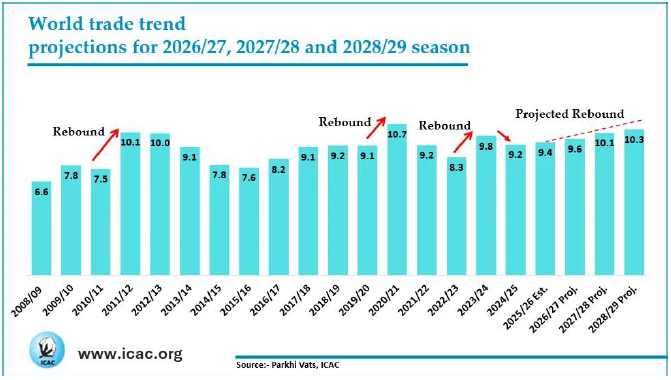
According to the publication — which is available free through the end of 2026 — global cotton trade is expected to remain on a positive trajectory over the medium term despite increasing supply-side pressures. Trade in the 2025/26 season is estimated at 9.4 million tonnes, representing a 2% increase over the previous season. It is projected to rise further to 9.6 million tonnes before reaching approximately 10.3 million tonnes by the end of the 2028/29 season.
The report identifies the increasingly tight balance between global production and consumption as a primary driver of future trade growth. In the 2026/27 season, global cotton production is projected to decline by 2% to 25.8 million tonnes, while consumption is expected to remain relatively robust at 25.5 million tonnes.
As the gap between production and consumption narrows, global markets are expected to become increasingly dependent on inventories held by major exporting countries. Any additional increase in demand would require exporters to draw down ending stocks, increasing the volume of cotton moving through international trade channels.
Demand developments in China, the world’s largest cotton-consuming country, will be particularly important in determining future trade patterns. Sustained growth in China’s textile manufacturing and consumer demand could push global consumption beyond current projections, increasing imports and providing additional support for international cotton trade.
Among the major trends addressed in the report:
- Global cotton trade is estimated at 9.4 million tonnes in 2025/26 and projected to reach 10.3 million tonnes by 2028/29.
- Brazil remained the world’s largest cotton lint exporter in 2025/26, supported by record production, competitive pricing, expanded market access, and reduced availability of U.S. cotton in international markets.
- U.S. exports declined in 2025/26 but are projected to increase by 3% in 2026/27, supported by higher ending stocks.
- China’s imports are expected to recover strongly in 2025/26 after falling sharply in the previous season.
- Bangladesh remains one of the world’s leading cotton importers, although consumption and imports have been affected by economic disruption, energy constraints, and logistical challenges.
- Vietnam continues to expand its role as a major cotton importer, supported by its growing textile and apparel sector and strengthening trade relationships.
- India’s cotton import and consumption patterns are being shaped by policy changes, tariff measures, and expanding domestic textile demand.
“Global cotton trade is entering a period in which supply constraints, inventory levels, policy decisions, and consumption trends will play an increasingly important role,” said Parkhi Vats, ICAC Principal Statistician and Data Architect and author of the World Cotton Trade Report. “While production challenges and geopolitical uncertainty remain significant, the medium-term outlook points to continued growth in trade as markets respond to stable consumption and shifting sourcing relationships.”
The report also highlights how tariffs, trade agreements, logistical bottlenecks, energy costs, and changing supplier relationships are adding uncertainty to cotton value chains and purchasing decisions. Disruptions affecting shipments through the Strait of Hormuz are identified as one particularly important logistical concern.
