

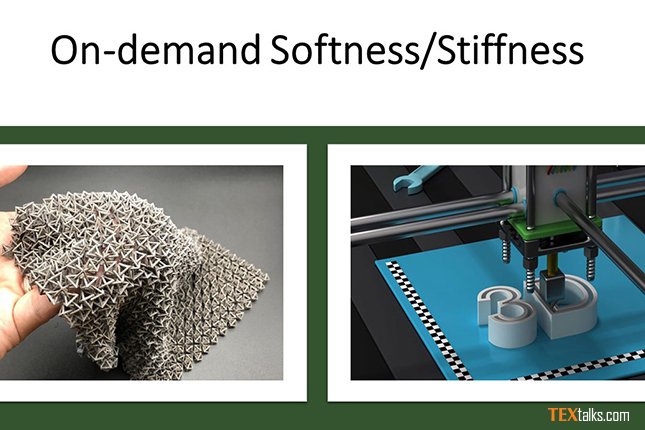
Scientists from Nanyang Technological University in Singapore and the California Institute of Technology (Caltech) have created a new type of ‘chain mail’ fabric flexible like cloth but can stiffen on demand. The 3D printing process turns a whole object into thousands of tiny little slices, then makes it from the bottom-up, slice by slice. Those tiny layers stick together to form a solid object.
Each layer can be very complex, meaning 3D printers can create a wide range of stuff, from ordinary to complex applications.
The lightweight fabric is 3D-printed using nylon polymers and comprises hollow octahedrons. Octahedron is a shape with eight equal triangular faces. The fabric uses the physical principle called “jamming transition.” In jamming transition, aggregates of solid particles switch from a fluid-like soft state to a solid-like rigid state, with a slight increase in packing density.
However, typical solid particles are usually too heavy and do not provide enough tensile resistance for wearable applications. The 3D printed fabric turns into a rigid structure that is 25 times stiffer or harder to bend than when relaxed.
These materials could be used for impact-resistant applications like bulletproof fabrics, stab-proof vests, and others.
The team has also turned aluminum into fabrics for various purposes and is looking to improve the material and fabric performance of the chain mail and explore more stiffening methods, such as through magnetism, electricity, or temperature.

