

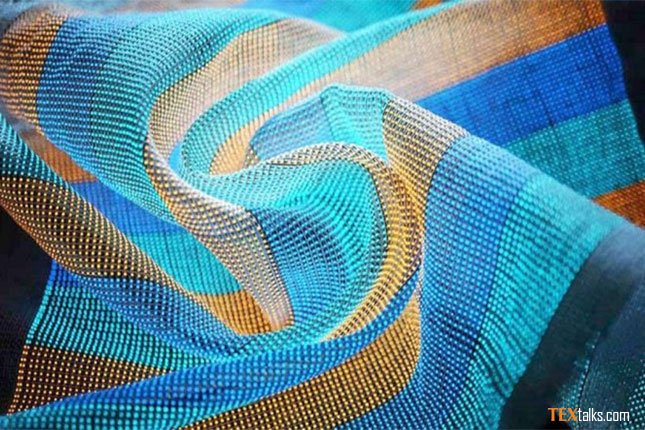
Researchers at Fudan University, China, have developed flexible, breathable, and durable textile material. According to Professor Huisheng Peng of Fudan’s Department of Macromolecular Engineering, the new material is ideal for practical uses.
Weaving conductive weft and luminescent warp fibers forms micrometer-scale electroluminescent units at the weft–warp contact points. The brightness between electroluminescent units deviates by less than 8 percent and remains stable even when the textile is bent, stretched, or pressed. As the light-emitting fibers’ diameter can be precisely adjusted between 0.2 mm and 0.5 mm, clothing woven with it can be ultra-fine and ultra-flexible. Fabrics will fit the human body’s irregular contours and can be as light and breathable as ordinary fabric.
The researchers incorporated a touch-sensitive 16-button fabric keyboard, solar-energy-harvesting threads, and battery fibers into their textile to add interactivity and a power supply. They added electronics to wirelessly link it to a smartphone via a Bluetooth connection so users could send and receive messages on their sleeves and see real-time locations on a map.
After 1,000 cycles of bending, stretching, and pressing, the vast majority of electroluminescent units’ performance remained stable. Besides, the brightness of the electroluminescent units remained stable after 100 cycles of washing and drying.
 Electronic textiles capable of communicating, sensing, and supplying electricity have been reported previously.
However, textiles with functional, large-area displays have not yet been achieved because it is challenging to obtain small illuminating units that are both durable and easy to assemble over a wide area.
Professor Peng said that “With the integration of more functionality, we expect these smart textiles to shape the next generation of electronic communication tools. We have shown that an integrated textile system consisting of a display, keyboard, and power supply can serve as a communication tool, demonstrating the system’s potential within the ‘internet of things in various areas, including healthcare. Our approach unifies the fabrication and function of electronic devices with textiles.”
