

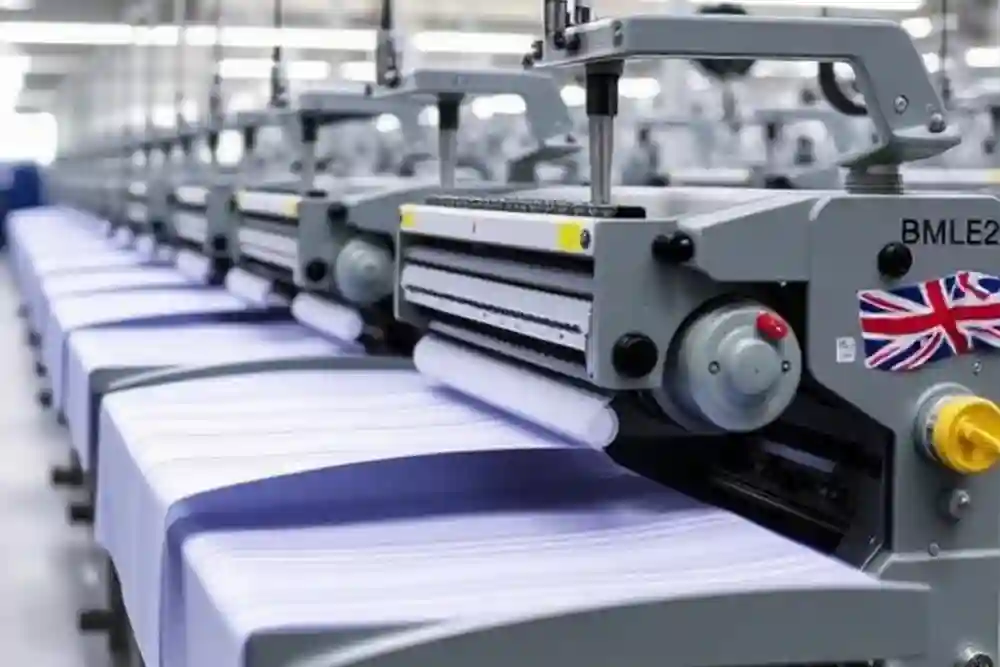
Members of the British Textile Machinery Association (BTMA) can look back on 2025 as a year that defied macro uncertainty through execution, not optimism. While markets remained volatile, British machinery suppliers advanced decisively in three areas that now define competitiveness in textiles: composites capability, data-driven quality, and intelligent process control.
As BTMA CEO Jason Kent notes, the industry’s momentum is not incremental—it is directional. What emerged in 2025 is a clear convergence of advanced machinery, AI-enabled software, and objective testing, laying the groundwork for a more resilient and transparent textile manufacturing ecosystem.
Composites: from niche to industrial scale
BTMA members are increasingly embedded in the fast-growing composites sector, where precision, speed and waste reduction are non-negotiable.
- Cygnet Texkimp earned nomination for a 2026 JEC Innovation Award through its ART rapid tape-deposition system, developed with McLaren Automotive. Depositing dry fibre tapes at up to 2.5 m/s, ART materially reduces scrap and cycle times—benefits already realised in supercar production.
- Circularity is moving from theory to equipment. Cygnet’s licensed deployment of the DEECOM pressolysis system (developed by Longworth Sustainable Recycling Technologies) enables low-carbon fibre and resin recovery from end-of-life composites.
- Supporting players such as Emerson & Renwick, Airbond and Slack & Parr reinforce the UK’s depth across the composites value chain.
Signal: British textile machinery is no longer confined to apparel—it is becoming core infrastructure for advanced mobility, aerospace and industrial composites.
High-performance fibres: smaller, smarter, more flexible
In gel spinning and high-end fibre processing, BTMA members addressed a critical bottleneck: scale rigidity.
- Fibre Extrusion Technology introduced a UHMWPE gel-spinning process using supercritical CO₂ for solvent extraction. Its FET-500 platform reduces complexity, resource intensity and entry barriers for new product development—an important shift away from monolithic, capital-heavy systems.
Signal: Flexibility and modularity are becoming strategic advantages as fibre innovation accelerates.
Quality assurance goes continuous and digital
Quality control across textiles is shifting from sampling to real-time, inline intelligence.
- Shelton Vision advanced its WebSpector platform to reliably detect defects on complex, distorted and patterned fabrics at production speed—extending applicability from airbags and automotive interiors to denim, performance wear and carbon fibre.
- Colour management is undergoing a parallel transformation. C-Tex, working with Shelton, now enables continuous colour variation analysis directly in production, with data shared downstream to garment and furniture manufacturers.
Strategic implication: Textiles are adopting the same data transparency norms long standard in automotive—reducing disputes, rework and risk across supply chains.
Testing: faster, objective, less resource-intensive
Advanced testing remains a British stronghold.
- James Heal introduced the Martindale Motion, enabling multiple abrasion and pilling tests to run independently and unattended—cutting labour and time costs while improving throughput.
- Water and colour testing have also been re-engineered for sustainability and precision, notably through TruRain and VeriVide’s DigiEye platform with fully LED illumination and automated capture.
Solving the “feel” problem: from subjective to measurable
Perhaps the most underappreciated advance of 2025 addresses a long-standing weakness in textiles: tactility.
- Roaches International’s Sentire fabric handle tester translates softness, drape and stiffness into objective data—reducing reliance on physical samples and subjective descriptors.
Why it matters: As digital product development, remote sourcing and DPP-style data exchange expand, objective handle metrics become commercially critical.
The bigger picture: convergence as strategy
What ties these developments together is not novelty, but system integration. BTMA members are no longer selling machines in isolation; they are delivering connected manufacturing intelligence—where production, inspection, colour, testing and recycling feed into a unified data loop.
Jason Kent’s assessment is therefore understated but accurate: British textile machinery is positioning itself at the intersection of efficiency, sustainability, and compliance—exactly where global manufacturing is heading.
Bottom line:
In an uncertain market, BTMA members did not retreat. They doubled down on capability. As 2026 exhibitions like JEC Composites and Techtextil approach, British textile machinery enters the next cycle not as a legacy supplier, but as an enabler of the data-driven, circular, and high-performance textile economy.
