

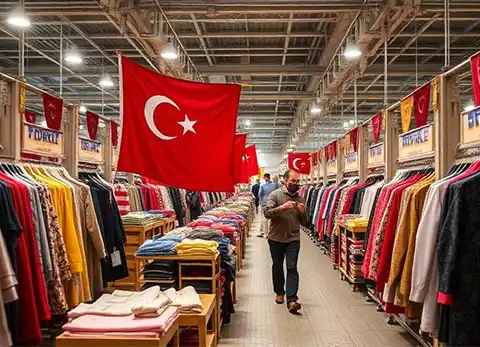
Türkiye’s textile and apparel industries generated $26.18 billion in exports in 2025, delivering a $17 billion trade surplus even as global demand weakened and domestic pressures—rising labor costs, tight financing, and slowing consumption—intensified.
Export performance: contraction but resilience
- Apparel exports: $16.77bn (–6.3% YoY)
- Textile exports: $9.4bn (–0.8% YoY)
- Combined contraction: –4.4% YoY
Despite the decline, the sector remains Türkiye’s largest manufacturing block. According to Istanbul Textile and Raw Materials Exporters’ Association (ITHIB) Chair Ahmet Oksuz, textiles and apparel together account for $77.2bn in production value (textiles $44.8bn, apparel $32.4bn).
Global standing
Türkiye ranks 5th among the world’s largest textile exporters, tied with Italy at $12bn, following:
- China ($141bn)
- India ($19bn)
- United States ($18bn)
- Germany ($13bn)
Notably, 8 of the top 10 textile exporters are G20 members; 4 are G7 countries—underscoring the sector’s strategic weight.
Markets: EU leads, Egypt surges
- European Union: $4.5bn (largest destination)
- Top countries: Italy ($838m), United States ($792m), Germany ($715m)
- Standout growth: Egypt, where exports rose 23% YoY to $567m in 2025, driven by new Turkish investments and production shifts.
Value over volume
Türkiye’s competitiveness shows up in unit values:
- National average: $1.59/kg
- Textiles: $4.3/kg
- Apparel: $21.3/kg
These premiums highlight strength in higher value-added products, even as volumes soften.
Imports down, inward processing up
- Textile imports fell from $9.2bn (2023) to $7.3bn (Jan–Nov 2025).
- Use of the inward processing regime (duty-free inputs for exports) increased to 22.9% of textile imports in 2025, versus ~10% for overall imports—signaling tighter margins and export-focused sourcing.
Employment pressure
Employment in textiles and apparel fell 10.9% YoY:
- Apparel: –12.1%
- Textiles: –9.3%
From a peak of ~1.25 million workers (Aug 2022), employment declined to ~860,000 in 2025.
Bottom line: Türkiye’s textile and apparel sector remains globally competitive and value-oriented, sustaining a large trade surplus and strong EU links. However, falling volumes, rising costs, and job losses point to a critical phase where productivity gains, market diversification, and higher value positioning will be decisive in 2026.
