

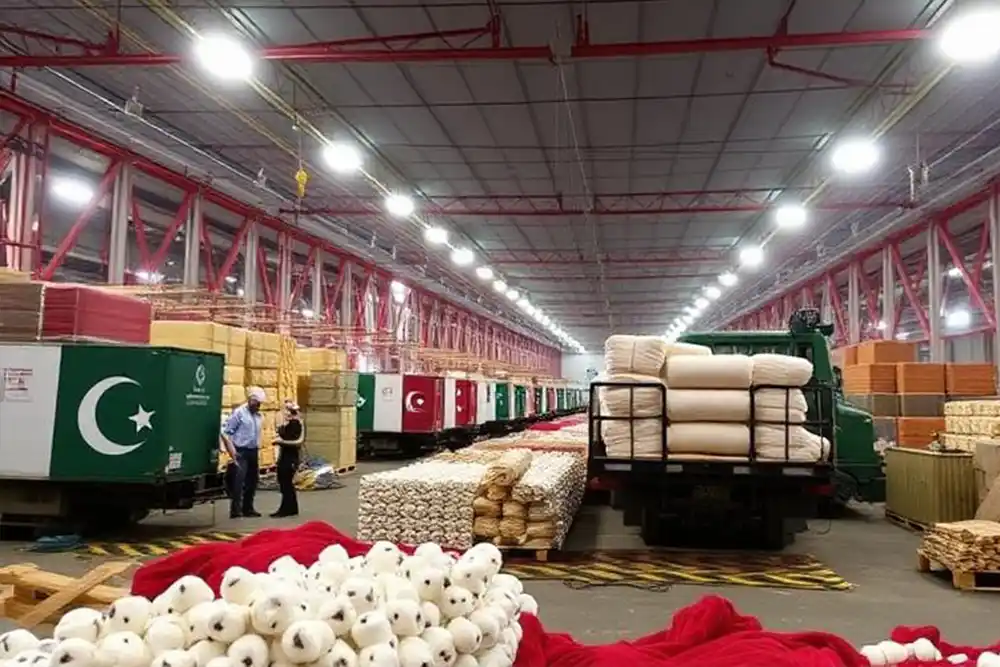
Pakistan’s cotton yarn exports to China exceeded $451 million in 2025, reflecting the durability and growing sophistication of bilateral textile trade under the China–Pakistan economic partnership, according to data from the General Administration of Customs of China (GACC).
Key trade highlights
- HS 52051100 (uncombed single cotton yarn, ≥85% cotton)
Exports reached $233.57 million, up from $222.73 million in 2024 — a 4.9% year-on-year increase. - HS 52051200 (another uncombed single cotton yarn category)
Generated $212.56 million in exports during 2025.
Together, these two categories underline both the scale and diversity of Pakistan’s yarn shipments to China.
Regional competitiveness
- Vietnam remained the largest supplier of HS 52051100 to China at $341.99 million.
- Pakistan ranked second with $233.57 million, well ahead of Malaysia ($17.28m) and Bangladesh ($12.70m) — highlighting Pakistan’s strong competitive position in the Chinese market.
Where the yarn goes in China
Chinese provincial data show deep integration into major textile hubs:
- Fujian: $107.47m
- Guangdong: $72.06m
- Beijing: $18.15m
Additional destinations included Zhejiang, Jiangsu, Anhui, Hunan, Shandong and Xinjiang, with trade conducted through multiple regimes such as ordinary trade, bonded entrepôt trade, processing with imported materials and customs warehousing — signalling increasingly sophisticated supply-chain structures.
Industry perspective
Sajjad Mazahir, Director Marketing at Keywin Trading Ltd., noted that Pakistan–China yarn trade has shifted from cyclical demand to stable, long-term supply-chain relationships. He added that Pakistani yarn played a key role in supporting China’s garment export industry in 2025, particularly as U.S. tariffs complicated China’s access to tariff-free exports.
Constraints and outlook
Despite the strong showing, experts caution that Pakistan’s textile exports to China remain over-concentrated in raw materials. Structural challenges persist:
- Inconsistent domestic cotton supply
- High energy and financing costs
- Limited alignment with China’s rapidly expanding web-based and AI-driven procurement systems
Still, amid floods, energy shocks and global slowdown, Pakistani spinners’ ability to sustain monthly yarn exports of $35–40 million from mid-2025 onward underscores the sector’s resilience — and highlights untapped potential if value addition and digital integration improve.
