

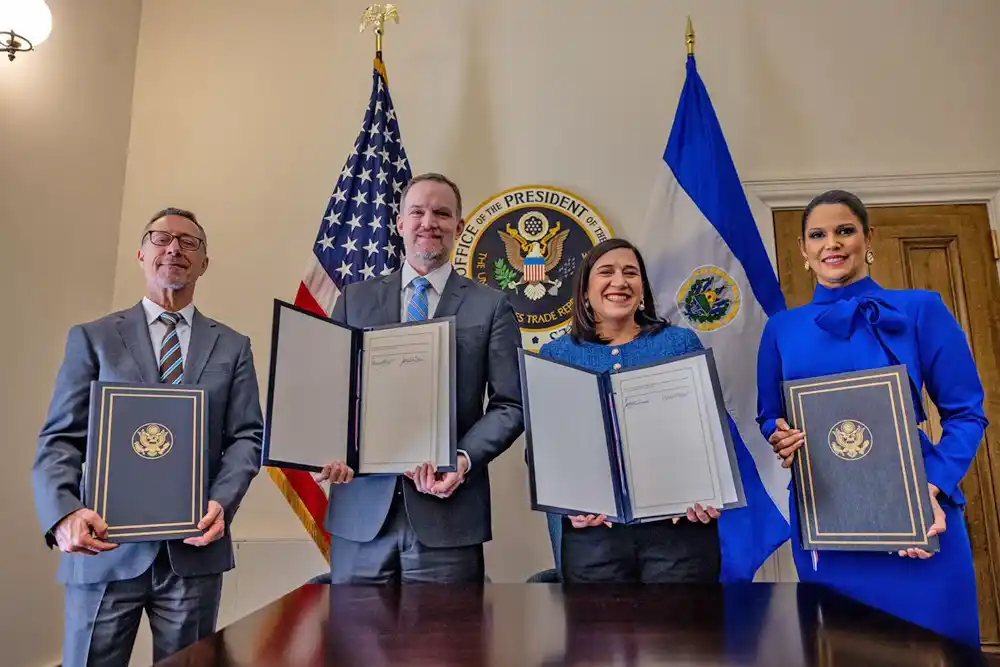
The National Council of Textile Organizations (NCTO) has welcomed the U.S. administration’s newly announced reciprocal trade agreement with El Salvador, calling it a meaningful boost to American textile exports and supply-chain resilience within the CAFTA-DR framework.
Industry reaction
NCTO President and CEO Kim Glas said the agreement strengthens a critical export market for U.S. textiles and reinforces the long-standing co-production model linking U.S. fiber, yarn and fabric producers with Central American apparel manufacturers.
She thanked Donald Trump, Jamieson Greer, and the administration for finalising the deal, noting its importance for U.S. jobs and industrial competitiveness.
Why El Salvador matters
- El Salvador is a key part of the CAFTA-DR regional supply chain, which integrates U.S. textile inputs with apparel manufacturing in Central America.
- The CAFTA-DR textile and apparel production chain generated $11.3 billion in two-way trade in 2024.
- The integrated supply chain supports over 470,000 U.S. textile workers across fiber, yarn, fabric and finished product manufacturing.
Strategic significance
NCTO emphasised that the U.S.–Central America textile ecosystem serves as a strategic counterweight to China and other Asian suppliers, offering:
- Shorter lead times
- Rule-of-origin protections for U.S. inputs
- Greater supply-chain security for U.S. brands and retailers
Bottom line
The reciprocal agreement with El Salvador is seen as reinforcing near-shoring and co-production in the Western Hemisphere, strengthening U.S. textile exports, safeguarding domestic jobs, and supporting a geopolitically resilient alternative to Asia-centric sourcing models.
