

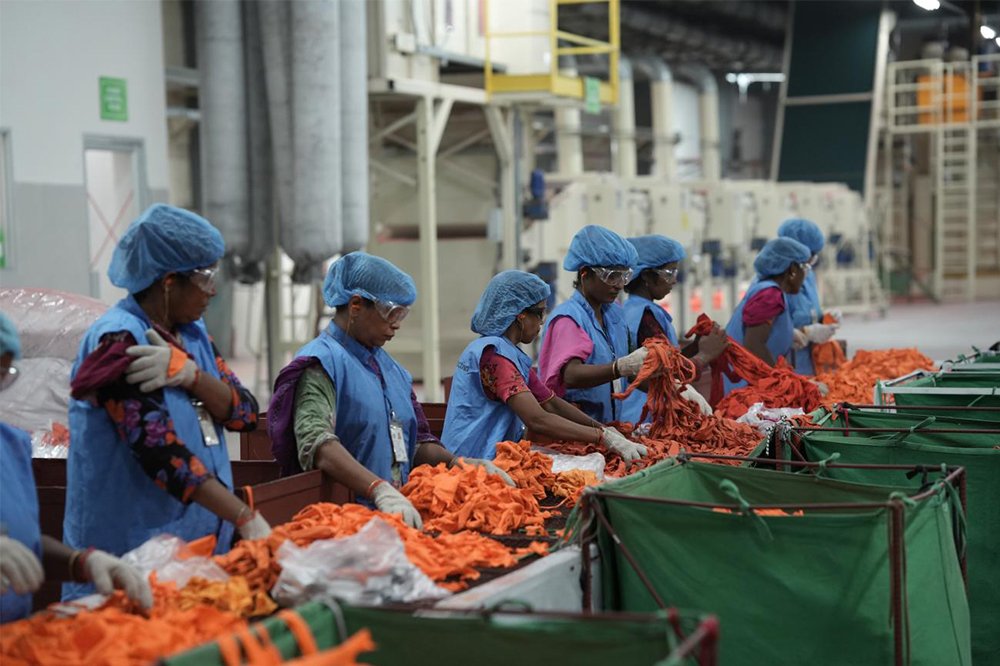
The pilot’s clearest lesson is that textile recycling in Bangladesh will not scale until waste is segregated, traced and organised as an industrial feedstock rather than treated as factory scrap.
A just-style report says a textile circularity pilot in Bangladesh improved waste segregation and aimed to expand traceable textile recycling among BESTSELLER’s Bangladeshi suppliers, while also strengthening local manufacturing resilience. Wider reporting on the same project shows that it was designed not merely as a recycling experiment, but as an attempt to build the foundations of a domestic post-industrial textile-waste system.
The core finding is practical. Bangladesh generates substantial volumes of post-industrial textile waste, but the infrastructure to capture, classify and trace that waste has remained weak. At the start of the pilot, suppliers were producing recyclable cotton waste, yet no factory was segregating textile waste at scale, classifications were broad, and fibre composition was rarely recorded. Better segregation, in turn, appears to have increased the value that factories can recover from their waste streams.
This matters because Bangladesh is under growing pressure to formalise circularity. Reuters has reported that only a small share of the country’s textile waste is recycled domestically, even as international regulation and buyer expectations push the industry towards stronger recycling systems and traceability. The commercial implication is straightforward: whoever controls classification and traceable feedstock will capture more of the value in circular textiles.
The real challenge is scaling beyond the pilot. That means building reliable collection, sorting and data systems, while managing the tension between new formal recycling models and the long-established informal waste economy. Bangladesh’s opportunity is large. But circularity will become industrial only when waste is treated as a managed raw material.
