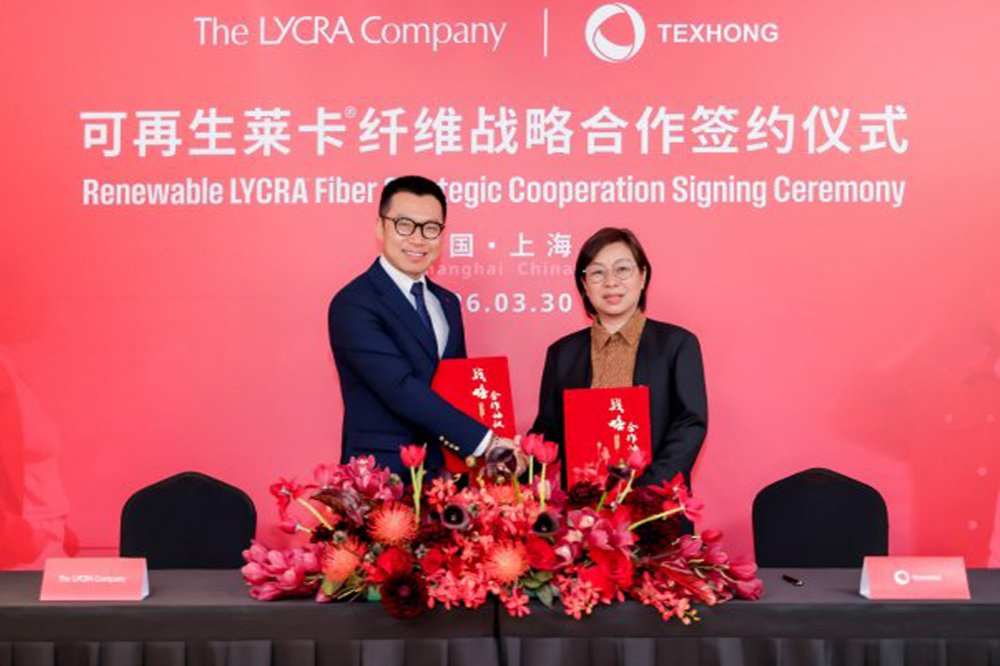
The deal gives Lycra a focused industrial route into China’s core-spun yarn segment while giving Texhong early access to a lower-impact elastane option for stretch cotton products.
The LYCRA Company has signed a strategic partnership agreement with Texhong International Group, deepening its push into renewable-content elastane and giving the Chinese spinner exclusive access to Renewable LYCRA® fiber with 30% plant-based content for the country’s core-spun yarn sector. The agreement is aimed at accelerating adoption of bio-derived spandex in apparel and textiles, with Texhong using its yarn and textile manufacturing base to commercialise customised core-spun products built around the new fiber.
Why the Texhong channel matters
This is a commercially important route to market because Texhong is one of the world’s largest suppliers of core-spun cotton textiles, a category where elastane is embedded directly into yarn construction and where performance, consistency and scale matter more than pilot-level novelty. For Lycra, the partnership moves the sustainability discussion beyond brand-level storytelling and into an industrial application segment that can influence large-volume stretch cotton programmes. The two companies said they will also work jointly on innovation in bio-derived spandex materials, yarn manufacturing and brand end-use applications.
The product claim needs careful reading
The fiber being commercialised in this agreement is described as Renewable LYCRA® fiber made with 30% plant-based content, partly derived from dent corn, with third-party confirmation of that renewable content still pending. Lycra says a recent cradle-to-gate life-cycle assessment showed up to a 32% reduction in carbon emissions versus fossil-derived LYCRA® fiber. That is a more limited claim than the company’s broader LYCRA® EcoMade platform, which the company markets separately as containing 70% renewable content and having the potential to cut carbon footprint by up to 44%. In other words, this Texhong agreement appears to focus on a nearer-term renewable-content offer rather than Lycra’s highest renewable-content elastane platform.
What the industry should watch
For mills, brands and sourcing teams, the next question is not the signing ceremony but conversion at scale: whether Texhong can build commercially attractive core-spun yarn lines that preserve stretch performance, avoid process disruption and win downstream brand uptake. If that happens, this partnership could become a meaningful test case for how renewable-content elastane moves from innovation messaging into mainstream cotton-spandex supply chains in China and beyond.