

Pakistan’s textile and apparel exporters remain heavily exposed to EU trade preferences, but the next GSP+ cycle will bring sharper compliance scrutiny.
Pakistan and the European Union have reaffirmed their commitment to continued trade cooperation under the GSP+ framework, but Brussels has made clear that future preferential access will depend on visible progress on labour rights, human rights, environmental protection and good governance.
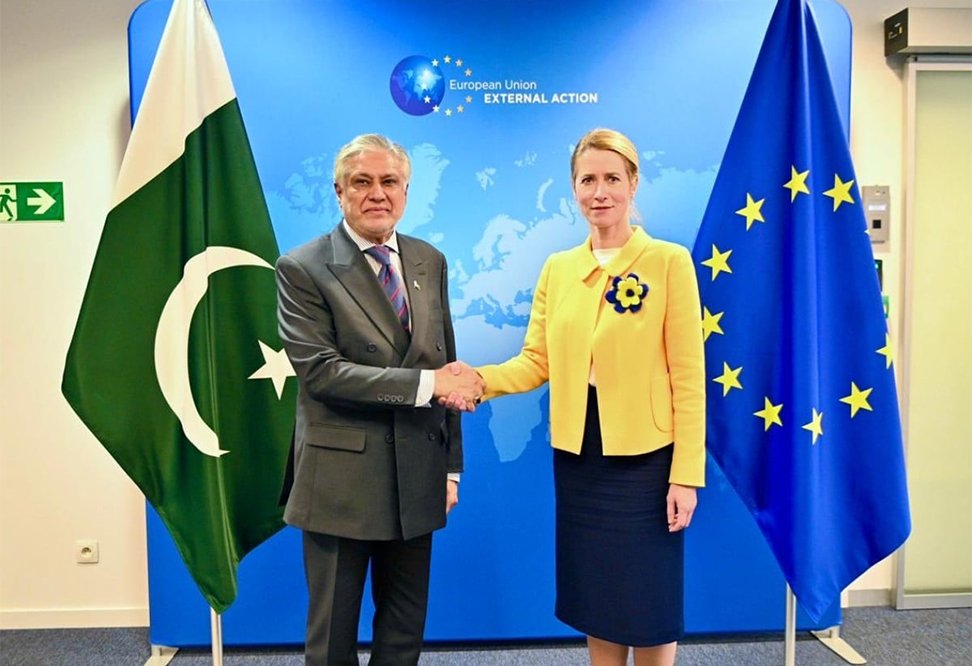
The message was delivered during the 8th Pakistan-EU Strategic Dialogue in Islamabad, co-chaired by Deputy Prime Minister and Foreign Minister Ishaq Dar and EU High Representative Kaja Kallas. Kallas described Pakistan as an important regional partner and said the EU remains Pakistan’s largest export destination, larger than China and the United States combined. She also noted that Pakistan is the world’s leading beneficiary of EU GSP+ preferences.
Export stakes rise
The commercial stakes are significant. EU data show total EU-Pakistan trade at €11.0 billion in 2024, with the EU taking 24% of Pakistan’s exports. Pakistan’s preference-eligible exports to the EU rose from €3.8 billion in 2013 to €7.5 billion in 2024, while its GSP+ preference-utilisation rate stood at 95%.
For textiles and clothing, the exposure is even sharper. The European Commission says more than 85% of Pakistan’s exports, including textiles and clothing, enter the EU duty- and quota-free under GSP+, while around 89% of EU textile and clothing imports from Pakistan enter at preferential tariff rates.
New compliance pressure
The EU’s revised GSP regulation, formally adopted by the Council on May 22, 2026, strengthens monitoring and transparency and introduces faster suspension procedures in cases of serious violations, particularly involving human rights, labour rights, environmental protection and good governance. It also adds, for the first time, a link between trade preferences and cooperation on migration and readmission. The new framework is scheduled to apply from January 1, 2027.
A test for exporters and policymakers
For Pakistan’s textile sector, GSP+ is no longer only a tariff advantage. It is becoming a compliance-linked market-access instrument. Mills, garment exporters and home-textile suppliers will need stronger documentation on labour standards, environmental practices, traceability and governance systems.
The next signal to watch is how quickly Pakistan converts diplomatic commitment into verifiable reforms before the new GSP+ framework becomes operational.
