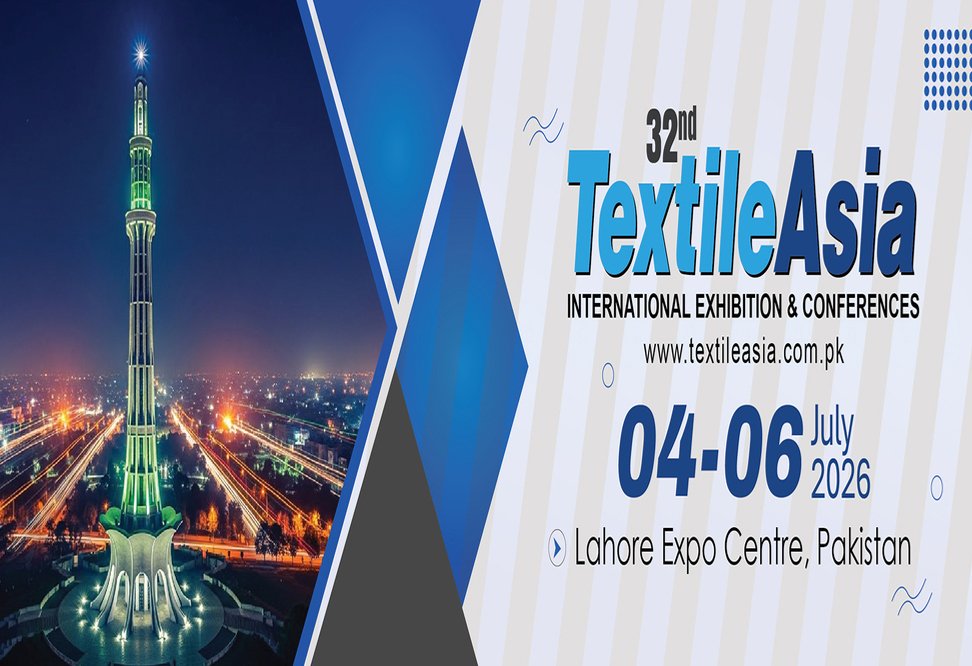
The real measure of Lahore’s flagship textile exhibition will be the equipment installed, productivity unlocked and export value created after the stands are dismantled.
The 32nd Textile Asia International Exhibition, held at Lahore Expo Centre from July 4–6, brought together more than 2,000 international brands, over 425 participating companies and official delegations from more than eight countries, including China, Türkiye, Germany, Italy, Japan and South Korea. The event covered textile and garment machinery, digital technologies, chemicals, raw materials and value-added manufacturing.
A technology marketplace with national stakes
Pakistan’s textile and apparel chain remains central to the country’s trade and industrial base. The Ministry of Commerce puts the sector’s contribution at around 56% of total exports, 40% of industrial employment and 24% of value addition.
That makes Textile Asia more than a calendar event. It is a test of whether Pakistani mills and garment manufacturers can move from equipment interest to operating capability.
For mill owners, the relevant questions are specific. Can a machine lower electricity, steam, water or chemical consumption per kilogram? Can it improve right-first-time quality, reduce rework, shorten changeovers or produce a fabric specification that global buyers value? And can its supplier provide credible commissioning, spare-parts and process-support capacity in Pakistan?
From exhibition leads to mill-level results
Visitor traffic and exhibitor numbers do not automatically translate into competitiveness. The exhibition’s commercial value will depend on what follows: sample trials, process audits, capex decisions, technical partnerships, joint ventures and buyer-linked product-development programmes.
The investment priority should be technologies that address Pakistan’s structural constraints: energy intensity, uneven process control, low automation in many units, limited product differentiation and rising requirements for traceability and environmental reporting. Digital systems deserve equal attention. Machine-level energy data, production records and batch traceability are increasingly necessary for cost management, compliance and buyer verification.
Policy execution still matters
The Eco Textile Conference 2.0, held alongside the exhibition, focused on green manufacturing, renewable energy and circularity. Yet the policy framework remains incomplete. The Commerce Ministry’s 2024–25 year book records that the Draft Textiles and Apparel Policy 2025–30 was circulated for stakeholder input before submission to the competent forum; it should not be presented as a completed reform.
Textile Asia’s success should be judged six to twelve months from now: by machinery commissioned, productivity gains measured, local service capacity strengthened and higher-value exports secured—not by footfall alone.