

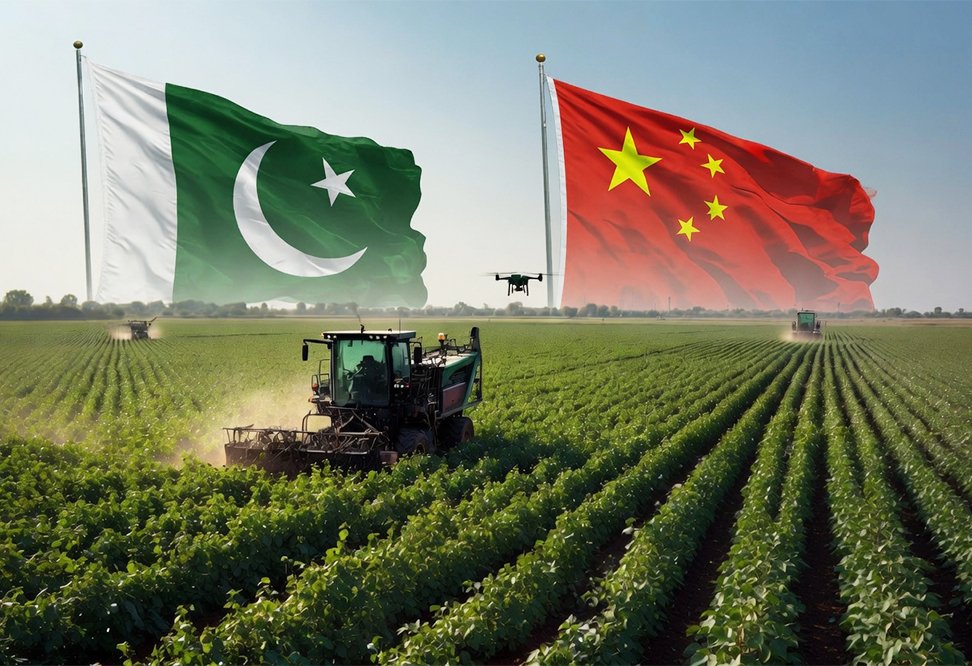
Pakistan’s cotton recovery will depend less on broad ambition than on converting joint research into locally validated seed, disciplined crop management and viable mechanised harvesting.
Pakistan and China are preparing to deepen cooperation in cotton research, with plans to test Chinese seed varieties under Pakistani growing conditions, expand joint breeding work and evaluate mechanical harvesting. The initiative comes as domestic cotton production remains far below the level required by Pakistan’s integrated textile value chain. Business Recorder quoted Adeel Munawar of the Pakistan-China Joint Chamber of Commerce and Industry as putting the latest crop at 5.6 million bales, a multi-decade low.
From imported genetics to local validation
The proposed programme would introduce Chinese cotton varieties for adaptability trials before any commercial release. That sequencing is critical. A variety’s performance depends not only on yield potential but also on its response to local heat, water availability, pest pressure, disease incidence, fibre-quality requirements and farm-management conditions.
The partnership is built on a potentially complementary resource base: Pakistani germplasm is associated with heat tolerance, while Chinese varieties are being assessed for yield and fibre-quality performance. Xinjiang Agricultural University has already collaborated with Pakistani institutions, with experimental fields established in Faisalabad and mechanical-picking trials under consideration.
Management remains the immediate constraint
Seed improvement alone will not close Pakistan’s yield gap. The report identifies timely sowing, balanced fertiliser application, efficient irrigation, integrated pest management, weed control and harvesting discipline as core production variables. In practical terms, this reinforces a long-standing issue: adjacent farms using the same variety can deliver sharply different results because of management quality.
Pakistan’s Ministry of National Food Security has already framed cotton revival as a strategic priority, with its 2025 national conference setting an ambition to restore production to at least 15 million bales, a level last reached in 2015. The gap between that target and recent output highlights the scale of implementation required.
Mechanisation needs a full operating model
Testing mechanical picking is commercially important, particularly as labour availability, picking quality and contamination remain persistent challenges. Yet machinery adoption will require compatible varieties, suitable row spacing, crop uniformity, field preparation, defoliation practices, custom-hiring models and gin-level handling systems.
A biotechnology Centre of Excellence laboratory is also being established at the Central Cotton Research Institute, according to the PCJCCI. The key test now is whether research collaboration produces measurable, district-level improvements in yield, fibre quality and cost per kilogram—not simply more trials and announcements.
