

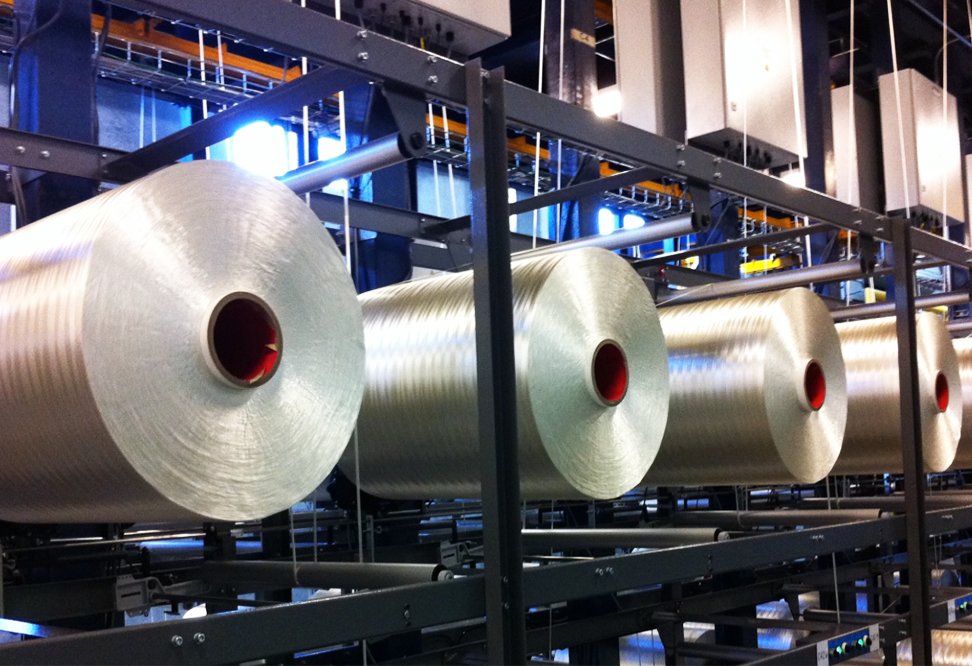
Larger precursor packages target a basic but costly constraint in carbon-fibre manufacturing: stoppages for bobbin changeovers.
UK fibre-handling specialist Cygnet Texkimp has developed a very-heavy-duty (VHD) unwinding creel for 500kg packages of polyacrylonitrile (PAN) precursor fibre, aiming to extend continuous carbon-fibre production runs and reduce operational interruptions. The development is intended for high-volume carbon-fibre lines, where precursor unwinding, tension stability and package changes can affect throughput and fibre consistency.
The new system increases package capacity from the 350kg bobbins that have been widely used in the sector for more than a decade. A 500kg package provides roughly 43% more precursor material per changeover, allowing lines to operate for longer between interventions. That should reduce non-productive time, manual handling events and the risk of process disruption during a production run.
Throughput, not merely capacity
The creel is designed to unwind PAN precursor into carbon-fibre conversion lines. According to Cygnet Texkimp, the larger format also supports higher-tow materials, including 24K and 48K fibres, and can help manufacturers pursue higher line speeds.
This matters because the economics of carbon fibre depend heavily on stable, continuous processing through stabilisation and carbonisation. A creel does not alter the chemistry or energy intensity of these thermal stages, but it can improve the utilisation of expensive downstream equipment by reducing avoidable upstream stoppages.
The system uses an operator-managed lifter-loader for package transfer, with a more automated handling configuration available. Its closed-loop dancer-arm tension-control system is intended to maintain near-constant fibre tension as the package unwinds—an important requirement where tension variation can affect precursor handling and ultimately fibre quality.
Scaling for industrial applications
Cygnet Texkimp says it has more than 70 VHD creels in operation worldwide, processing over 24,000 fibre bobbins. The company links the 500kg development to expanding global carbon-fibre capacity and demand from high-volume industrial applications.
The commercial significance is straightforward. As carbon fibre moves beyond aerospace into wind energy, pressure vessels, automotive components and industrial structures, manufacturers need productivity gains that do not compromise process control.
The next question is whether higher-capacity precursor handling will be paired with wider automation, digital tension monitoring and lower-energy conversion technologies. Research programmes using microwave-assisted carbonisation are separately targeting major reductions in the energy demand of carbon-fibre manufacture, suggesting that future competitiveness will depend on both line uptime and thermal-process efficiency.
