

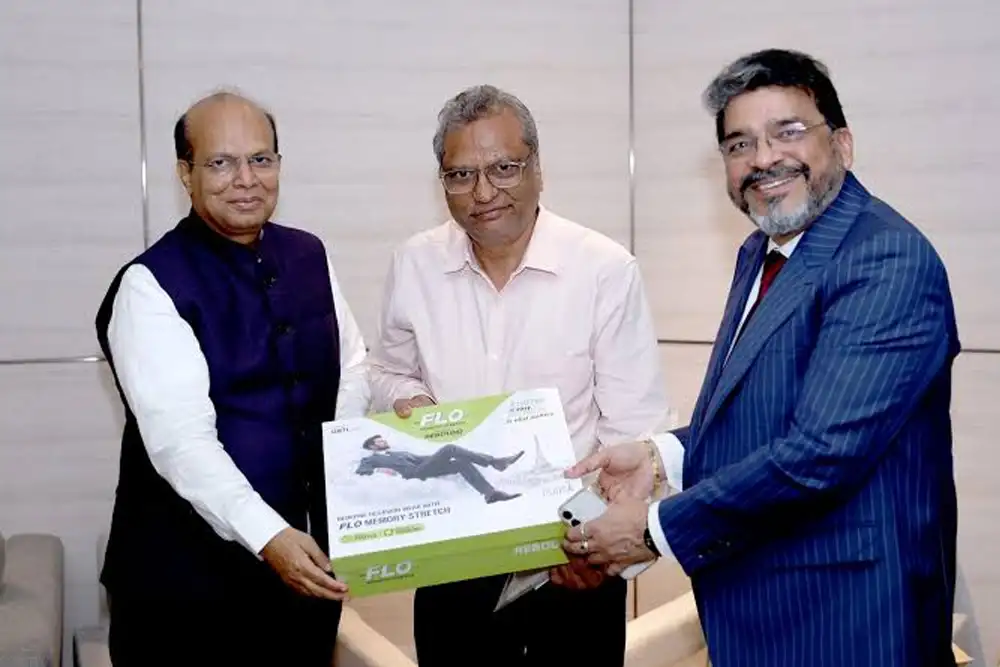
The new fabric platform shifts the performance conversation from stretch alone to how effectively tailored garments recover their shape after repeated movement.
India’s GBTL has introduced FLO Memory Stretch, a premium suiting and occasion-wear fabric platform designed to combine mobility with improved shape retention. Unveiled at an industry preview in Mumbai, the range uses the company’s proprietary Rebound Tech and will be marketed across business, everyday, travel, leisure, party and wedding applications.
Recovery becomes the selling point
Most stretch-fabric marketing emphasises elongation: how far a textile can extend when the wearer sits, bends or moves. GBTL is instead positioning elastic recovery—the fabric’s ability to return towards its original dimensions—as the critical measure for premium tailoring.
The company says Rebound Tech allows garments to move naturally while retaining their structure, drape and appearance through extended wear. This proposition is particularly relevant to trousers, jackets and suits, where excessive growth at the knees, elbows or seat can undermine fit and visual sharpness.
However, GBTL has not publicly disclosed the fibre composition, stretch percentage, recovery rate, testing method, wash durability or comparative trial results for FLO. The current performance claims should therefore be treated as manufacturer statements until supported by standardised laboratory and garment-wear data.
One technology, six wearing occasions
Rather than presenting a single universal construction, GBTL has organised FLO into six occasion-led collections. The strategy allows fabric weight, handle, colour, drape and stretch behaviour to be adapted to different use cases while retaining a common recovery-focused brand proposition.
The range was described as “crafted in Paris and engineered in India”, combining international styling input with GBTL’s domestic manufacturing and product-development capabilities. GBTL, formerly Grasim Bhiwani Textiles, has operated within Donear Group since its 2017 acquisition and specialises in premium formal and semi-casual fabrics.
Forecasting supports the fabric launch
GBTL also unveiled FLO CAST, a biannual journal covering colours, materials, silhouettes and consumer preferences. Its first edition addresses July 2026 to January 2027 and is intended to help retailers and manufacturers align purchasing with emerging fashion directions.
The commercial test will be whether FLO delivers measurable recovery after repeated stretching, laundering and garment use. Transparent test data—and evidence that tailors can process the fabrics without specialised cost or complexity—will determine whether the platform develops beyond branding into a defensible performance category.
