

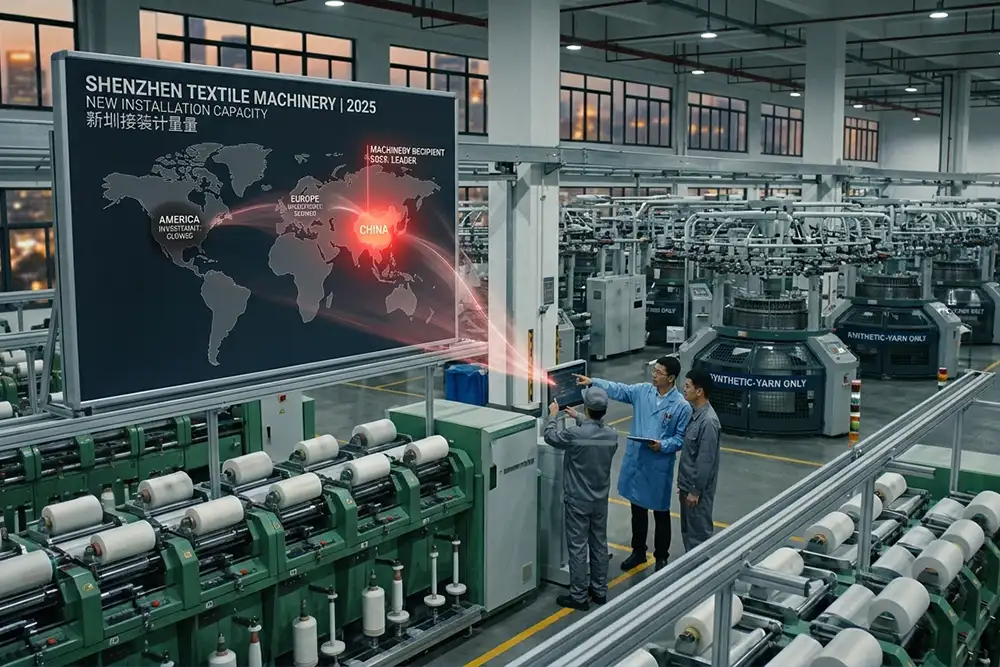
China continued absorbing most new synthetic-yarn and knitting equipment in 2025, reinforcing its scale advantage as worldwide machinery shipments contracted.
China remained the dominant destination for several textile-machinery categories in 2025 despite a broad decline in global capital investment. The International Textile Manufacturers Federation’s latest survey shows expansion concentrated in spinning and selected knitting segments, while weaving, texturing and flat-knitting deliveries weakened.
Compiled with data from more than 200 machinery manufacturers, the survey recorded a 3.3% rise in short-staple spindle shipments to 6.11 million and a 3.5% increase in open-end rotors to 645,000. Draw-texturing spindle deliveries fell about 23%, shuttle-less looms 27.5%, large circular knitting machines 13% and electronic flat-knitting machines 21%.
Synthetic fibres remain China’s stronghold
China accounted for 92% of global single-heater draw-texturing spindle deliveries, primarily used for polyamide, and 93% of double-heater shipments, mainly serving polyester. These shares remained exceptionally high even though worldwide deliveries in the two categories declined 21% and 22%, respectively.
China also received 11,700 large circular knitting machines—53% of the global total and 9% more than in 2024. It retained a 66% share of electronic flat-knitting machine shipments, although Asian deliveries in that segment fell substantially.
Weaving investment turns selective
China remained the largest buyer of air-jet and water-jet looms, but its deliveries dropped 32% and 57%, respectively. India moved ahead in rapier and projectile looms, increasing purchases by 21%. China also took 46% of long-staple spindle shipments and remained among the leading investors in short-staple and open-end spinning equipment.
Capacity pressure moves downstream
The pattern suggests China is prioritising synthetic-filament processing, knitting and selective spinning upgrades rather than expanding every stage uniformly. Its machinery dominance strengthens productivity and product-range advantages, but may intensify global price competition if new capacity outpaces demand.
For equipment suppliers, China remains indispensable, while India, Vietnam, Bangladesh, Indonesia, Uzbekistan and Pakistan provide diversification. The next test is whether weak global orders slow Chinese investment—or domestic machinery supply, automation and export pressure sustain further capacity upgrading.
