

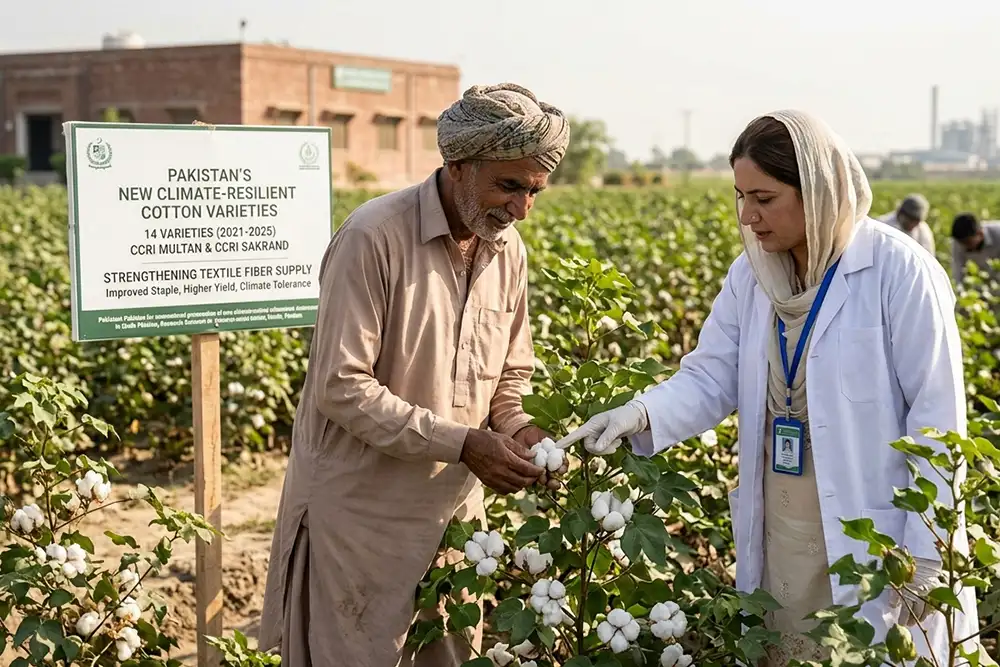
Improved staple length, fibre strength and ginning recovery could reduce pressure on mills, but commercial impact will depend on certified-seed multiplication and farmer adoption.
Pakistan approved 14 cotton varieties between 2021 and 2025, expanding its portfolio of higher-yielding, climate-resilient and pest-tolerant seed for the domestic textile industry. Eleven varieties were developed by the Central Cotton Research Institute in Multan and three by CCRI Sakrand in Sindh.
Fibre gains matter upstream
The approved varieties recorded ginning outturns of 38.2–42.3%, staple lengths reaching 29.6 millimetres and fibre-strength readings ranging from 28.3 to 33.5. Their micronaire values remained within the 3.5–4.9 range generally preferred for balancing fibre fineness and maturity in conventional spinning.
CIM-775 delivered the highest reported ginning outturn at 42.3%, potentially improving lint recovery from each unit of seed cotton. Cyto-226 produced the longest staple at 29.6 millimetres, while CIM-343 recorded the strongest fibre result at 33.5. Bt CIM-663, Bt CIM-678 and Bt CIM-785 were developed with heat tolerance, while other varieties combine drought tolerance, bollworm resistance or improved resistance to cotton leaf curl virus.
Sindh’s three additions—Bt CRIS-674, Bt CRIS-682 and non-Bt CRIS-644—were approved for cultivation in 2024. CRIS-644 recorded a 40.5% ginning outturn and 28.4-millimetre staple length.
Approval is not adoption
The development comes as Pakistan targets 9.64 million cotton bales from 2.16 million hectares in 2026/27. However, varietal approval alone does not guarantee sufficient commercial seed, genetic purity or adoption across suitable production zones.
The government estimates national cotton-seed requirements at 53,796 tonnes and says more than 50,000 tonnes are available. It has also banned hundreds of companies accused of distributing uncertified or substandard seed, highlighting persistent weaknesses in the seed market.
The next test is field-scale performance. Mills and ginners will need evidence on actual yield, contamination, staple uniformity, short-fibre content and spinning behaviour across regions. Pakistan’s textile sector will benefit only when improved genetics translate into reliable volumes of consistently graded domestic cotton.
