

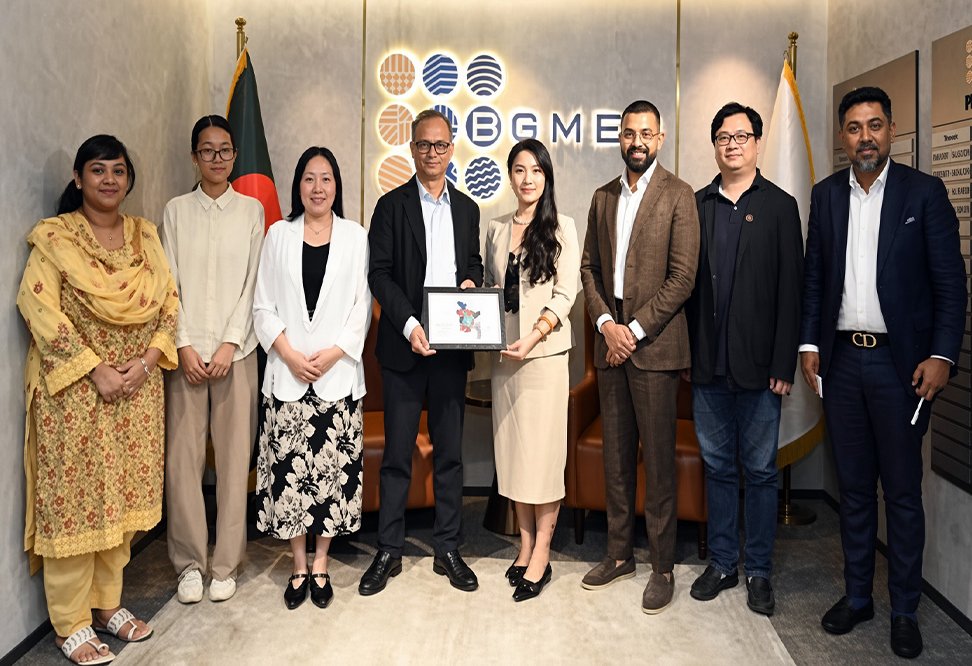
The initiative targets closed factories, upstream capacity and higher-value production as Bangladesh tries to reduce import dependence and improve apparel competitiveness.
The Bangladesh Garment Manufacturers and Exporters Association has launched a structured initiative with the Overseas Chinese Association in Bangladesh to attract Chinese investment into the country’s ready-made garment and textile supply chain. The programme will connect Chinese investors with Bangladeshi factories seeking new capital, technology, joint ventures or ownership partnerships.
Idle factories become investment targets
BGMEA plans to collect detailed information from interested members covering factory size, available space, machinery, production capacity, operational status and preferred investment model. Suitable opportunities will then be shared with OCAIB, effectively creating a matchmaking platform between Chinese capital and local manufacturers.
The initiative explicitly includes both operating and closed or underperforming factories. Investment structures could range from technology partnerships and minority stakes to full or partial ownership transfers. BGMEA expects fresh capital and machinery to help revive distressed assets while expanding capacity in backward-linkage and higher-value manufacturing.
Bangladesh wants more value upstream
The strategy addresses a structural weakness in Bangladesh’s export model: its garment sector remains substantially dependent on imported fabrics, fibres, chemicals and machinery. BGMEA said in April that the country imports around $8–9 billion of woven fabric annually, highlighting the scale of potential import substitution through domestic textile investment.
Earlier BGMEA-OCAIB discussions also identified synthetic fibres, digital printing, automation, circular manufacturing, renewable energy and artificial intelligence as areas where Chinese technology could support industry upgrading.
Information gap could slow investment
Chinese representatives said companies are interested in establishing factories and transferring technology but often lack reliable information needed to assess opportunities. Customs procedures, machinery clearance and regulatory complexity have also been cited as investment barriers.
The commercial test is therefore not simply how much Chinese capital Bangladesh attracts, but where it goes. Investment that expands commodity garment capacity could intensify price competition; capital directed into MMF, synthetic fabrics, technical textiles, advanced processing and automation could instead help Bangladesh capture more value domestically and diversify beyond its traditional cotton-based apparel strength.
