

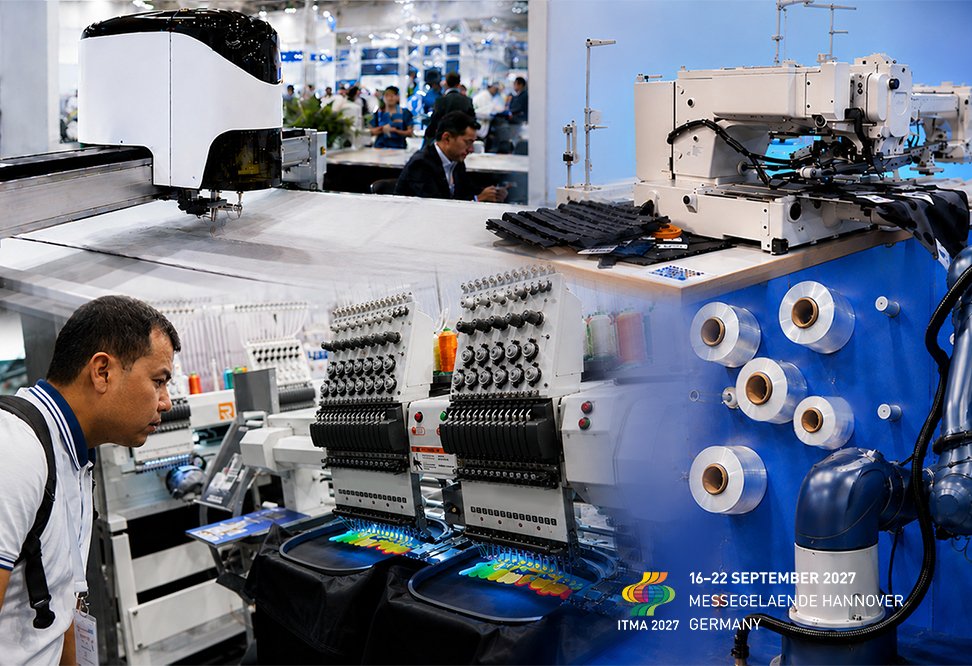
 Walk into one of today’s large apparel factories and you’ll witness autonomous vehicles, intelligent transport systems, automated warehouses, machine vision, AI-driven production planning and thousands of networked sewing machines.
Yet at the centre of all this technology remains a surprisingly familiar sight – banks of operators guiding fabrics through sewing machines.
Joining two pieces of textile together continues to be one of manufacturing’s hardest automation challenges. Unlike steel, plastic or other rigid materials, fabrics stretch, wrinkle, distort and behave differently depending on their construction, weight and finish. Humans instinctively compensate for these variations. Robots still struggle.
As a result, sewing remains the most labour-intensive stage of garment production and depending on the complexity of the products being made, typically accounts for between 30-50% of the workforce within a vertically integrated garment factory, according to industry studies by Better Work, the International Labour Organization (ILO) and apparel manufacturing researchers.
Rather than attempting to replace sewing operators, however, manufacturers have spent the past two decades systematically eliminating almost every other task surrounding them.
Engineering At Scale
The scale at which this challenge is being addressed is notable. A factory producing 8-12 million T-shirts each year may operate between 600 and 1,000 sewing machines, while the world’s largest apparel manufacturers increasingly develop campuses containing several factories, with 2-4,000 machines installed during a single phase of expansion.
Coordinating thousands of operators, millions of garment components and hundreds of production orders has become an engineering challenge almost as complex as manufacturing the garments themselves.
Fabric preparation is now highly automated, and rolls are identified by barcode or RFID, stored in automated warehouses and delivered directly to spreading equipment as required. Computer-controlled spreading systems lay multiple fabric plies under carefully regulated tension before CNC knife or laser cutters produce precisely nested pattern pieces with minimal operator intervention.
Modern automatic cutting systems routinely achieve fabric utilisation of 80-90%, such as Bullmer, Lectra and other CAD/CAM equipment suppliers, while integrated vision systems can identify defects before cutting begins. With a high fabric utilisation rate, there is minimal waste.
Automation increasingly extends throughout the movement of materials within the factory itself. Instead of workers pushing trolleys between departments, autonomous guided vehicles, overhead transport systems, automated conveyors and intelligent storage systems now move cut components, work-in-progress and finished garments wherever they are required. Production planning software continuously dispatches materials to the correct sewing line, ensuring operators spend less time waiting and more time on value-added sewing operations.
Together, these technologies illustrate how garment manufacturing increasingly depends on connected production systems rather than individual machines operating in isolation.
Intelligent production flow
One of the most significant advances has been the widespread adoption of unit production systems.
Instead of building piles of work beside individual machines, garments travel independently through the factory on overhead carriers. Each carrier carries its own digital identity, recording the order, garment size, colour, production stage, operator history and quality data.
As soon as one operation is completed, the system automatically routes the garment to the next available operator with the appropriate skills.
The result is a factory that behaves less like a conventional production line and more like an intelligent transport network, continuously balancing work between hundreds or even thousands of operators.
Work-in-progress can be dramatically reduced, while productivity rises because operators spend almost all of their time sewing rather than handling garments. In one shirt-production example, Eton Systems reports that installation of its unit production technology reduced throughput time from 14 days to less than one day, while doubling production.
Smarter Sewing
Modern equipment can automatically trim threads, lift the presser foot, back-tack, position the needle, cut tape or elastic, detect broken threads, count stitches, recognise variations in material thickness, adjust thread tension electronically and communicate production data directly to the factory network.
Individually, these functions may appear modest, but collectively they remove hundreds of small interruptions from every working day, allowing experienced operators to concentrate almost exclusively on guiding fabric accurately through the machine.
Many repetitive sewing operations have meanwhile become almost fully automated. Dedicated sewing automats routinely perform shirt pocket setting, pocket welting, belt-loop attachment, button sewing, buttonhole stitching, collar assembly, cuff construction, waistband attachment and automatic hemming. Instead of requiring continuous manual manipulation, operators simply load the components, initiate the cycle and remove the completed assembly.
Although such specialised machines have existed for decades, they continue to become faster, more flexible and capable of handling an increasingly wide range of garment styles.
Garment Decoration
Decoration has also become an increasingly integrated part of automated garment production. Computer-controlled embroidery systems can now produce intricate logos, badges and branding with minimal operator intervention, automatically changing thread colours, trimming threads and monitoring stitch quality throughout the process.
Multiple embroidery heads operating simultaneously allow identical designs to be reproduced consistently across thousands of garments while digital production files eliminate much of the manual set-up once required.
Digital textile printing has undergone a similar transformation. High-speed inkjet systems from companies including EFI Reggiani and Kornit Digital increasingly complement conventional screen printing for short production runs, customised garments and technically demanding designs.
Automated pre-treatment, colour management and curing systems enable photographic-quality graphics to be applied directly onto finished garments or cut panels with excellent repeatability while reducing water consumption, chemical use and inventory requirements.
As brands continue to demand shorter lead times and greater product personalisation, both embroidery and digital printing have become increasingly important components of connected apparel manufacturing systems.
Seeing Every Stitch
Machine vision is also becoming increasingly prevalent in many advanced garment factories.
Cameras continuously monitor seam position, identify skipped stitches, verify thread colours, check label placement, inspect embroidery, confirm print alignment and measure dimensional accuracy.
Quality inspection is therefore no longer confined to the end of the production line but increasingly takes place throughout the manufacturing process. Defects can be identified almost immediately, reducing expensive rework while providing immediate feedback to operators and production managers.
The Connected Factory
Perhaps the least visible but most transformative development has been the integration of every machine into digital factory management systems.
Individual sewing machines now operate as industrial sensors, continuously reporting what is being sewn, by whom, how quickly and with what quality outcome. Manufacturing Execution Systems (MES) provide managers with real-time information on line efficiency, operator productivity, bottlenecks, downtime, machine utilisation, quality rates and energy consumption.
Large digital dashboards update every few seconds, enabling supervisors to rebalance production before minor issues become significant disruptions. Increasingly, artificial intelligence is also being applied to analyse production data, predict maintenance requirements and optimise workflow across connected manufacturing operations.
These developments illustrate how garment manufacturing has evolved beyond individual machines towards connected production systems, where productivity increasingly depends on how technologies work together across
the manufacturing process.
For established sewing technology manufacturers such as Brother, the focus has increasingly shifted towards labour-saving and flexible automation, helping manufacturers address workforce challenges while improving productivity.
“We have advanced connected factory solutions through increased machine connectivity and data utilisation, while continuing to improve energy efficiency to support both sustainability goals and lower operating costs. These priorities reflect our commitment to smarter, more efficient and sustainable manufacturing”, says Folker Stachetzki, Head of Marketing at Brother Industrial EMEA.
Bringing The Garment Manufacturing Ecosystem Together
Today’s factories increasingly integrate cutting, sewing, embroidery, finishing, machine vision, software, automation and digital factory management into connected manufacturing systems designed to improve productivity, quality, flexibility and sustainability.
As manufacturers invest in more connected production environments, they are looking beyond individual technologies to understand how different solutions fit into their overall manufacturing strategy. This is creating new opportunities not only for garment technology suppliers, but also for software developers, automation specialists, robotics companies, machine vision providers and other digital manufacturing innovators.
ITMA 2027 reflects this evolution by bringing together technology providers from across the textile and garment manufacturing value chain on one international platform. Here, manufacturers can compare solutions, engage directly with innovators, build partnerships and make informed investment decisions as they plan future production capabilities.
As garment manufacturing continues to evolve, success will depend not simply on smarter machines, but on how technologies work together to create smarter manufacturing systems.
