

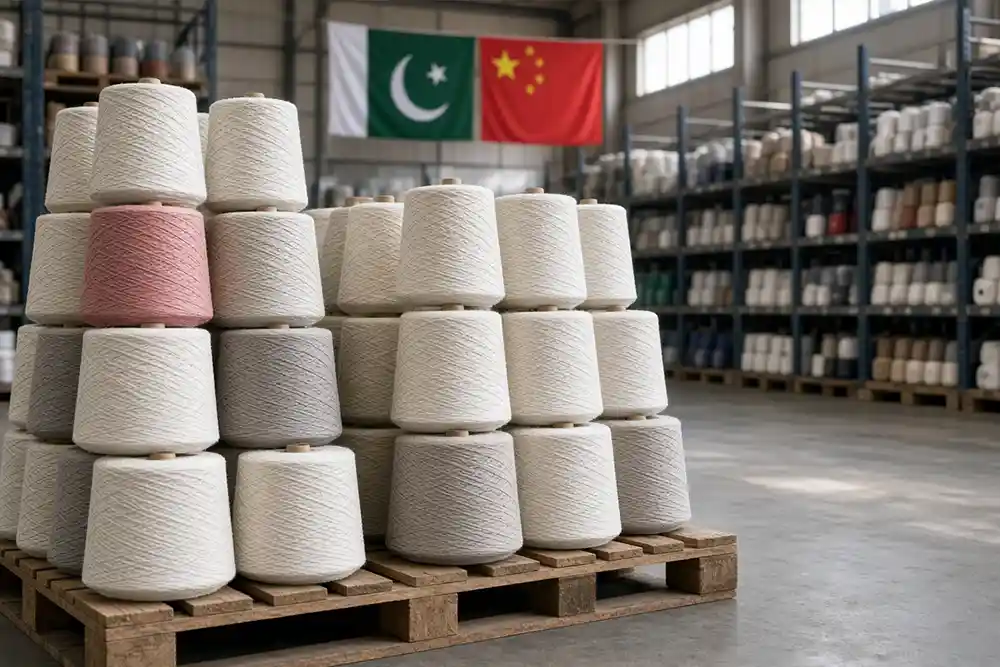
The revised five-year tariff schedule sharply cuts duties for several major Chinese polyester yarn producers while retaining protection for Pakistan’s domestic DTY industry and exempting qualifying export-oriented inputs.
Pakistan’s National Tariff Commission (NTC) has issued a fresh anti-dumping determination on Chinese polyester filament Drawn Textured Yarn (DTY), setting exporter-specific duties ranging from 3.07% to 19.32% through November 14, 2029.
The August 22 decision follows a June 11 ruling by the Anti-Dumping Appellate Tribunal, which upheld the NTC’s findings against importer appeals but ordered a de novo assessment of issues raised by Chinese exporters. The NTC again concluded that dumped imports were causing material injury to domestic DTY producers.
Major producers win lower rates
The revised calculations substantially reduce duties for several large suppliers. Xinfengming Group now faces 3.07%, down from 5.35% in the June 2025 determination. Shenghong Group’s rate falls from 18.73% to 3.18%, Hengyi from 6.79% to 4.50%, and Tongkun from 15.49% to 4.57%.
Hangzhou Qingyun’s rate is 7.65%, Jiaxing Longyin faces 19.32%, while cooperating non-sampled exporters receive 4.69%. All other Chinese producers are subject to 19.32%.
Fabric and hosiery costs are exposed
DTY, classified under PCT 5402.3300 and 5402.6200, is widely used in knitted and woven fabrics, hosiery and other synthetic-textile applications. The original case was filed by domestic producers Gatron Industries and Rupali Polyester.
For downstream mills, the reduced duties on major suppliers should ease some imported-yarn cost pressure compared with the previous schedule.
Exporters retain an important exemption
Crucially, anti-dumping duties will not apply to DTY used as an input in goods destined solely for export, provided imports are covered under qualifying customs-duty exemption schemes.
That distinction matters for Pakistan’s export textile chain: the policy protects domestic DTY manufacturing while limiting the cost penalty for export-oriented fabric and garment producers.
The next issue to watch is whether lower revised duties materially alter Chinese DTY import volumes—and whether domestic producers respond through higher capacity utilisation, pricing discipline and product differentiation.
