

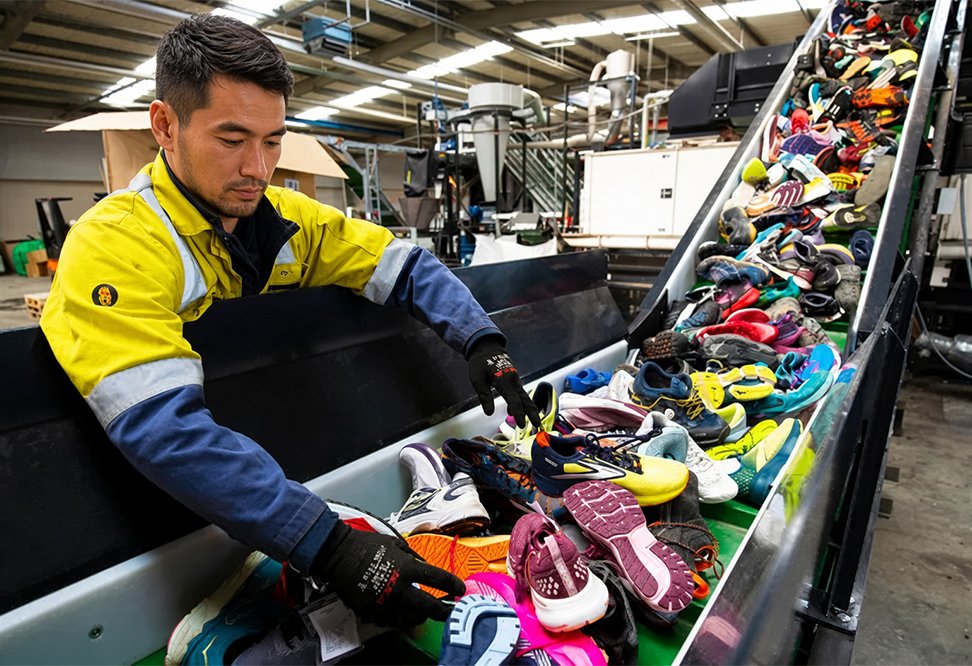
The award-winning process tackles polyurethane and elastane contamination while supporting a wider shift toward mono-material polyester footwear designed for repeated recycling.
A Taiwanese consortium has developed a one-step separation and decolourisation process capable of converting difficult footwear waste into recycled polyester with purity of at least 99.5%, addressing one of the major technical barriers to textile-to-textile recycling.
The technology was developed by the Taiwan Textile Research Institute (TTRI) with Far Eastern New Century (FENC), Jade Long John Enterprise, Long John Tsung Right Industrial and Pro Arch International Development Enterprise. It was selected as a 2026 R&D 100 Award winner in the Process/Prototyping category.
Tackling the contamination problem
Footwear is particularly difficult to recycle because fabrics, foams, elastomers, adhesives and coatings are typically combined into complex structures.
The consortium’s process specifically addresses polyurethane and elastane contamination, separating and decolourising discarded footwear to recover manufacturing-grade rPET certified at ≥99.5% purity under ISO 1833 testing. R&D World describes the technology as production-ready and already deployed through footwear-manufacturing supply chains.
The developers report a 74.6% carbon reduction for the recycling architecture based on an ISO 14067-aligned assessment.
FENC pushes polyester into elastic components
The development complements FENC’s broader strategy of replacing hard-to-recycle materials with polyester-based alternatives.
Its TOPGREEN recycled thermoplastic polyester elastomer (rTPEE) converts recycled PET into flexible components suitable for footwear midsoles and other applications. FENC has already commercialised rTPEE in Salomon footwear and says the material can enter existing footwear manufacturing processes without additional equipment modifications.
FENC is also developing polyester-based elastic fabrics intended to replace conventional spandex and support mono-material construction.
Design for recycling becomes critical
The larger opportunity lies in combining better recycling technology with products engineered for easier end-of-life recovery.
For textile, footwear and fibre manufacturers, the emerging model is clear: reduce incompatible material combinations, recover high-purity polyester, and return that polymer into fibres, membranes, synthetic leather and footwear components.
The commercial test will be economics. Purity and carbon performance are promising; the next milestones are throughput, collection volumes, cost versus virgin polyester and reliable closed-loop demand from brands.
