

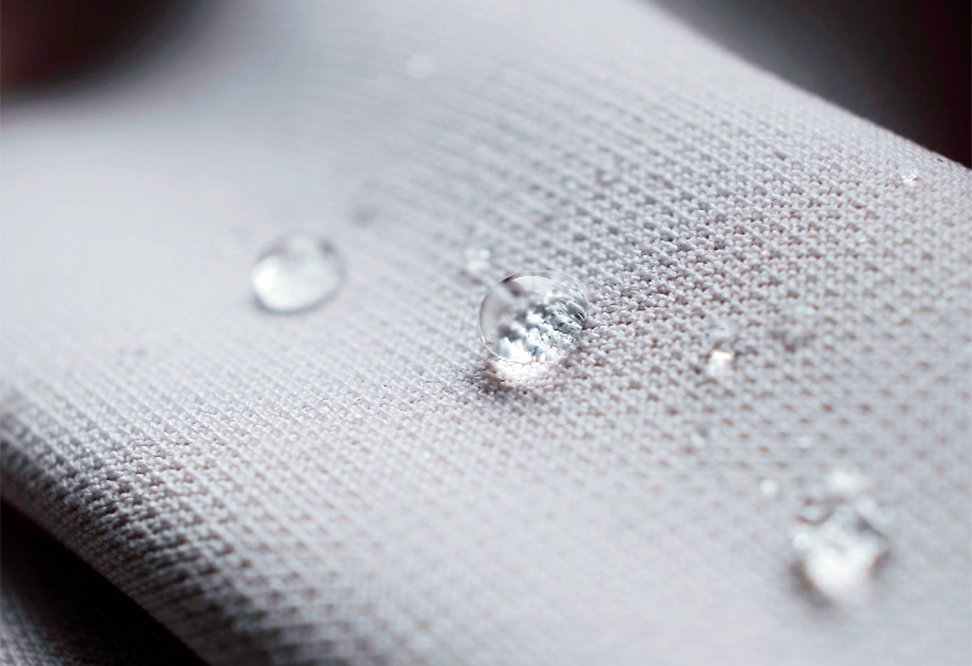
The Nature-published technology generates whiteness and water repellency through microscopic structure rather than conventional pigments and fluorinated coatings, with researchers already demonstrating the process on fabrics.
Researchers led by Kyoto University’s Institute for Integrated Cell-Material Sciences (iCeMS) have developed a polymer-foaming technology capable of producing intense whiteness and water-repellent surfaces without titanium dioxide pigments or PFAS-based fluorinated coatings.
Published in Nature on September 10, the technique—called Deep Foam Photolithography (DFP)—was developed with collaborators from Tokyo Metropolitan University and China’s Donghua University. Its potential applications include textiles, packaging and high-resolution printed materials.
Structure replaces added chemistry
DFP takes inspiration from snow, clouds and natural foams, where whiteness results from light scattering rather than white pigment.
The process exposes a polymer to light, breaking some polymer chains into shorter molecular fragments. Subsequent treatment with a mild solvent makes the material swell and form an open porous structure.
Those pores scatter visible light, producing structural whiteness, while the highly roughened surface creates strong water repellency similar to the lotus-leaf effect. The platform has demonstrated printing resolutions of up to 20,000 dpi.
Textile application already demonstrated
Working with researchers at Donghua University, the team successfully applied DFP to fabrics, showing that the concept is not limited to polymer films.
Importantly, researchers say several commercially available polymers can be processed, potentially reducing the need for entirely new specialty materials.
For textile finishing, the concept is significant because conventional whiteness and repellency typically require separate material inputs—pigments, optical systems or surface-finishing chemicals. DFP instead generates both functions through physical architecture.
Industrialisation is the next hurdle
The technology remains a research-stage platform rather than a commercially validated textile finish. Before mill adoption, manufacturers will need evidence on abrasion and laundering durability, handle, breathability, processing speed, cost and compatibility with continuous textile machinery.
Still, the research points toward an important direction for functional textiles: achieving performance through engineered fibre or surface structure rather than increasingly complex chemistry.
If DFP can be scaled economically, it could provide manufacturers with a new route to white, water-repellent textiles while reducing dependence on both mineral pigments and persistent fluorinated substances.
