

The Belgian textile machinery group will showcase innovations promising up to 13% lower compressed-air consumption, carpet weaving speeds of 250 rpm and automated handling of 240 yarn packages per hour.
Belgian textile machinery manufacturer Vandewiele Group will present new technologies for weaving, carpet manufacturing, tufting, yarn processing and automation at ITMA Asia + CITME 2026, scheduled for November 20–24 in Shanghai.
The company will exhibit in Hall 3, Booth D01, highlighting machinery upgrades designed to improve productivity, reduce operating costs and increase manufacturing flexibility.
Weaving Innovations Target Energy Savings
Vandewiele will introduce four weft-feeding solutions, including three new products.
The Chrono X4 features a modular design supporting advanced yarn tensioning systems and compatibility with existing rapier and projectile loom controls, allowing manufacturers to upgrade without extensive modifications.
The Super Elf GF-TC and GF-TD feeders target specialised glass-fibre weaving for printed circuit board applications.
Another development is the Loom Control System (LCS), incorporating proprietary solenoid valves for air-jet looms.
According to Vandewiele, the system can reduce compressed-air consumption by up to 13% compared with standard alternatives.
Carpet Weaving Reaches 250 rpm
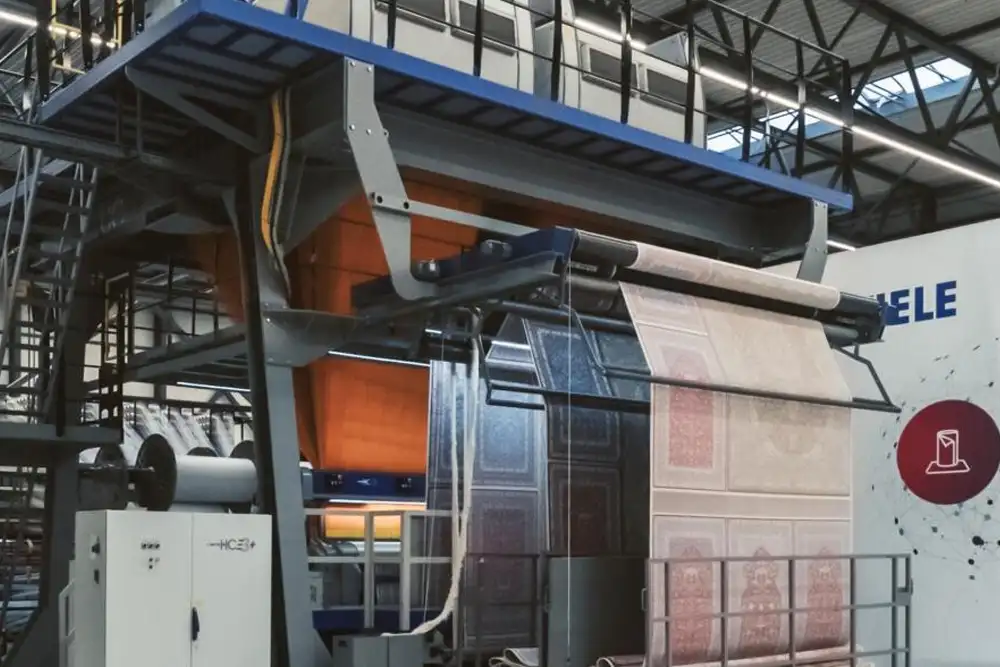
The company’s RCF face-to-face carpet weaving machine operates at speeds up to 250 revolutions per minute.
Its Fast Creel technology enables bobbin changes during production, reducing interruptions.
The UCF platform provides greater flexibility in carpet constructions, while the MAX91 Axminster machine supports complex designs with up to 16 colour frames.
For tufting, Vandewiele will demonstrate its digitally controlled HST platform alongside a lower-cost Standard platform.
Robotics Automates Yarn Handling
Vandewiele Automation’s KR1 automatic knotting robot uses machine vision to identify, handle and knot yarn packages.
The system can process up to 240 packages per hour, reducing repetitive manual operations.
Group company SUPERBA will also present continuous heat-setting and space-dyeing technologies for carpet yarns, including its TVP3, DHS3, MCD3M and MF400 systems.
Commercial Implications
For textile manufacturers, these technologies offer opportunities to reduce compressed-air costs, improve machine utilisation and automate labour-intensive operations.
However, realised savings will depend on production conditions and equipment configuration.
The next test will be demonstrating measurable productivity improvements, energy savings and investment payback under commercial manufacturing conditions.
