

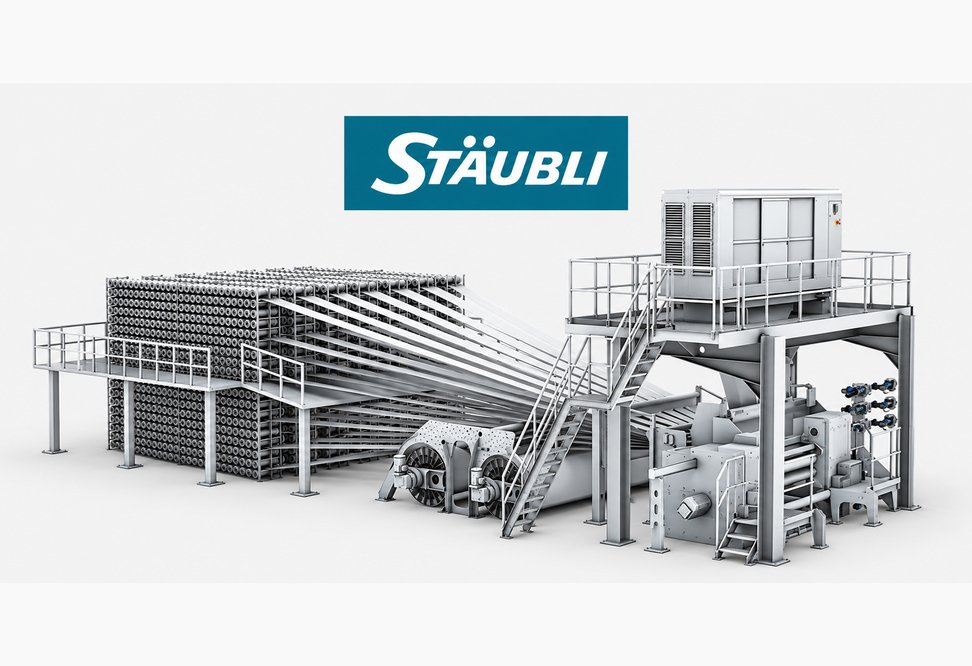
Stäubli’s Technical Weaving Systems centre is targeting one of technical textiles’ highest-value frontiers: converting complex 3D woven architectures into repeatable industrial production for aerospace, defence and composites.
Swiss machinery group Stäubli is expanding its 3D-weaving capabilities through its Technical Weaving Systems (TWS) organisation, centred on a specialised facility in Bayreuth, Germany. The operation supports customers from feasibility studies and application engineering through machine adaptation and industrial-scale production.
The technology targets applications including carbon-fibre composites, multilayer structures, spacer fabrics, aerospace components and high-performance industrial textiles, where conventional two-dimensional fabrics may not provide the required fibre orientation or structural geometry.
One platform, multiple architectures
Stäubli’s TF machinery is designed as a configurable platform rather than a machine tied to one end product. The TF20 targets high-speed production and can use double-rapier weft insertion, while the TF30 emphasises gentle handling of demanding materials including carbon, glass, aramid and sensitive ceramic yarns.
For complex shedding, the UNIVAL100 electronic Jacquard individually controls warp threads, enabling precise formation of sophisticated 3D structures. Standard configurations extend to 15,360 threads, with up to 30,720 possible by combining two machines.
Near-net-shape reduces downstream work
A major attraction of 3D weaving is the ability to manufacture near-net-shape preforms that already resemble the final composite component. This can reduce subsequent cutting and shaping while improving material utilisation. Multilayer weaving can also integrate several layers into one structure with controlled fibre orientation.
Takeaway for Pakistan
For Pakistan, 3D weaving represents a much higher technological tier than conventional apparel or home textiles. Entry would require collaboration between textile engineering, composite-material specialists, aerospace and defence users, machinery suppliers and universities.
The opportunity is not initially mass production. It is to build capabilities in advanced woven preforms, carbon/glass/aramid processing, structural textile design and testing for high-value applications.
The key industry signal is that weaving machinery is evolving from fabric production toward engineered structural manufacturing. Countries that develop the design, materials and certification capabilities around these machines can capture substantially more value than those competing only in conventional fabrics.
